REVIEW · SORRENTO
Private Pompeii & Herculaneum Tour from Sorrento
Book on Viator →Operated by IAMME IA! - Gray Line Amalfi Coast · Bookable on Viator
Two volcano-stilled cities in one day? Yes. You’ll see Pompeii and Herculaneum through a timed, guided route that cuts down on waiting and helps you understand what you’re looking at.
I like the pickup from central Sorrento and the easy, air-conditioned ride inland. I also like how the guide focuses on the everyday stuff: markets, public baths, homes, and the places where people worked, shopped, socialized, and worshipped.
One drawback to plan for: the price is premium, and this is a long day with lots of walking in the heat. Bring your own water—your best move if you tend to feel it.
In This Review
- Key things that make this tour work
- Pompeii and Herculaneum in one day: the value of a guided route
- Pickup in central Sorrento and the inland ride you don’t have to plan
- Entering Pompeii with timed tickets and a guide who explains what you see
- Pompeii’s Forum core: Temple of Jupiter, the civic heart, and real business
- Via dell’Abbondanza and the Stabian Baths: where Romans shopped and washed
- Lupanar, Casa del Fauno, and Teatro Grande: the famous stops that still make sense
- Lunch break between Pompeii and Herculaneum: plan your energy, not your schedule
- Herculaneum’s preservation: mud and lava make details easier to read
- Casa dei Cervi, the baths, and the House of the Skeleton: where the story gets intense
- Partem Domus lignea and the Salone della Barca: the details you’ll remember later
- Back to Sorrento around 4pm–5pm: how to make the rest of your evening easy
- Price and value: what $769.43 per person really buys you
- Who should book this private Pompeii and Herculaneum tour
- Should you book this Pompeii and Herculaneum private tour?
- FAQ
- How long is the Pompeii and Herculaneum private tour from Sorrento?
- What’s included in the price?
- Is hotel pickup offered?
- Does the tour include skip-the-line tickets?
- What language is the tour provided in?
- Do I need to bring tickets?
- Is lunch included?
- Where does the tour start and end?
- What is the cancellation policy?
Key things that make this tour work
- Skip-the-line tickets for both Pompeii and Herculaneum (less queue time, more ruin time)
- Private, English-speaking guiding timed for two full sites in one day
- Hotel-area pickup and drop-off, so you’re not figuring out transit or meeting hassles
- Admission included with guided time at Pompeii (2 hours) and Herculaneum (2 hours)
- Real-world highlights like the Stabian Baths, Via dell’Abbondanza, mosaics, and the boat hall
- Free time for lunch between sites, plus a breather at Herculaneum
Pompeii and Herculaneum in one day: the value of a guided route
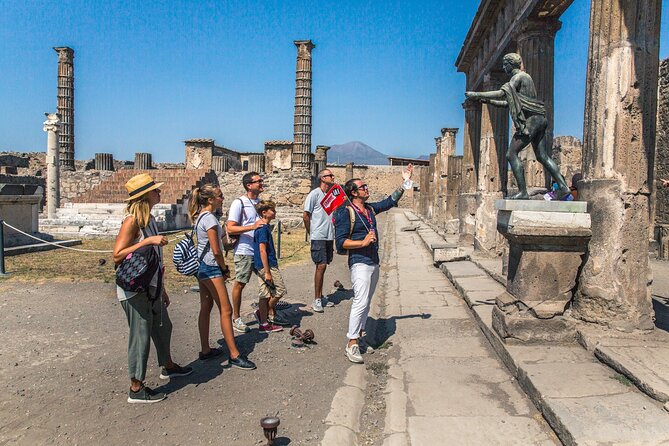
If you’ve ever been to Pompeii without a plan, you know the problem: it’s huge, and the ruins can turn into a scenic blur. This tour solves that with a guide-led route that hits the highlights and ties them back to daily life in Roman times.
I also like that you’re not choosing between Pompeii and Herculaneum. You get both, and the contrast matters. Pompeii was buried under ash and pumice from the AD 79 eruption, while Herculaneum was encased in mud and lava—meaning the second site can feel easier to read, down to surfaces and everyday objects.
The best part is the pacing. You’re not sprinting the whole time, but you also won’t waste your day guessing where to start.
You can also read our reviews of more private tours in Sorrento



Pickup in central Sorrento and the inland ride you don’t have to plan
The day starts with pickup from your hotel or a central Sorrento location in an air-conditioned private vehicle. It’s one of those small travel comforts that makes a big difference: you show up, you climb in, and you head inland without wrestling with buses or taxi math.
Meet-up point is listed as Piazza Torquato Tasso, 16, 80067 Sorrento, and the tour ends back there after you return from Herculaneum. The tour duration is about 8 hours total, with the return to Sorrento around 4pm to 5pm.
Practical tip: wear comfortable shoes before you leave Sorrento. The ruins are outdoors and uneven in places, and the walking adds up faster than you expect.
Entering Pompeii with timed tickets and a guide who explains what you see
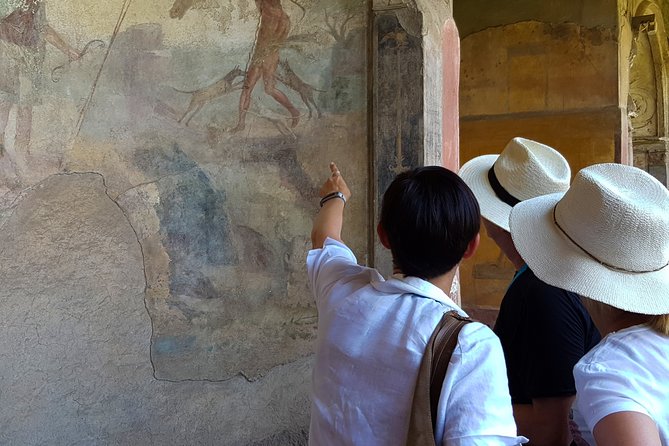
Pompeii is UNESCO-protected, and the entrance can be a time sink in peak seasons. This tour includes skip-the-line entrance tickets for Pompeii and Herculaneum, which is exactly what you want for an all-in-one-day itinerary.
Once you’re inside, your guided time in Pompeii is set for about 2 hours. That’s enough time to cover key neighborhoods and monuments without turning the visit into a checklist you forget instantly. The guide frames the story around the AD 79 eruption of Mount Vesuvius and what the town looked like under volcanic ash for centuries.
You’ll spend time in the old commercial core and learn how Romans moved through their city day-to-day. The “what am I looking at?” questions start to fade, because the guide puts names and purposes on the stones.
Pompeii’s Forum core: Temple of Jupiter, the civic heart, and real business
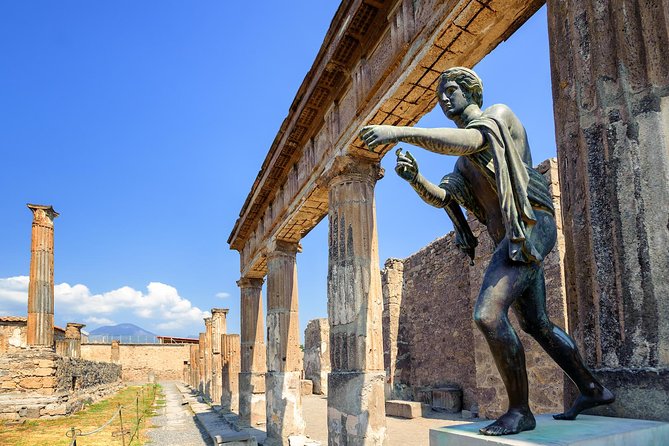
Pompeii’s Foro (Forum) is where you understand how Roman cities worked. You’re standing in the focal point of civic administration, justice, worship, and trade. That matters because the ruins aren’t just pretty stones—they’re the architecture of daily power and daily errands.
From there, you’ll see highlights tied to the Forum:
- The Temple of Jupiter (Tempio di Giove Capitolino) on the north side, with Mount Vesuvius rising behind in the view.
- The Macellum, the market area, including spaces likely linked to food sales and imperial cult messaging.
- The Basilica, described as the Forum’s most sumptuous building, where business and justice were handled.
These stops are quick by necessity—each is scheduled in short time windows—but they work well when your guide connects the dots. You don’t just see an entrance arch; you learn why it was built there, how people used it, and what it meant socially.
Via dell’Abbondanza and the Stabian Baths: where Romans shopped and washed
Two of Pompeii’s best “daily life” scenes are the main street and the baths.
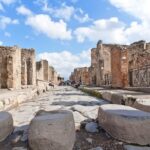
You’ll walk along Via dell’Abbondanza, Pompeii’s main commercial artery stretching from the Forum to the Sarno Gate. This is where you get the sense of movement: shops, workshops, and even well-known electoral graffiti. Today it’s a walking experience on basalt stones, with raised stepping stones that hint at how people navigated storefronts and crowds.
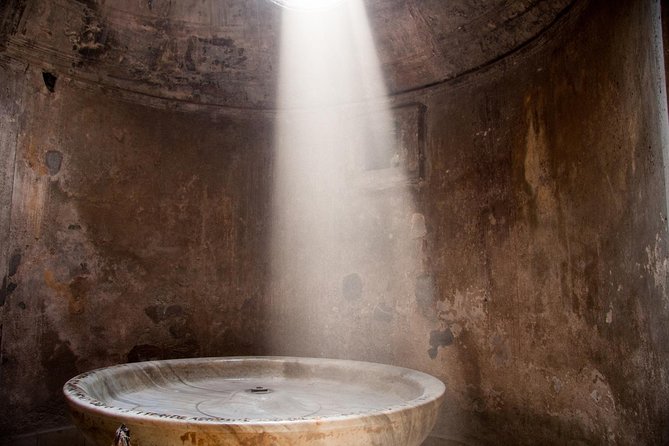
Then comes the Stabian Baths (Terme Stabiane), one of the oldest and largest public bathing complexes in Pompeii. It includes Roman engineering like underfloor heating (a hypocaust) and separate areas for men and women. You’ll also see the open-air gymnasium (palaestra) and a large pool—basically a social and wellness hub, not just a place to clean up.
If you’re tempted to skip baths in favor of grander buildings: don’t. This is where Roman life feels human and practical.
- Sorrento Farm and Food Experience including Olive Oil, Limoncello, Wine tasting
★ 5.0 · 2,524 reviews





Lupanar, Casa del Fauno, and Teatro Grande: the famous stops that still make sense
Pompeii has a few headline attractions, and this itinerary includes them in short, focused bursts.
- The Lupanar (brothel) is the most famous one in Pompeii, known for erotic paintings on its walls. It’s a blunt slice of reality from an ancient city.
- The Casa del Fauno (House of the Faun) is one of the largest aristocratic residences in Pompeii, built in the 2nd century BC. It’s a strong contrast to public spaces like markets and baths.
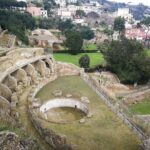
- The Teatro Grande (Great Theatre) holds about 5,000 people and dates back to the 2nd century BC. It’s a major venue for comedies, tragedies, and pantomimes, with a hillside setting and a grand stage background.
A quick note on expectations: these are scheduled for minutes at a time. That’s not a flaw if your goal is to see a wide, meaningful arc in one day. It’s a drawback only if you’re the type who wants slow wandering in just one building.
Lunch break between Pompeii and Herculaneum: plan your energy, not your schedule
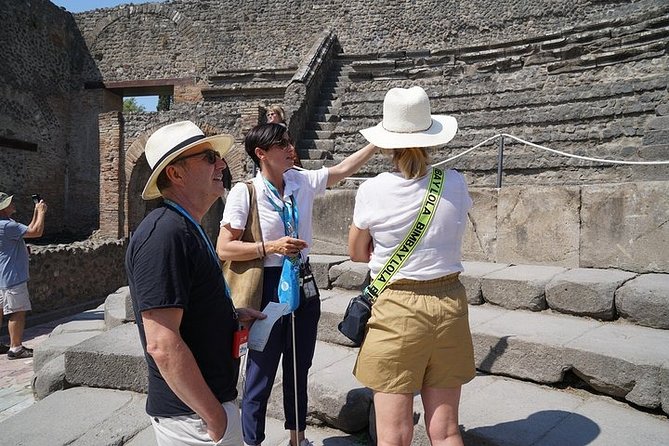
After Pompeii, you get free time for lunch at your own expense. This break matters more than it sounds, because the day is designed to keep moving: two major guided segments plus travel time.
My advice: eat something simple and not too heavy. You’ll likely want your energy for Herculaneum’s walking and the heat. If you’re sensitive to sun, this is the moment to step away, refill water, and take a few minutes off your feet.
Then you head to Herculaneum, another city buried in the AD 79 eruption.
Herculaneum’s preservation: mud and lava make details easier to read

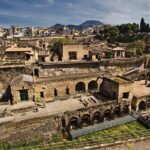
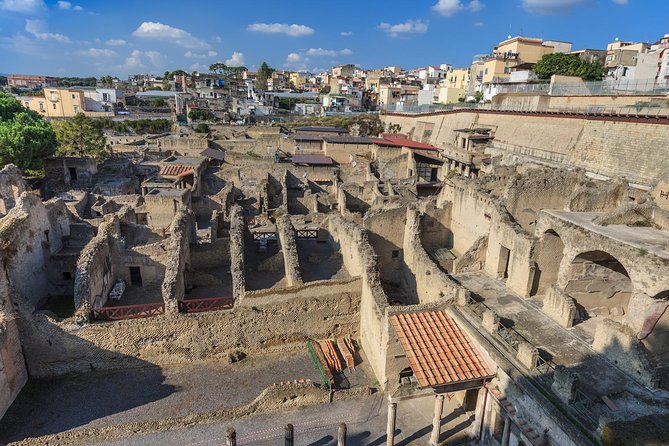
Herculaneum sits in the shadow of Mount Vesuvius, and it was destroyed by volcanic pyroclastic flows in 79 AD. The big takeaway is the preservation style: the town was encased in mud and lava, which can make ruins feel more intact than Pompeii.
Your guided time here is listed as about 2 hours, with additional free time to explore at leisure. That pairing is smart. The guide helps you decode buildings and mosaics, then you can slow down and look at textures and layouts at your own pace.
Expect a different mood than Pompeii. Pompeii often feels like a massive city to navigate; Herculaneum can feel more like rooms and streets preserved in a snapshot, where you can connect everyday life to what’s still standing.
Casa dei Cervi, the baths, and the House of the Skeleton: where the story gets intense
Herculaneum’s stops are packed with strong “place storytelling.” Some are about family life and status, others are about how people faced the end.
Here are key highlights you’ll see:
- Casa dei Cervi: an imposing noble family house with murals and still-life paintings, described as having had a seafront address before the volcanic mud slide.
- College of the Augustales: thought to be a center of the cult of Emperor Augustus, tied to the Collegium Augustalium and possibly local civic leadership.
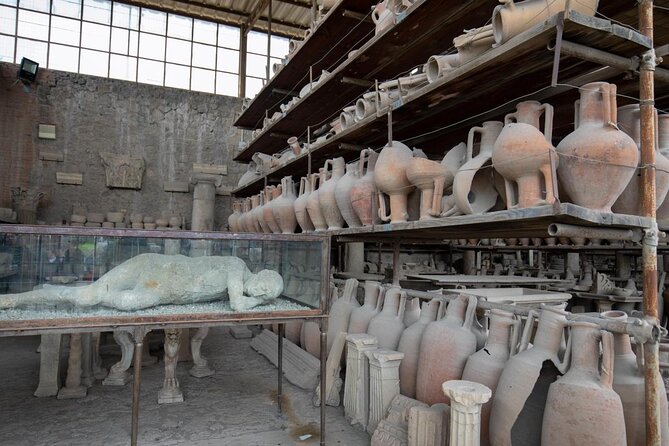
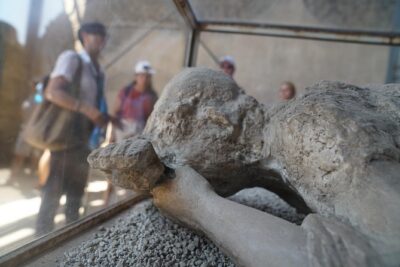
- House of the Skeleton: named after human remains discovered in a second-floor room in 1831. It’s linked to people who stayed and died in their homes, described as possibly suffocating or dying from extreme heat of the gases.
- Central Thermae: public baths with separate sections for women and men, including changing room, cold, tepid, and hot bath areas.
This is where your guide’s interpretation really helps. Without it, it’s easy to think you’re just looking at rooms. With it, you’re seeing behavior—how people gathered, how they worked, and what daily routines looked like.
Partem Domus lignea and the Salone della Barca: the details you’ll remember later
Two Herculaneum stops are especially memorable because they’re so specific.
- Partem Domus lignea – Casa del Tramezzo di Legno: named after a folding wooden door discovered there, used to separate parts of the home (atruium from the tablinium). You can also see benches where clients waited to be received.
- Salone della Barca di Ercolano: a hall featuring a wooden boat recovered from the ancient beach. After the eruption, people fled toward the shore; the story notes that the port and beach were destroyed, and the boat was preserved by resinous material. The recovered boat was put back in position in 1982 so visitors can admire it.
These aren’t just “cool facts.” They give you a feeling for what survived and why. When you’re done with this day, you’ll likely remember the boat hall longer than you expect.
Back to Sorrento around 4pm–5pm: how to make the rest of your evening easy
When the tour ends, you’ll return to Sorrento around 4pm to 5pm, back to the meeting point area. You’ll be tired in a good way, but tired all the same.
My practical advice: don’t book anything that requires sharp focus or long transit right after. Instead, grab dinner near where you’re staying and use the evening to decompress. If you still want to look at ruins photos, do it slowly—take a moment to label what you saw (Forum, baths, theatre, houses). It helps your brain lock the day in.
If you loved the contrast between the two towns, you’ll likely find yourself studying Pompeii maps later. That’s a good problem.
Price and value: what $769.43 per person really buys you
This isn’t a budget day trip, and you shouldn’t pretend it is. At $769.43 per person, you’re paying for a private setup: pickup and drop-off, air-conditioned private transportation, guided time at both sites, and skip-the-line entrance tickets with admission included.
Here’s what makes the cost feel more reasonable. If you subtract what you’d spend on transport, tickets, and a good guide, you’re not just buying entry—you’re buying time saved and meaning gained. Pompeii alone can eat up a day, and Herculaneum adds another chunk. This tour folds both into one efficient schedule.
That said, the expense only makes sense if you truly value guidance and convenience. If you’re the type who wants long, independent wandering without a strict route, you might feel the day is too tight.
One more small note from a common nit: water should be on your list. The itinerary doesn’t mention it as included, so bring your own.
Who should book this private Pompeii and Herculaneum tour
Book it if you want:
- First-time clarity at Pompeii and Herculaneum, with a guide to explain daily life and major monuments
- A day that’s structured but not chaotic, with skip-the-line entry
- Pickup convenience from central Sorrento
- English guiding with guided time at both sites (Pompeii and Herculaneum)
It’s especially appealing if you’re short on time in the Bay of Naples area and you want one high-impact day rather than two separate plans.
Also, you’ll likely enjoy it more if you like practical storytelling. In reviews tied to this tour experience, guides such as Connie, Ugo (Ugo/Hugo), Nella, and Carmela are singled out for being strong at answering questions and keeping the stops balanced.
Should you book this Pompeii and Herculaneum private tour?
Yes—if you value efficiency and you want the ruins to make sense fast. This is a smart choice for a one-day hit of two UNESCO sites, with private transport, skip-the-line entry, and guided highlights that focus on daily life.
Hold off if you’re on a strict budget or you prefer a slow, unscripted pace with lots of time in just one area. With an 8-hour format and multiple scheduled stops, you’re getting breadth over deep solo time.
FAQ
How long is the Pompeii and Herculaneum private tour from Sorrento?
The tour is about 8 hours long, including guided time at Pompeii and Herculaneum and travel back to Sorrento.
What’s included in the price?
Pickup and drop-off in the Sorrento area, private transportation, guided tours of Pompeii (2 hours) and Herculaneum (2 hours), and skip-the-line entrance tickets for both sites. Admission tickets are included.
Is hotel pickup offered?
Yes. Pickup is offered from your hotel or a central location in Sorrento.
Does the tour include skip-the-line tickets?
Yes. Skip-the-line entrance tickets are included for both Pompeii and Herculaneum.
What language is the tour provided in?
The tour is offered in English.
Do I need to bring tickets?
You should use the provided mobile ticket. Admission tickets are included in the tour.
Is lunch included?
Lunch is not included. You’ll have free time for lunch between Pompeii and Herculaneum, at your own expense.
Where does the tour start and end?
The activity starts at Piazza Torquato Tasso, 16, 80067 Sorrento NA, Italy, and it ends back at the meeting point.
What is the cancellation policy?
You can cancel for a full refund up to 24 hours in advance of the experience start time.
You Might Also Enjoy

More Private Tours in Sorrento



More Tours in Sorrento


More Tour Reviews in Sorrento
- Sorrento Farm and Food Experience including Olive Oil, Limoncello, Wine tasting
★ 5.0 · 2,524 reviews