REVIEW · SORRENTO
Private Pompeii Tour with Guide & Transfer included from Sorrento
Book on Viator →Operated by IAMME IA! - Gray Line Amalfi Coast · Bookable on Viator
Pompeii gets way easier with the right plan. This private tour from Sorrento pairs hotel pickup and drop-off with an official guide inside the site, plus priority entry so you spend less time stuck at the ticket window.
I like that it’s built for real pacing: you get guide-led walking time, quick stops at the big set pieces, and plenty of chances to ask questions along the way. One thing to weigh is the price, especially if you’re not using the included transfer and tickets, and in hot months you’ll want to manage the heat smartly.
Key points worth knowing before you go
- Round-trip transfer from your Sorrento-area hotel saves you the hassle of planning buses or taxis.
- Fast-track entry helps you bypass the ticket line and get into Pompeii sooner.
- Official guide commentary keeps the place readable instead of just ruins-as-a-map.
- Focused route hits the Forum core, baths, main street, and major public buildings.
- Short stop times (often around 10 minutes) mean you’ll see a lot, but it’s not a slow museum day.
- A guide like Vincenzo shows up in feedback as friendly and strong on practical Pompeii details.
In This Review
- From Sorrento: Round-Trip Transfer Without the Headache
- Priority Access: Getting Into Pompeii Faster
- Your Private Guide Makes the Ruins Make Sense
- The Archaeological Park: The 79 AD Story You Can Walk Through
- Forum of Pompeii: Where Government, Business, and Worship Happened
- Temple of Jupiter: Big Views, Big Symbolism
- Macellum: Pompeii’s Market Hub With Imperial Clues
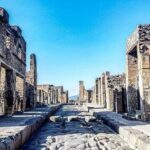
- Via dell’Abbondanza: The Main Street That Still Has Energy
- Stabian Baths: Cold, Warm, Hot, and Built for Routine
- Casa del Fauno: Roman Republic Luxury in a Real Home
- Teatro Grande: Watching How Romans Used Space
- Basilica: Business and Justice Under One Roof
- Via delle Ville: The Scenic Route Toward the Villa of the Mysteries Area
- Who This Pompeii Tour From Sorrento Is Best For
- Price and Value: Is $504.67 Per Person Worth It?
- Practical Tips That Make the Day Feel Easier
- Should You Book This Private Pompeii Tour From Sorrento?
- FAQ
- How long is the Pompeii tour?
- Is pickup and drop-off included?
- Will I have to walk a lot inside Pompeii?
- Is fast-track or priority entry included?
- Is the guide included, and what language is it?
- Are entrance tickets included?
- Does the tour include food or drinks?
- Is this a private tour?
- What should I do if my hotel is hard to reach?
- Can I cancel for a full refund?
From Sorrento: Round-Trip Transfer Without the Headache
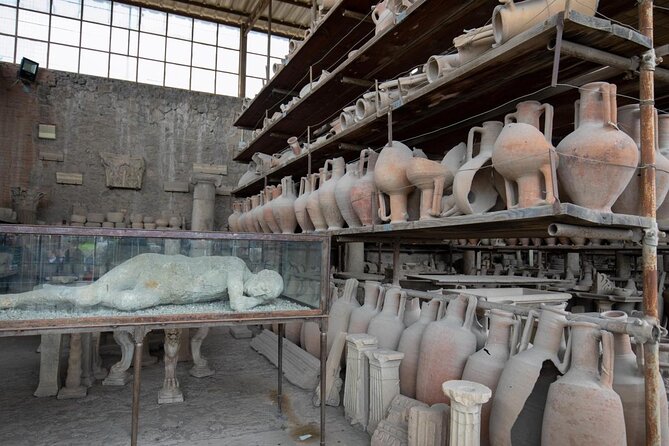
This is the kind of Pompeii day trip that starts the way you want travel to start: pickup from your hotel in the Sorrento area. The big win is that you don’t need to figure out transport, timing, or where to meet after you’ve already had a long morning.
There’s also a real-world logistics note: some Sorrento-area hotels can’t be reached because of traffic restrictions and pedestrian zones. You’re told to confirm the exact pickup location with the local provider at least 24 hours before departure, which is exactly the kind of small step that prevents a stressed start.
Priority Access: Getting Into Pompeii Faster
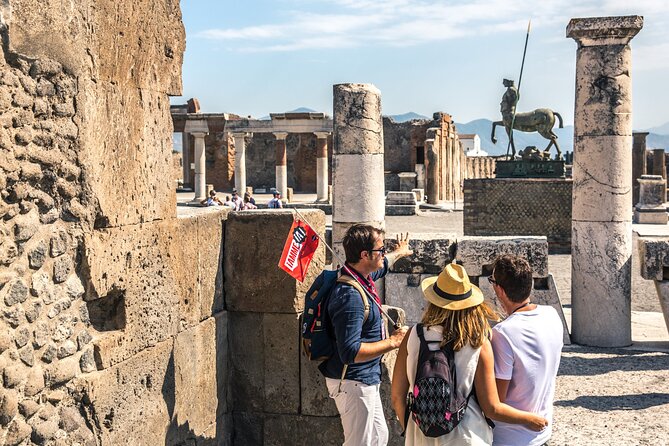
Pompeii is famous, which means lines can be long. This tour includes priority access to the Pompeii archaeological site, specifically to bypass the line at the ticket window. That matters because your time inside is limited to about 4 to 5 hours total.
You’ll also have a mobile ticket, so there’s less to carry and less to lose. Even with fast-track entry, you’re still walking on stone and steep ground, so your best move is simple: wear comfortable shoes and come ready to move.
You can also read our reviews of more guided tours in Sorrento
Your Private Guide Makes the Ruins Make Sense
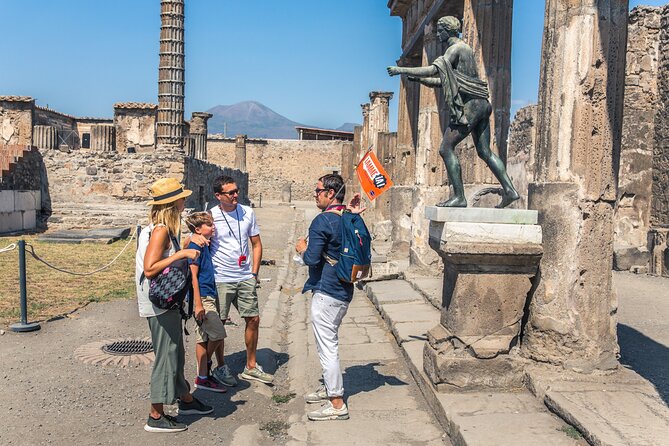
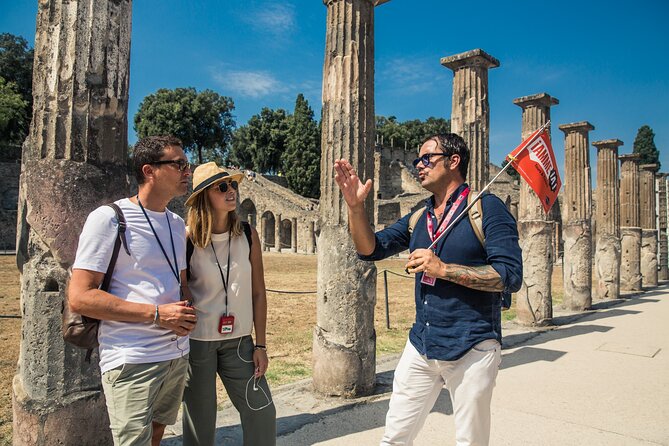
This isn’t a quiet audio-headphones situation. You have an expert private local guide with live commentary, and it’s private, meaning only your group participates. The structure is designed for learning without the feeling that you’re constantly sprinting.
One reason this works so well in feedback is that guides are described as steering people toward spots that feel less crowded, so you’re not just herded through the same photo stops. Another reported benefit: you’ll hear about how conservation efforts help protect Pompeii as a living archaeological site, not just a backdrop.
The pace is also adjustable. You should expect a mix of a longer guided walk—around 2 hours at the Archaeological Park—plus shorter guided stops at standout buildings. That combination is ideal if you want both context and highlights.
The Archaeological Park: The 79 AD Story You Can Walk Through
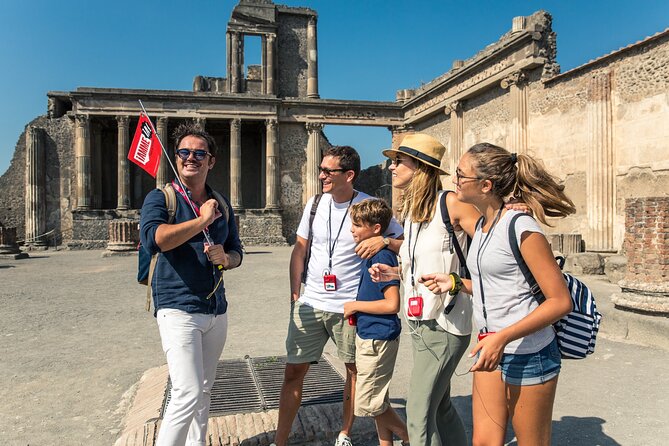
The main guided portion is in the Archaeological Park of Pompeii (about 2 hours), where you’ll see how the city was preserved after the eruption of Mount Vesuvius in 79 AD. Lapilli and lava buried the city in a way that protected structures and materials, which is why Pompeii looks so intact compared with many ancient sites.
Your guide’s job here is to help you read what you’re seeing: where people walked, how spaces were used, and why certain buildings mattered. If you’ve ever visited a ruin and felt lost, this is the fix—your guide gives the “why” behind each turn.
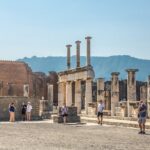
Forum of Pompeii: Where Government, Business, and Worship Happened
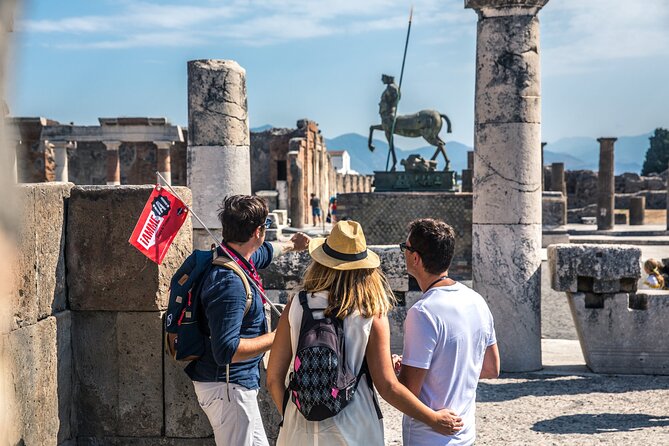
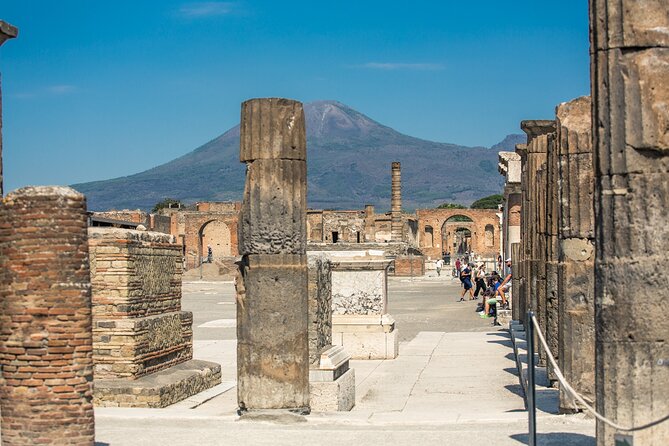
After the big introduction, the tour zeroes in on the heart of daily life: the Foro de Pompeya (Civil Forum). This is described as the core of daily activity—city administration, justice, business management, trade, markets, and places of citizen worship all centered here.
The stop time here is about 10 minutes, so I treat it like a highlight stamp: you’ll get the meaning of the space quickly, then you move on. The payoff is that once you understand the Forum, the rest of Pompeii’s buildings make more sense because you know what kind of life they supported.
Temple of Jupiter: Big Views, Big Symbolism
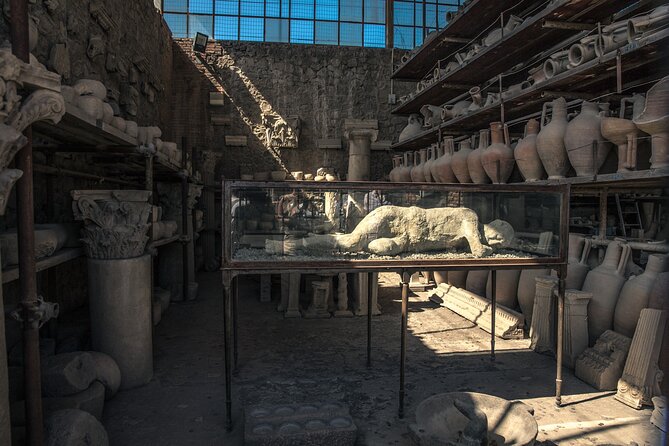
Next comes the Tempio di Giove Capitolino, on the north side of the Forum. This temple dominates the view, with Mount Vesuvius rising behind it in the background—so it’s one of those locations where the scenery helps explain the story.
This building also has a political-religious angle. When the colony was founded in 80 BC, the temple was radically renovated and became a real Capitolium. The tour describes the three cult statues—Jupiter, Juno, and Minerva—positioned so they were visible to people passing through the Forum square, like an ancient civic broadcast system.
You can also read our reviews of more private tours in Sorrento






Macellum: Pompeii’s Market Hub With Imperial Clues
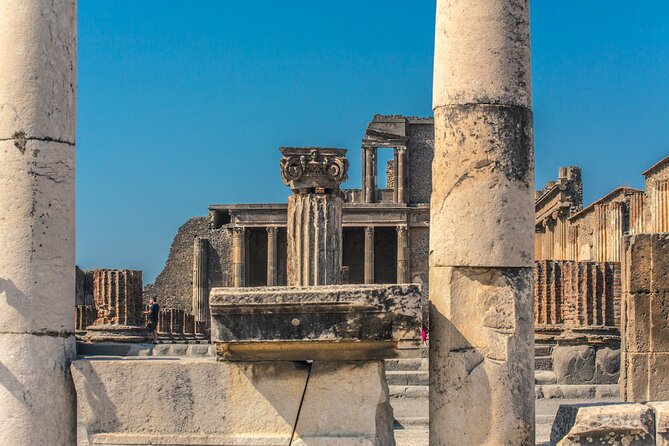
If the Forum is where life ran, the Macellum is where people shopped and ate. This was Pompeii’s market complex, described as a tuff quadriporticus with a hall used for worship on the elevated eastern side.
What I like about this stop is the mix of daily and political life. The layout includes niches with copies of marble statues (a male and a female, plus a larger fragment likely linked to Titus or Vespasian). That imperial-cult detail reminds you this wasn’t just a place for food—it was also a stage for Roman authority.
The tour gives about 10 minutes here, which is enough time to understand the layout and spot the key features your guide points out.
Via dell’Abbondanza: The Main Street That Still Has Energy
Then you hit Via dell’Abbondanza, Pompeii’s ancient main street (a decumanus maximus). It ran east/west from the Forum toward the Porta Sarno, which means it links the civic center to city exits—the kind of street you’d notice even if you didn’t know where you were.
This is where the city sounds come back to your head. The description includes shops, workshops (officinae), cafes, snack-bars, and restaurants for food and drink. The stop time is short (about 10 minutes), but it’s a great one because it turns the stone into street life in your imagination.
Stabian Baths: Cold, Warm, Hot, and Built for Routine
The Stabian Baths (Terme Stabiane) are behind the Temple of Jupiter, dating to the years right after Pompeii became a colony of veterans (around 80 BC). The key detail is how the bathing experience was structured.
The stop is about 10 minutes, but there’s a lot to notice because the building has separate entrances for women and men. In the men’s section, the tour description explains a sequence of rooms: apodyterium (dressing room), tepidarium (medium temperature), frigidarium (cold baths), and calidarium (hot baths). Even in a short visit, that’s the kind of practical information that makes ruins feel real.
And yes, earthquakes played a role. Like many buildings, the baths were heavily damaged during the earthquake of 62 AD, which adds another layer to what you’re seeing.
Casa del Fauno: Roman Republic Luxury in a Real Home
For a change of mood, the tour includes Casa del Fauno (House of the Faun). This private residence dates to the 2nd century BC and is described as one of the largest and most impressive houses in Pompeii, with major art pieces.
What I like here is the “not just public life” perspective. Pompeii is famous for its streets and temples, but private homes show you wealth, status, and taste in a way that public buildings can’t. The tour gives about 10 minutes here, so you’ll likely focus on the standout features your guide prioritizes.
Teatro Grande: Watching How Romans Used Space
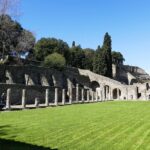
Next is the Teatro Grande (Large Theater), built into a hillside slope so Roman builders could create an auditorium that felt built into the landscape. It’s divided into five sectors, and the stage hosted tragedies from Greco-Roman traditions.
A theater stop is always a good reset during a Pompeii day because it shifts you from daily routine to public performance. In about 10 minutes, you can grasp how the space was designed for viewing and sound—even if you’re not seeing a production.
Basilica: Business and Justice Under One Roof
The tour finishes the set-piece circuit at the Basilica, one of the largest buildings tied to the Forum area. It’s described as around 1,500 square meters, used for business and for administering justice.
This is another “meaning-making” stop. With a guide, you’ll see why this building mattered for how people organized their lives—contracts, disputes, and daily civic movement would all orbit the Forum and its connected spaces.
Via delle Ville: The Scenic Route Toward the Villa of the Mysteries Area
You also get a segment called Via delle Ville, a road outside Pompeii’s city walls connecting the urban center to the suburbs. It runs away from the Porta Ercolano gate and passes through a necropolis lined with impressive tombs.
The tour notes this route is often linked to the path to the Villa of the Mysteries, known for frescoes depicting Dionysian rites. In this itinerary, it functions more like a scenic, atmospheric contrast to the busier city streets—an in-between moment that helps you feel Pompeii beyond the main Forum stops.
One practical point: the time and exact entry details for this part aren’t fully spelled out in the tour outline you shared. So I treat it as a short, meaningful segment—great for photos and context, not necessarily a long gallery-style visit.
Who This Pompeii Tour From Sorrento Is Best For
This private setup is best for you if you want:
- A guide-led route so you don’t get lost in the scale
- Transfer included so logistics don’t eat the day
- Fast entry to maximize time on-site
- A lot of highlights within roughly 4 to 5 hours
It’s also a strong match for couples, families who want adult guidance without group chaos, and anyone who prefers comfort over figuring things out.
Price and Value: Is $504.67 Per Person Worth It?
At $504.67 per person, this isn’t the cheapest way to do Pompeii. The value comes from combining several things you’d otherwise pay for or arrange separately: round-trip transport from your hotel area, an English-speaking driver, an official private guide, and priority entry plus included admission for key stops.
So the math is less about price alone and more about what you’re buying: time saved at the gate, expert interpretation on the ground, and a route that hits major buildings without leaving you to wander and guess. If you’re traveling solo and would otherwise take public transport and buy individual tickets, the difference can feel bigger. If you’re traveling in a pair or small group and want comfort + clarity, it starts to make sense quickly—especially since Pompeii days can be a time sink if you’re not organized.
One more context clue: this tour is booked about 100 days in advance on average, which tells me the best times (and guides) move fast.
Practical Tips That Make the Day Feel Easier
Pompeii is hot in summer. The tour guidance says to use sunscreen and wear comfortable shoes, and a note from experience is that an early start helps manage July heat. If your dates line up with peak sun, I’d prioritize a morning departure if the schedule allows.
Also plan for steady walking. Even with short stop times, you’re moving between multiple major sights in one stretch, including baths and a theater.
Finally, check pickup reachability. If your hotel is inside a restricted zone, you may need a nearby pickup point. Confirming it at least 24 hours before keeps the day smooth.
Should You Book This Private Pompeii Tour From Sorrento?
I’d book it if you want a guided, organized Pompeii day with transfer included and priority entry. The private guide component is the heart of the value: Pompeii is huge, and the official commentary helps you understand what you’re seeing instead of just collecting pictures.
Skip it or reconsider if you’re chasing a super slow, long-form exploration where you linger for an hour per site. This route is designed to cover a lot in about half a day, so it’s highlights-focused.
If you’re short on time, traveling in summer, or you simply hate standing in lines and guessing your way around ruins, this is a solid choice.
FAQ
How long is the Pompeii tour?
The tour lasts about 4 to 5 hours.
Is pickup and drop-off included?
Yes. Round-trip transport is included with pickup from your hotel in the Sorrento area and return to your hotel by private vehicle.
Will I have to walk a lot inside Pompeii?
This is a walking tour of Pompeii with an official guide, including a guided portion of about 2 hours plus additional short stops at major buildings.
Is fast-track or priority entry included?
Yes. You get priority access to the Pompeii archaeological site, which helps you bypass the line at the ticket window.
Is the guide included, and what language is it?
Yes. You’ll have an expert private local guide with live commentary in English.
Are entrance tickets included?
Yes. The itinerary lists admission tickets included for the Pompeii sites you visit (including the Archaeological Park and the listed stops).
Does the tour include food or drinks?
No. Food and beverages are not included.
Is this a private tour?
Yes. It’s a private tour/activity with only your group participating.
What should I do if my hotel is hard to reach?
Some hotels may not be reachable due to traffic restrictions and pedestrian areas. You should confirm the exact pickup location with the provider at least 24 hours prior to departure.
Can I cancel for a full refund?
Yes. You can cancel for a full refund up to 24 hours before the experience’s start time.
If you want, tell me your travel month and whether you’re a solo traveler, couple, or family, and I’ll help you judge if the timing and pace match what you like.
You Might Also Enjoy




More Guided Tours in Sorrento


More Tours in Sorrento






More Tour Reviews in Sorrento
- Sorrento Farm and Food Experience including Olive Oil, Limoncello, Wine tasting
★ 5.0 · 2,524 reviews