REVIEW · SORRENTO
Skip-the-Line Pompeii Guided Tour from Sorrento
Book on Viator →Operated by IAMME IA! - Gray Line Amalfi Coast · Bookable on Viator
Pompeii feels huge, until you have a plan. This skip-the-line tour uses an air-conditioned coach and a guided route so you get into the ruins fast and keep moving with purpose. You’ll tackle major sights without losing half your day to entry lines.
I really like how the guide’s storytelling turns scattered stones into a working Roman city. With headsets on larger groups, the commentary stays clear, and names like LuLu, Luisa, Lucio, Nello, Roberta, and Patricia show up often in the kind of guides people remember.
The one catch is pace and terrain. Expect uneven ground, steps, and inclines, and the tour is not set up for everyone’s mobility needs; one review noted wheelchairs aren’t allowed (while strollers are okay), so I’d think hard before booking if you use a wheelchair.
In This Review
- Key things I’d watch for
- Getting From Sorrento to Pompeii Without the Hassle
- Skip-the-Line Entry: What That Buys You at Pompeii
- The Forum Stops: Where City Life Really Happened
- Civil Forum: the city’s “decision center”
- Temple of Jupiter: power plus a dramatic backdrop
- Macellum: markets, worship, and imperial touches
- Via dell’Abbondanza and the Baths: Daily Routines Made Visible
- Via dell’Abbondanza: the main street vibe
- Stabian Baths (Terme Stabiane): social life, not just bathing
- The Lupanar, House of the Faun, and the Grand Public Buildings
- Lupanar: the brothel built into the city fabric
- House of the Faun: wealth, Hellenistic influence, and mosaics
- Basilica: law, business, and justice under one roof
- Teatro Grande and the Reality of Walking Time
- Price and Value for a First Trip to Pompeii
- Who This Tour Suits (and Who Should Choose Another Plan)
- Should you book this skip-the-line Pompeii tour?
- FAQ
- How long is the Pompeii tour from Sorrento?
- Where do I meet in Sorrento?
- Does this tour include skip-the-line admission?
- What’s included in the ticket price?
- Is food or drinks included?
- Is the tour offered in English?
- How big are the groups?
- Is there a mobile ticket?
- What is the cancellation policy?
- Is the tour wheelchair accessible?
Key things I’d watch for
- Skip-the-line entry saves time and helps you start early, often before the worst crowds hit
- Air-conditioned round-trip coach from central Sorrento makes the long drive feel shorter
- Headsets for groups over 10 keep the guide’s explanations audible without crowding
- Short highlight stops mean you’ll see a lot, but you won’t have hours of solo wandering
- Pompeii’s ground is uneven and can be tiring on ancient stones and stairs
Getting From Sorrento to Pompeii Without the Hassle
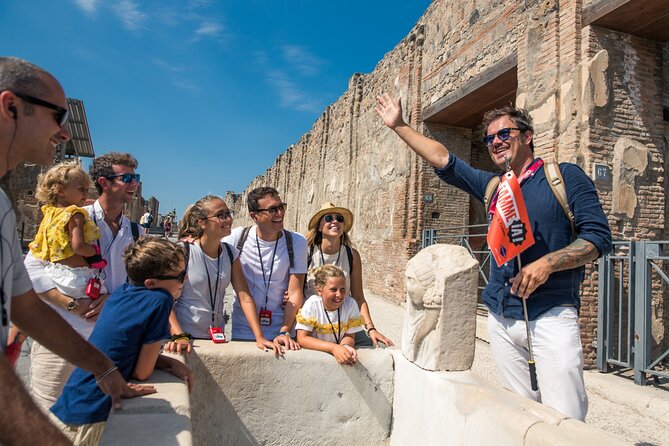
The biggest quality-of-life win here is the ride. You meet at IAMME IA! – Gray Line Amalfi Coast in Sorrento (Piazza Torquato Tasso, 16), then take a round-trip air-conditioned coach to Pompeii. For a day that includes a lot of walking on ancient surfaces, that comfort matters more than you’d think.
The tour runs about 5 hours total, which is a smart length for a first Pompeii visit from the Sorrento area. It’s long enough to cover the Forum area plus several standout “wow” stops, but short enough that you’re not stuck doing this for an entire day with no real rest.
Group size is capped at 29 people, which helps. It’s still a group, but it’s not a massive herd. You also get a mobile ticket, so you’re not juggling paper while you’re trying to get your bearings.
You can also read our reviews of more guided tours in Sorrento

Skip-the-Line Entry: What That Buys You at Pompeii
Pompeii is famous, and that means it’s busy—especially later in the morning and into the afternoon. The value of skip-the-line access is not just faster entry. It’s what you do with the extra time after you’re inside.
People reported getting in early enough to be among the first groups through. That can translate into better photo timing, more breathing room at key structures, and fewer moments where the guide has to rush because the crowd surge has already swallowed the paths.
Your entrance experience also matters because Pompeii is easy to misunderstand when you arrive on your own. The site is vast and streets loop in ways that don’t feel intuitive. A guide helps you follow a logical route instead of zigzagging across the park wondering what you’re actually seeing.
If you’re choosing between morning and afternoon departures, I’d favor early. One review called out that early morning worked better because the later crowds and heat build quickly as the day goes on.
The Forum Stops: Where City Life Really Happened
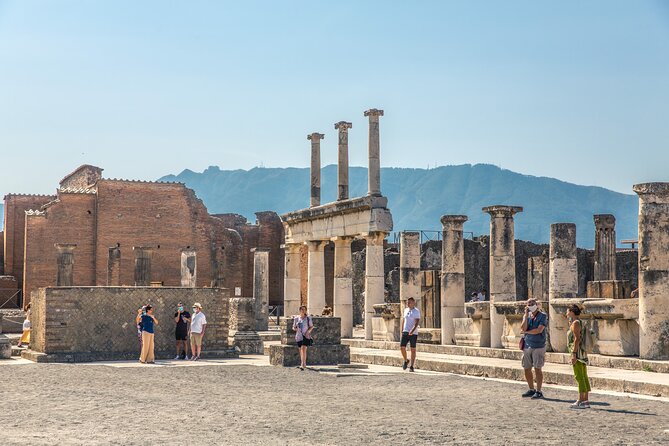
Once you’re in, the tour focuses on the center of civic life first. You’ll spend about 2 hours at the Archaeological Park of Pompeii, with the route anchored around the main public heart of the city.
Civil Forum: the city’s “decision center”
You’ll walk through the Civil Forum, where daily life, administration, justice, business, and worship overlapped. This isn’t just ruins-with-statues. It’s the space that shows how Romans mixed politics, trade, and religion in one place.
If you’ve ever wondered what people did with their time in a Roman city besides work and eat, the Forum is where the answer lives. You’ll see the kind of monumental space that made the city feel official and permanent.
Temple of Jupiter: power plus a dramatic backdrop
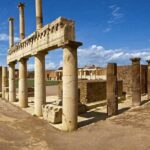
On the north side of the Forum sits the Temple of Jupiter, a structure that had major upgrades when the colony was founded. You’ll hear how it became a Capitolium-style temple with cult statues of Jupiter, Juno, and Minerva.
One of the more striking details here is the staging: Mount Vesuvius rises behind the scene, so the ruins feel connected to the disaster that froze this city in time.
You can also read our reviews of more tours and experiences in Sorrento


Macellum: markets, worship, and imperial touches
Next comes the Macellum, a market complex described as a tuff quadriporticus with an elevated worship area. This is where you learn a key Pompeii lesson: economics and religion weren’t separate categories.
You’ll also encounter hints of the imperial cult, including references to marble statue fragments and a setup that suggests loyalty to Rome was built into daily spaces. Even the layout tells a story: this was a place for eating, buying, and showing status.
Via dell’Abbondanza and the Baths: Daily Routines Made Visible
After the Forum core, you shift from “government space” to “life in motion.”
Via dell’Abbondanza: the main street vibe
Via dell’Abbondanza was Pompeii’s main street, the decumanus maximus running east/west. You’ll get a short window (about 10 minutes) to picture how this corridor worked when it was alive—crowded, noisy, and full of shops, workshops (officinae), snack-bars, and places to grab food.
Even if you don’t memorize every stall location, you’ll start seeing Pompeii like a real neighborhood rather than a museum. That’s the point of this stop: it teaches scale and texture.
Stabian Baths (Terme Stabiane): social life, not just bathing
Behind the Temple of Jupiter are the Stabian Baths, with separate quarters for women and men. The tour gives you about 10 minutes here, which is enough to grasp the sequence of rooms: dressing area and temperature stages like tepid and hot baths.
These baths date to soon after the colony was founded (around the era of 80 BC), and you’ll hear they were damaged during the earthquake in 62 AD. That detail matters because it shows Pompeii wasn’t perfectly preserved immediately after a single event. It was already fragile—then Vesuvius finished the job.
If you like “how did people live” answers, the baths are often the most humanizing stop. It’s Roman daily life: routine, socializing, and even architecture built around comfort levels.
The Lupanar, House of the Faun, and the Grand Public Buildings
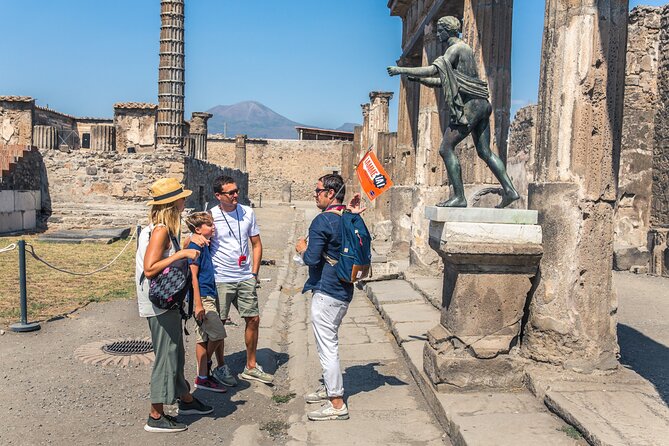
This is where the tour hits the famous, unforgettable names.
Lupanar: the brothel built into the city fabric
The Lupanar is the most famous official brothel in Pompeii, tucked in a narrow street near the center. It’s a two-story building with built-in beds in small ground-floor rooms. The big draw here is the preservation of erotic frescoes above doorways, likely serving as a kind of visual menu.
You’ll also hear about the graffiti left by visitors, giving a raw look into plebeian life and language. That can feel surprising if you expected Pompeii to be only tragic or only “upper-class art.” The Lupanar shows a different side of the city’s social reality.
House of the Faun: wealth, Hellenistic influence, and mosaics
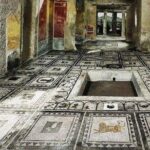
Then comes the House of the Faun, one of the largest and most luxurious private residences in Pompeii. It covers an entire city block and blends Roman architecture with Hellenistic influence.
The highlight is the Alexander Mosaic, depicting Alexander the Great’s battle against Darius III. This is where Pompeii’s art and wealth jump off the stone. You’re not just looking at a home—you’re seeing elite taste turned into permanent decoration.
Basilica: law, business, and justice under one roof
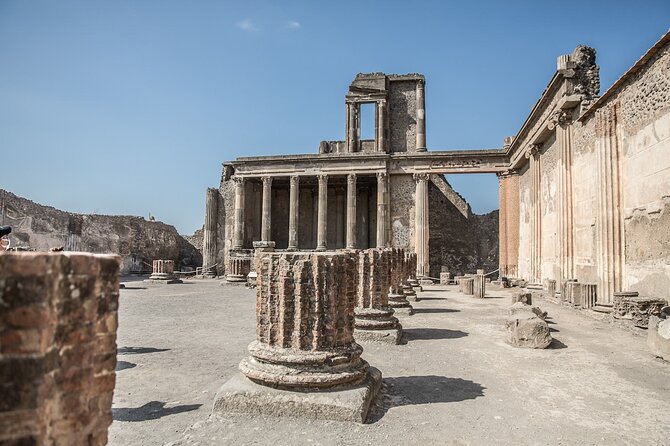
The Basilica is described as the most sumptuous building of the Forum, with about 1,500 square meters. It was used for business and administration of justice. In other words: it’s the Roman version of a “public institution,” where legal and commercial life overlapped.
This is also a good stop for first-timers because it reinforces that Pompeii’s buildings weren’t single-purpose. People moved between social, legal, and commercial functions constantly.
Teatro Grande and the Reality of Walking Time
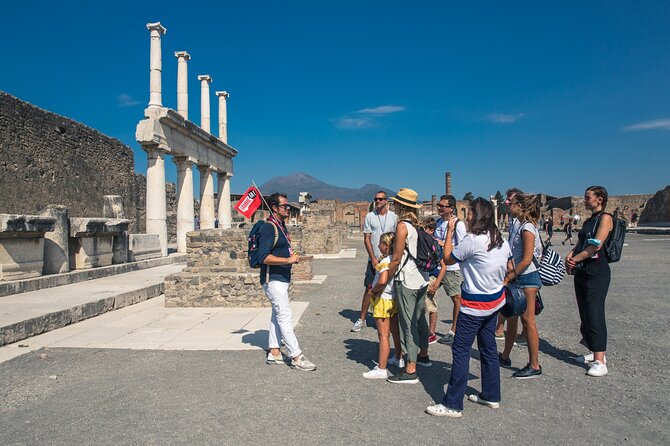
The final major highlight is the Teatro Grande, a large theater built using the slope of a hill. It’s organized into five sectors, and the stage hosted tragedies of Greco-Roman traditions.
The tour gives you about 10 minutes here. That’s enough to understand the scale and the setting, but not enough to sit for a long performance of your own. Treat this as a “look and learn” stop, not a “linger for an hour” moment.
This is also the point where you feel how the whole day is structured. One review noted that the time inside Pompeii can feel closer to around 90 minutes depending on how the group moves, even though you get included time and ticket access. In practice, you’ll spend more time on walking and transitions than you might for a slow museum day.
A guide helps keep the pace manageable, and some guides were praised for noticing when someone needed a rest and for keeping the group together. Still, the reality is: Pompeii is not a flat, smooth path. If you know you can’t keep up with stairs and inclines, you’ll want to consider whether a different format (more time on fewer sights) fits better.
Price and Value for a First Trip to Pompeii
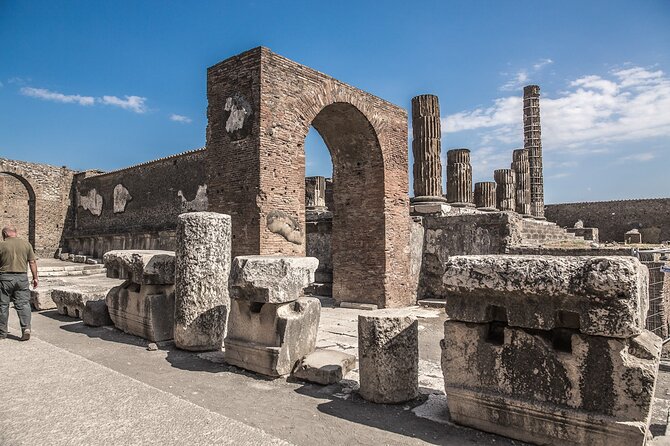
At $90.70 per person for about 5 hours, this isn’t a bargain in the cheap-and-cheerful sense. It is, however, a strong value if your goal is to see the major sights with guidance and not waste time fighting entry lines.
What you’re paying for includes:
- Round-trip air-conditioned coach from central Sorrento
- Official guide in Pompeii (the route and explanations are the real cost-driver)
- Skip-the-line admission so you spend your time inside the site
- Headphones for groups bigger than 10, so the guide’s narration stays clear
- Admission to the Pompeii Archaeological Site
- A mobile ticket
Food isn’t included, so plan on grabbing snacks before or after. That also means you can control what you eat without feeling locked into a fixed meal schedule.
If you’re deciding whether to book now, note that this tour is often booked about 58 days in advance on average. That’s a good sign that prime departures and guide timing can fill up. If Pompeii is your anchor activity in the trip, earlier booking gives you more flexibility.
Who This Tour Suits (and Who Should Choose Another Plan)
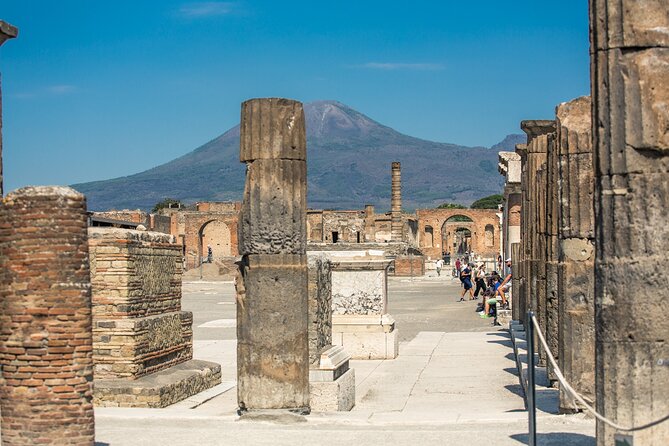
This works best if you’re:
- On a time budget and want the Forum, markets, baths, and the big signature houses on one guided route
- Interested in how the city worked, not just what it looked like
- Happy with a structured walk where the guide keeps you moving and helps you avoid getting turned around
It can also be a good family fit. One review specifically mentioned traveling with five kids and still finding the tour engaging for all ages. The key is that you’re not trapped listening forever in one place—you’re getting a string of visual stops.
I’d think twice if you:
- Need lots of solo free time to revisit your favorite spot. Some people said the guide used the entire slot and there wasn’t much open time for wandering, shopping, or a second look
- Have mobility challenges. Pompeii’s uneven ground and stairs can make it hard to keep up with a group pace. One reviewer flagged wheelchairs aren’t allowed and questioned how that impacts real accessibility
Also, if you’re expecting a slow, comprehensive Pompeii experience, this tour is more of a “best-of route.” You’ll leave with a strong overview, but not with every alley detail.
Should you book this skip-the-line Pompeii tour?
If it’s your first time to Pompeii from Sorrento and you want the smoothest path in—skip-the-line entry, a guided route, and headsets when needed—I think this is a smart booking. It’s especially appealing if you want to maximize your day and avoid the worst heat and crowd pressure by choosing an earlier departure.
I’d only skip it if you strongly need: long unstructured time in the ruins, very flexible pacing, or accommodations for wheelchair use. In that case, you may prefer a different format that focuses on fewer stops and slower walking.
If you want Pompeii to feel like a city you can picture, not just a pile of stones, this tour is built for that goal.
FAQ
How long is the Pompeii tour from Sorrento?
It runs about 5 hours (approximately), including round-trip transport and guided time inside Pompeii.
Where do I meet in Sorrento?
You meet at IAMME IA! – Gray Line Amalfi Coast, Piazza Torquato Tasso, 16, 80067 Sorrento, Italy.
Does this tour include skip-the-line admission?
Yes. Skip-the-line access and entry to the Pompeii Archaeological Site are included.
What’s included in the ticket price?
Round-trip air-conditioned coach transportation, an official Pompeii guide, skip-the-line admission, headphones in Pompeii when groups are bigger than 10, and the Pompeii admission itself.
Is food or drinks included?
No. Food and drinks are not included.
Is the tour offered in English?
Yes, the tour is offered in English. It may be operated by a multi-lingual guide.
How big are the groups?
The tour has a maximum of 29 travelers.
Is there a mobile ticket?
Yes, the tour includes a mobile ticket.
What is the cancellation policy?
Cancellation is free up to 24 hours in advance for a full refund. If you cancel less than 24 hours before the start time, the amount paid is not refunded.
Is the tour wheelchair accessible?
One review noted wheelchairs are not allowed, while strollers are okay. The terrain can be uneven with steps and inclines, so plan carefully if mobility is an issue.
You Might Also Enjoy




More Guided Tours in Sorrento



More Tours in Sorrento





More Tour Reviews in Sorrento
- Sorrento Farm and Food Experience including Olive Oil, Limoncello, Wine tasting
★ 5.0 · 2,524 reviews