REVIEW · POSITANO
Transfer from Naples to Positano with 2 hours Private Tour in Herculaneum
Book on Viator →Operated by Askos Tours · Bookable on Viator
Herculaneum plus Positano in one smooth move. This private transfer takes the stress out of Amalfi Coast logistics, with an air-conditioned ride plus a guided walk through one of Rome’s buried towns. I like the door-to-door private transfer setup and the fact you get a real stop to see Herculaneum instead of just changing locations.
I really like that the Herculaneum portion is guided and structured, with an archaeologist guide meeting you at the ticket office and then steering you from stop to stop. The other big win is practical: your driver handles the vehicle and your luggage stays under care, so you can focus on the ruins for the tour time.
One consideration: at about 4 hours total, this is a focused hit rather than a slow, lingering day. If you want lots of free time in Positano before dinner, you may need a different plan.
In This Review
- Key things that make this transfer worth it
- Naples to Positano, minus the transport headache
- How the Herculaneum stop fits into a 2-hour guided visit
- The Parco Acheologico di Ercolano: what you’ll see, stop by stop
- Stop 1: Parco Acheologico di Ercolano (ticket office + entry)
- Stop 2: Casa dei Cervi (the house named for deer statues)
- Stop 3: La Terrazza di M. Nonio Balbo (a benefactor’s story in stone)
- Stop 4: College of the Augustales (religion and civic organization)
- Stop 5: Casa del Rilievo di Telefo (an elegant house with private access)
- Stop 6: Partem Domus lignea – Casa del Tramezzo di Legno (the wood that survived)
- Stop 7: House of the Skeleton (the name comes from 1831 remains)
- Stop 8: Central Thermae (men’s and women’s entrances)
- Stop 9: Casa del Salone Nero (the Black Hall house)
- Stop 10: Casa Sannitica (Samnite-style atrium and frescoes)
- Stop 11: Casa del Bel Cortile (courtyard and stone balcony)
- Stop 12: House of the Grand Portal (centerpiece domus with charred remnants)
- The arrival in Positano: you’re not stuck commuting
- Price and value: what you’re paying for
- Who this tour suits best (and who might prefer something else)
- Practical tips to make the day go smoothly
- Should you book this private Naples-to-Positano + Herculaneum combo?
- FAQ
- Is this tour private?
- How long does the whole experience last?
- What’s included for the Herculaneum visit?
- Where do pickup and drop-off happen?
- Are meals included?
- Can I bring a child seat, and what’s the cancellation policy?
Key things that make this transfer worth it
- Private, door-to-door timing in Naples and hotel drop-off in Positano so you can move efficiently
- A guided Herculaneum stop that turns transit time into sightseeing time
- Air-conditioned private minivan with a professional driver and luggage transport
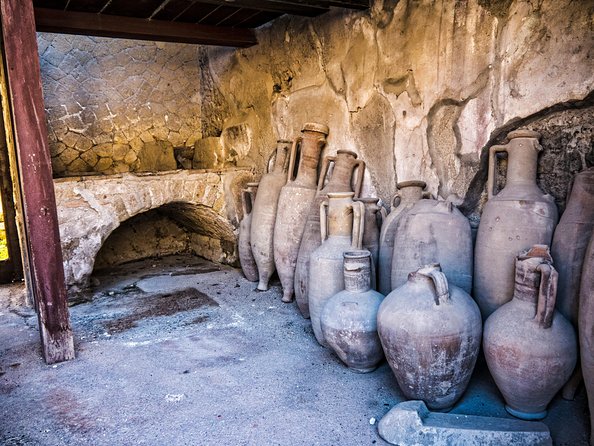
- A focused route of houses and baths, including wooden architectural remnants
- Skip the hassle of trains and buses with a single, coordinated ride
Naples to Positano, minus the transport headache
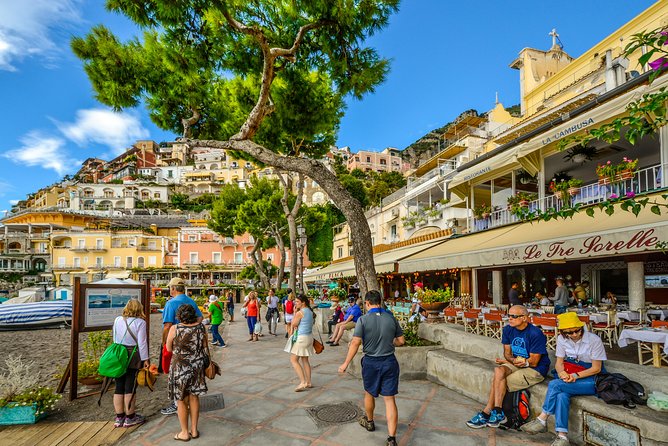
The Amalfi Coast is gorgeous, but getting from Naples to Positano can turn into a game of schedules, transfers, and standing around. This experience is built for the opposite vibe. You get a private one-way transfer from Naples to Positano in an air-conditioned minivan, with a professional driver doing the driving and the navigating.
The “private” part matters more than it sounds. When you control pickup time and where in Naples you start, you’re not stuck riding public routes that don’t quite match your day. And when you reach the Herculaneum stop, the driver stays with the vehicle while your group does the guided visit, which keeps the whole day from turning into a juggling act.
Also, the ride is designed with comfort and practicality in mind. There’s luggage transport, and car seats are available on request (handy if you’re traveling with kids). If your group wants an all-in-one day plan—travel + culture + arrival—this arrangement is a strong fit.
You can also read our reviews of more private tours in Positano



How the Herculaneum stop fits into a 2-hour guided visit
This tour’s key idea is simple: make your transfer day do more work for you. Instead of arriving in Positano with nothing but transit fatigue, you get a guided Herculaneum stop first. The highlights promise a stop for about two hours of guided exploration, which is long enough for a meaningful overview without eating the whole day.
You meet the guide at the ticket office for the Parco Acheologico di Ercolano (Herculaneum ruins). From there, the itinerary is laid out in bite-size pieces—mostly around 10–15 minute segments—so you get a variety of spaces without getting stuck in one room too long.
Here’s what I like about that pacing: Herculaneum is full of rooms, names, and details. Short guided stops help you actually retain things, like why a certain house is named what it’s named, or what a benefactor’s inscription is telling you about status in the town.
A good real-world note from the reviews: guides can make or break a ruins visit. One review specifically called out that the Herculaneum guide was amazing and really knew the history of ancient Rome—plus they met a guide named Laura, which is a nice detail if you’re drawn to a storytelling, historical approach.
The Parco Acheologico di Ercolano: what you’ll see, stop by stop
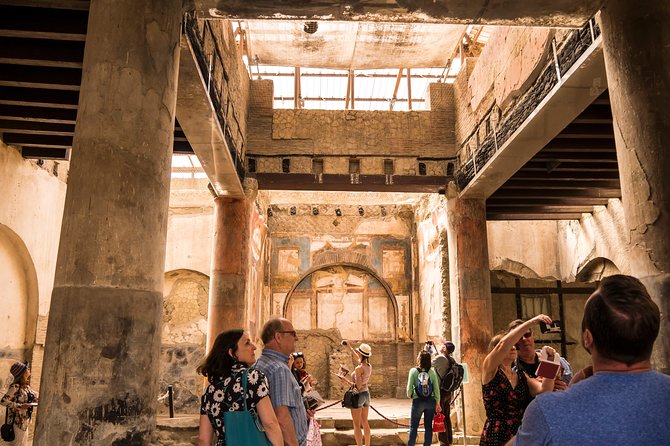
The itinerary is packed, but it’s not random. It’s essentially a route that cycles through the town’s identity: famous spaces for display, homes for daily life, and baths that show how Romans organized gendered public routines.
Below is what to expect from each segment, and what each one is trying to teach you.
Stop 1: Parco Acheologico di Ercolano (ticket office + entry)
You start at the Parco Acheologico di Ercolano, meeting the guide at the ticket office. This first stop includes admission ticket handling (10 minutes noted) and sets the stage for what you’ll be seeing: charred remains, stone foundations, and architecture that still reads like a lived-in town.
What’s useful here is timing. You’re not wandering in cold-start mode. You’re guided right away, so you understand what you’re looking at instead of playing guessing games.
Stop 2: Casa dei Cervi (the house named for deer statues)
Next is Casa dei Cervi, named for marble statues of deer found in the peristyle. Even in a short visit, this kind of detail matters because it links archaeology to taste, symbolism, and the culture of display.
The downside is that this is a quick stop. If you’re hoping for a slow, photo-friendly hour in one mansion, this format won’t feel like that. It’s more about variety and context.
You can also read our reviews of more tours and experiences in Positano



Stop 3: La Terrazza di M. Nonio Balbo (a benefactor’s story in stone)
You then reach La Terrazza di M. Nonio Balbo, tied to the city’s major benefactor, M. Nonius Balbus. On his death, he was honored and patronized, and the itinerary notes a long inscription on his funeral altar that tells the story.
This is the kind of stop where a guide can really help you connect the dots. Roman ruins aren’t just buildings; they’re also records of power and civic identity. An inscription-focused stop is a reminder that these were places where status could be literally carved into public memory.
Stop 4: College of the Augustales (religion and civic organization)
Next comes the College of the Augustales. The description notes it’s thought to have functioned as a center of the cult of Emperor Augustus and possibly the headquarters of the Collegium Augustalium, or even the local curia.
If you want one reason Herculaneum feels different from “just houses,” this is it. It shows civic and religious life in a town where Roman identity wasn’t theoretical—it was built into institutions and spaces.
Stop 5: Casa del Rilievo di Telefo (an elegant house with private access)
Casa del Rilievo di Telefo is described as a house that may have belonged to a leading benefactor (Marcus Nonius Balbus is named), and it’s unusual because it has its own private access to the adjoining Suburban Thermae to the south.
That’s a fascinating idea for a short visit: not every house interacted with the baths the same way. This stop gives you a sense of how wealth could reshape daily life, including leisure routines.
Stop 6: Partem Domus lignea – Casa del Tramezzo di Legno (the wood that survived)
One of the most striking segments is Partem Domus lignea – Casa del Tramezzo di Legno. The description stresses its importance due to an elegant wooden partition that remained.
This is a stop I’d prioritize in your mind even if you’re not an archaeology nerd. Wood is often the first thing to disappear. So when the itinerary points it out, it’s basically telling you: pay attention, this is rare evidence of what daily interiors may have looked like.
Stop 7: House of the Skeleton (the name comes from 1831 remains)
Then you’ll see the House of the Skeleton. It gets its name from the discovery of human remains in a second-floor room in 1831.
This can feel heavy, and that’s normal. What makes a guided route important is framing—your guide can help you see it as historical evidence and not just a grim label. Still, if you’re sensitive to such discoveries, take note that the tour includes this stop.
Stop 8: Central Thermae (men’s and women’s entrances)
Next is the Central Thermae. The description says they were built around the beginning of the 1st century AD and were divided into men’s and women’s baths, each with separate entrances.
This is a strong “how Romans lived” example in a quick format. It’s not only about what they built—it’s about how society organized public spaces. You’ll leave with a clearer sense that daily routines were structured, not spontaneous.
Stop 9: Casa del Salone Nero (the Black Hall house)
Casa del Salone Nero, or the House of the Black Hall, is described as one of Herculaneum’s more luxurious mansions. You’ll hear about a monumental entrance that retains carbonised remains of doorposts and lintel.
That mention of carbonised door structures is the kind of detail that makes the ruins feel tangible. It’s easy to see walls. It’s harder to imagine doors and thresholds. Here, the guide should help you bridge that gap.
Stop 10: Casa Sannitica (Samnite-style atrium and frescoes)
Then you get Casa Sannitica, described as arranged in a style typical of the Samnites, with a splendid atrium and a gallery with Ionic columns. The rooms are decorated with frescoes.
Even with short time slots, this stop helps you understand that Herculaneum didn’t develop in a vacuum. There were regional influences, and decorative choices carried meaning.
Stop 11: Casa del Bel Cortile (courtyard and stone balcony)
Casa del Bel Cortile is one of the most original houses in the town. It features a courtyard with a stairway and a stone balcony instead of an atrium.
This is a good “compare and notice” moment. If you’ve been seeing atrium-style layouts, this reminds you there were multiple household designs and priorities.
Stop 12: House of the Grand Portal (centerpiece domus with charred remnants)
Finally, the House of the Grand Portal is described as a beautiful domus in the center of the archaeological area, with various environments, collonnati, frescoes, and charred remains of wooden parts.
This last stop gives you a wraparound view of the scale and design ambition within Herculaneum. When you’re finished, you should feel like you’ve covered more than random highlights—you’ve touched different layers of town life.
The arrival in Positano: you’re not stuck commuting
After the Herculaneum guided time, the rest of your day is about moving comfortably to Positano. This experience includes hotel drop-off in Positano, which saves you from the next layer of decisions—how to get from a bus terminal or pier to your actual lodging.
That drop-off piece is worth real attention. In Positano, even a short ride can mean a lot of stairs or a walk if you land in the wrong place. Getting delivered closer to where you’re staying means you can start your evening faster.
And because it’s private and coordinated, you also avoid the “wait-and-wonder” feeling that can come with public transport. You’re on a schedule, but it’s built into the plan, not imposed by it.
Price and value: what you’re paying for
The price is $456.70 per person for this private Naples-to-Positano transfer with guided Herculaneum. That’s not cheap, and it shouldn’t be. You’re essentially buying three things at once:
1) Private air-conditioned transport with a professional driver
2) Herculaneum guided time (including admission ticket handling as part of the experience)
3) Door-to-door convenience, including hotel drop-off in Positano and luggage transport
Where the value shows up is in how you use the day. If you tried to assemble this yourself—Naples to Herculaneum, then onward to Positano—you’d likely lose hours to timing gaps, ticket lines, and transfer uncertainty. This experience packages the moving parts into one plan.
There’s also a hint of flexibility in the features: group discounts are mentioned. If you’re traveling with friends or family and can share the private setup, the per-person value improves fast. If you’re solo, it’s more of a splurge, but you still get a lot of friction removed.
Who this tour suits best (and who might prefer something else)
This is ideal if you want an efficient “Amalfi Coast day” plan. You’ll like it if you care about getting culture in without turning your trip into a transit marathon.
It also fits well if:
- you want private pickup and drop-off
- you want guided context rather than roaming
- you like the idea of seeing Herculaneum as a less famous buried Roman town compared with the poster-child ruins
It may not be ideal if:
- you need a lot of unstructured time in Positano right away
- you want to spend longer than a guided route allows in each site
Practical tips to make the day go smoothly
A couple things can help you get the most from the 4-hour rhythm.
- Plan for a guided format: the Herculaneum portion is organized into short segments (mostly 15 minutes), so come ready to move and listen.
- Remember meals aren’t included. If you want a nice dinner in Positano, I’d treat the tour as part of your timing plan.
- If you’re traveling with kids, ask about car seats on request.
- If you’re booking with accessibility needs, note that it’s described as near public transportation and that most travelers can participate, but it’s still a ruins visit with walking through archaeological areas.
And if plans change, cancellation is described as free up to 24 hours in advance for a full refund, which is reassuring when weather and ferry or road plans can be unpredictable.
Should you book this private Naples-to-Positano + Herculaneum combo?
Book it if you want to turn one travel day into a real experience. The biggest wins are the private, air-conditioned transfer and the guided Herculaneum stop that gives you substance before you even arrive in Positano.
Skip it if you’re craving a slower schedule or you already plan to spend multiple hours in each location. This is a focused route, not a linger-and-browse day.
If you like getting your bearings fast and you’d rather trade public-transit hassle for a driver and a guide, this is the kind of smart combo that makes the Amalfi Coast feel less complicated.
FAQ
Is this tour private?
Yes. It’s a private activity with only your group participating.
How long does the whole experience last?
It’s listed as about 4 hours (approx.).
What’s included for the Herculaneum visit?
You get guide and assistance by a professional guide in Herculaneum, plus the Herculaneum entry tickets (€16.00 each).
Where do pickup and drop-off happen?
Pickup is offered at a time and location you choose in Naples, and hotel drop-off in Positano is included.
Are meals included?
No. Meals are not included.
Can I bring a child seat, and what’s the cancellation policy?
Car seats are available on request. You can cancel for a full refund if you cancel up to 24 hours in advance of the experience start time.