REVIEW · POSITANO
Positano Private Walking Tour With A Professional Guide
Book on Viator →Operated by Global Guide Services · Bookable on Viator
Positano hits you fast. In just about 2 hours, this private walking tour helps you piece together the town’s story and its best viewpoints without getting stuck in a map maze. I really like the fact that it’s private (your group only), so your guide can match your pace and interests, whether you’re there for church details, back-street views, or quick photo stops. I also love how the route connects big-time history to everyday sights: roman-era Positano origins, the Church of Santa Mary of the Assumption, artisan shops and art galleries, and the sea view payoff at Fornillo Beach.
One possible drawback: you’re hearing the tour through a human voice, not a podcast. A past guest noted their guide spoke fast and softly, which meant they caught only part of the message. If you’re sensitive to audio speed/volume, it’s worth asking your guide to slow down when you start.
In This Review
- Key highlights in plain terms
- How this private Positano walk gets you oriented quickly
- Starting at Santa Maria Assunta: where your tour makes its first move
- The roman story you’ll hear: origins, Villa di Positano, and Villa Romana
- Positano Downtown: artisan streets and the joy of skipping the map
- Don Catello and the town’s living details
- Amalfi Republic context: why your church and streets feel connected
- Church of Saint Mary of the Assumption: what to actually look for
- Fornillo Beach finish: the payoff and your next smart step
- The guide experience: what you’ll get (and what to watch for)
- Price and value: what $307.07 per group really means
- Who this tour suits best (and who should choose something else)
- FAQ
- FAQ
- How long is the Positano private walking tour?
- What’s the price for the tour?
- Is the tour private?
- What language is the tour offered in?
- Where does the tour start and end?
- Can the tour be customized to your interests?
- Should you book this private Positano walking tour?
Key highlights in plain terms
- Private guide only for your group: less waiting, more time asking questions.
- A tight 2-hour route: you’ll learn how Positano hangs together from top to sea.
- Roman to Amalfi story in walking distance: origins, Villa di Positano, and the Amalfi Republic.
- Landmarks with a reason: the church isn’t just a stop; it’s part of the timeline.
- Photo-friendly ending: Fornillo Beach gives you a natural closing viewpoint.
- Guide names matter: Floriana, Gabriella, and Celia earned strong praise for passion, clarity, and pacing.
How this private Positano walk gets you oriented quickly
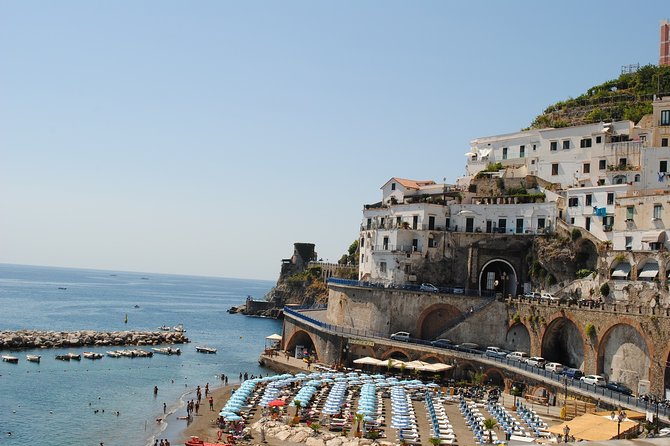
Positano is famous, but it’s also easy to feel a bit lost. The streets curve, the stairs multiply, and the views change every few steps. This tour is designed for that reality: you start at a real anchor point, then move through the town in a way that makes the place start to click.
The big value for me is speed with context. You’re not just being pointed at pretty corners. You’re learning the “why” behind what you’re seeing—how Positano grew from an ancient settlement into a wealthy market port, and why later eras (including the Amalfi Republic) shaped what’s still standing today. That means when you wander afterward, you’ll know what you’re looking at and why it matters.
You’ll also enjoy the private format in practical ways. A group tour moves on rails. Here, your guide can slow down for your footing, pause for questions, or adjust for what you care about. One praised experience centered on a guide like Floriana, whose passion for Positano came through clearly—exactly what you want when you only have two hours.
You can also read our reviews of more walking tours in Positano


Starting at Santa Maria Assunta: where your tour makes its first move
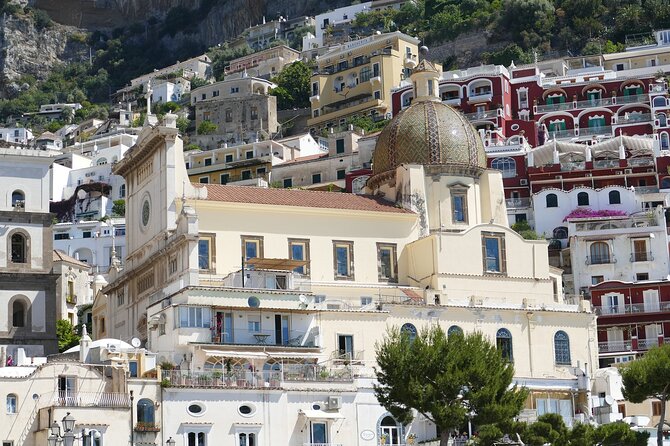
Your tour begins at Chiesa di Santa Maria Assunta in Piazza Flavio Gioia. That’s a smart start, because it’s a central landmark and it gives you an immediate sense of the town’s vertical layout—how Positano climbs and then drops toward the sea.
From the first minutes, you’ll get the tone of what this walk will do: connect history to place. You’ll learn about Positano’s origins in the first century BC, and you’ll hear how the area developed over time. The guide’s job isn’t to read a textbook. It’s to give you enough background that the later stops—church, viewpoints, and the seaside finish—feel like chapters rather than random sights.
Even if you’re not the religious-type, the church stop is still worth it. You’re there for the structure, the location, and the role it played in community life. Plus, it’s a natural place for photos before the walking begins.
The roman story you’ll hear: origins, Villa di Positano, and Villa Romana
One of the most interesting parts of this tour is how it handles the ancient side without dragging you into an endless lecture. You’ll learn about the Villa di Positano and the idea of Positano as a wealthy market port—a place connected to trade and travel rather than just a seaside postcard.
Then you’ll see a viewpoint tied to Villa Romana. Even when your route is mostly about walking through the town, your guide will keep bringing you back to the same theme: Positano didn’t just “happen.” It developed in layers, and you can still read those layers in what you’re seeing now.
This is where a pro guide really earns their fee. A good guide will point out what you might overlook on your own: how the town’s shapes relate to older settlement patterns, and why certain areas feel like they’ve always been “important.” If you love history but hate feeling stuck, this is a nice middle ground.
Positano Downtown: artisan streets and the joy of skipping the map
After the anchor and the ancient background, you’ll move into the heart of town—Positano Downtown—where the experience becomes more hands-on. This is where you’ll feel the “skip the map” advantage. You’re not trying to figure out which stairway goes where. The guide is leading you through the flow of streets and viewpoints.
This is also the section where the tour becomes more about style and atmosphere. You’ll pass artisan shops and art galleries, which means you’re seeing the town’s creative side, not just its big landmark views. The key is that your guide can steer you toward what’s most worthwhile in the time you have—so you’re not wandering in circles trying to decide.
A practical plus: if you’re buying anything small (a postcard, a gift, a piece of local art), you’ll have a guide who can help you time it so you’re not breaking the tour rhythm too often. That matters when the tour is only about 2 hours.
Don Catello and the town’s living details
You’ll also visit Don Catello. The value here is less about a single “wow” moment and more about how local details create the texture of a place. In Positano, that texture is half the fun. One reason private tours work well here is that your guide can explain what you’re looking at in plain language while you’re still surrounded by it.
This isn’t the kind of stop where you need to be a scholar to appreciate it. It’s more like a window into how Positano communicates its identity—through the way the town is arranged, named, and shared.
You can also read our reviews of more guided tours in Positano





Amalfi Republic context: why your church and streets feel connected
In the middle of the walk, your guide ties the story forward to the Amalfi Republic. This is another “good guide” moment. Without context, Positano can feel like a set of pretty scenes. With context, you start to see continuity: the church, the town layout, and the areas tied to wealth and trade all connect back to the region’s history.
This matters because it changes how you look at what’s around you. You’ll stop noticing just the visual highlights and start noticing patterns—where things make sense, why certain routes evolved, and how the past shaped today’s walkability (or stair-ability).
And yes, there’s also a pop-culture angle. You’ll hear that Positano has been featured in several films. That’s not just trivia. It’s part of why the town became a global icon in the first place, which helps explain why you’ll see so many visitors (and why your guide’s crowd-skipping approach is valuable).
Church of Saint Mary of the Assumption: what to actually look for
At Church of Saint Mary of the Assumption, don’t treat the stop as a quick photo and go. Treat it like a “reset” point in the tour. This is where your guide can bring the history together: Positano’s ancient origins, its later regional story, and how the church anchors community life.
Even if you’ve visited churches before, the best way to enjoy this one is to let the guide direct your attention. Focus on what’s in front of you and ask questions that come up naturally:
- What role did the church play in the life of the town?
- How does its position fit the town’s steep layout?
- What’s the most important detail worth noticing, even if you’re not an expert?
If you take that approach, the church becomes more than a building. It becomes a timeline marker.
Fornillo Beach finish: the payoff and your next smart step
The tour ends at Fornillo Beach. This is a good finishing choice because it gives you a clear physical endpoint and a satisfying view reward after the town and stairs.
Fornillo Beach is also a practical place to stop because it sets you up for the rest of your day. You can take a breather, plan your next walk, or figure out the best way to continue exploring without feeling like you must squeeze in everything before your energy runs out.
If you’re someone who likes your tours to end with a view (and not with a rushed sprint back), this format works well. You learn, you walk, and you land at the sea.
The guide experience: what you’ll get (and what to watch for)
This tour is built around a local guide who stays with your group only. That’s the main reason it’s worth doing as a private experience rather than hoping you can piece things together on your own.
The positive side shows up clearly in the reviews you can learn from. Guides such as Floriana and Gabriella were praised for passion and for covering a wide set of topics—from churches to town details and the way the town presents itself in everyday life. Celia received standout praise for pacing, especially on busy streets and stairs, and for sharing practical guidance like how to get around town and even tips about good places to eat.
The one caution to keep in mind comes from a review where the guide spoke quickly and softly, making it hard to catch the full story. You can’t control that from your side, but you can control how you respond: if you struggle, ask your guide to repeat or rephrase. Private tours are better for fixing those moments on the spot.
Price and value: what $307.07 per group really means
The price is $307.07 per group for up to 15 people, and the tour runs about 2 hours. That pricing structure matters, because your real cost-per-person depends on how many people are in your group.
If you travel as a couple or small family, private tours can feel expensive compared with a group bus tour. But in Positano, paying for a guide can be value-positive because the town is so easy to navigate poorly. When you’re saving time, not backtracking, and you’re getting history and practical tips in a tight window, you’re buying less frustration and more insight.
If you’re traveling with a few people, the math gets easier. A private guide for up to 15 means the experience can be affordable for a group once you split it. And because the tour can be customized on the spot, you’re not locked into a one-size-fits-all script.
Who this tour suits best (and who should choose something else)
This experience fits best if you:
- want a quick orientation to Positano rather than a long day of wandering
- like history but want it tied to real places you can see and touch
- care about pacing and prefer a guided route over map gymnastics
- want an ending that feels like a reward, with Fornillo Beach as the finish
You might look at another option if:
- you want a very long, slow church-and-art deep experience (two hours moves at a “cover highlights” pace)
- you’re very sensitive to audio speed and volume and you don’t feel comfortable asking for adjustments mid-tour
FAQ
FAQ
How long is the Positano private walking tour?
It’s approximately 2 hours.
What’s the price for the tour?
The price is $307.07 per group, up to 15 people.
Is the tour private?
Yes. It’s a private tour/activity with only your group participating.
What language is the tour offered in?
The tour is offered in English.
Where does the tour start and end?
It starts at Chiesa di Santa Maria Assunta (Piazza Flavio Gioia, Positano) and ends at Fornillo Beach.
Can the tour be customized to your interests?
Yes. Your local guide can customize the tour on the spot based on what you want to focus on.
Should you book this private Positano walking tour?
I think you should book it if you want Positano to make sense quickly—top to bottom, ancient to modern, church to beach—without spending your precious time trying to decode stairs and street curves. The private setup is a real advantage here, especially if your group includes people with different walking speeds.
Book it with confidence if your style is simple: you want highlights, good storytelling, and practical guidance you can use right after the tour. Just go in knowing this is a tight 2-hour highlights format—so if you want a slower, deeper pace everywhere, you may prefer a longer experience.