REVIEW · SORRENTO
Private Skip-the-line Pompeii & Mt. Vesuvius Tour from Sorrento
Book on Viator →Operated by IAMME IA! - Gray Line Amalfi Coast · Bookable on Viator
Pompeii and Vesuvius in one focused day? That’s exactly why this private tour works so well: you get hotel pickup, skip-the-line priority, and a Pompeii guide that keeps the walking meaningful instead of just busy. I especially like how the day is structured around the Roman heart of Pompeii and ends with real up-close crater views on Vesuvius. One possible drawback: Vesuvius time is limited, and the path is uneven, so you’ll want good footwear and a realistic pace.
The other thing I like here is the “private” part. It’s only your group, you get an English-speaking driver, and your guide runs the Pompeii experience in your selected language—useful when you want context, not just photos. Still, because this is a tight 8-hour schedule, you’ll want to move with purpose and plan for minimal breaks (especially around the Vesuvius base area).
In This Review
- Key highlights you’ll feel right away
- Sorrento pickup and skip-the-line access that protects your day
- Pompeii time allocation: 2 hours that still feels like a lot
- Foro de Pompeya: the city’s daily engine and power center
- Temple of Jupiter (and the view with Vesuvius behind it)
- Macellum and the mixed-purpose world of Pompeii
- Via dell’Abbondanza: the main street vibe in a few steps
- Stabian Baths: how Pompeii handled hot, cold, and social time
- Casa del Fauno: wealth, taste, and the Alexander Mosaic
- Lupanar: a complicated stop, explained with context
- Teatro Grande and Basilica: where culture and justice met
- Mt. Vesuvius: drop-off height, uneven paths, and real crater drama
- Time reality check: you’ll want to pace the crater walk
- Driver + guide quality: what makes or breaks the day
- Price and value: is $635.61 per person worth it?
- Food, breaks, and what to pack for a crater day
- Who this tour suits best (and who might prefer something else)
- Should you book this private Pompeii and Vesuvius tour?
- FAQ
- How long is the Pompeii and Mount Vesuvius private tour from Sorrento?
- Is hotel pickup and drop-off included?
- Do I need tickets for Pompeii and Vesuvius?
- Is this a private tour or shared group?
- Is skip-the-line or priority access included?
- What language options are available?
- How much time do you spend at Pompeii?
- How much time do you spend at Mount Vesuvius?
- What isn’t included in the price?
- Where does the tour start?
Key highlights you’ll feel right away
- Skip-the-line priority at both Pompeii and Mount Vesuvius, which saves you from time-sink lines.
- Door-to-door pickup in Sorrento with an English-speaking driver, so you spend less of the day figuring out logistics.
- A Pompeii walking tour that actually tracks daily life, from the Forum to markets and baths.
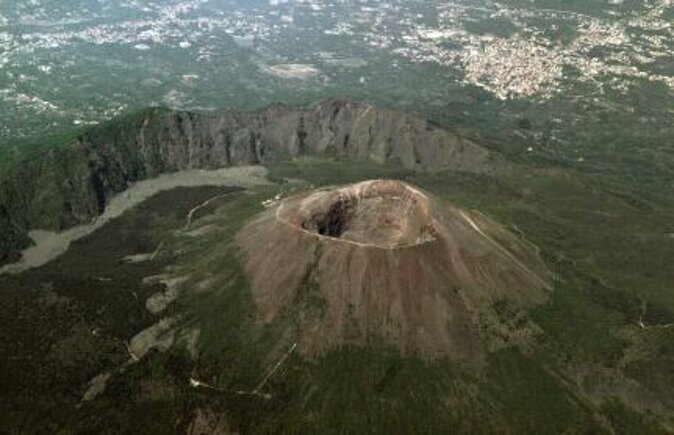
- Up-close crater views with a short walk to the edge at about 1,280 m.
- Tickets included for Pompeii stops and Vesuvius admission, so the day is simpler to budget.
- A “private” format for pacing—your group stays together, and your guide can respond to you.
Sorrento pickup and skip-the-line access that protects your day
This tour is designed for people who want the big sights without wasting hours in queues. You start in Sorrento with pickup from your hotel area, and you’ll be with a private English-speaking driver for the ride. That matters because Pompeii and Vesuvius are popular, and timing is everything.
You also get priority access at the Archaeological Park of Pompeii. That’s not just comfort—it’s real value. Pompeii is a place where the most interesting stops are spread out, and when you lose time at the entrance you lose time for the ruins that connect to each other.
Then there’s Mount Vesuvius. The tour includes priority access to the volcano area, plus the Vesuvius entrance ticket. You’re not just getting views from far away. You’ll be dropped at a high starting point and then head toward the crater edge.
Practical note: the whole day is about timing and flow. If you’re the type who wants long sit-down breaks every hour, you might find the schedule a bit intense.
You can also read our reviews of more private tours in Sorrento



Pompeii time allocation: 2 hours that still feels like a lot
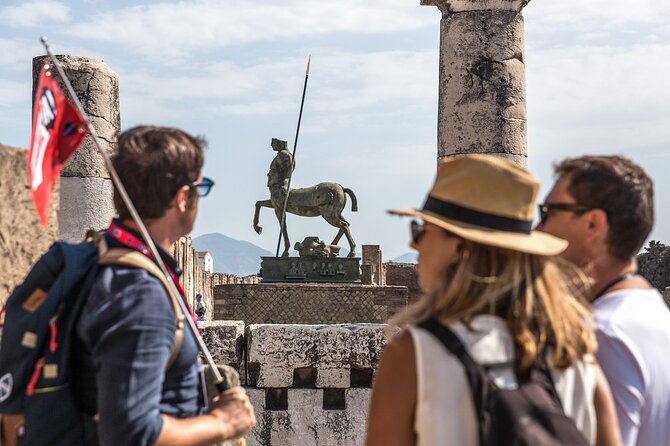
Pompeii is huge. This tour gives you about 2 hours at the Archaeological Park, and then it layers in additional short stops as part of the walk route.
That can sound short on paper. But the trick is that this is not a random self-guided wander. You’re moving through the city’s main public spaces and some of the most famous structures, so each 10-minute stop has a purpose.
Also, Pompeii’s ruins are dense with details. A guided stop helps you pick out the story—what you’re looking at, why it mattered, and how it connects to the rest of the city.
Foro de Pompeya: the city’s daily engine and power center
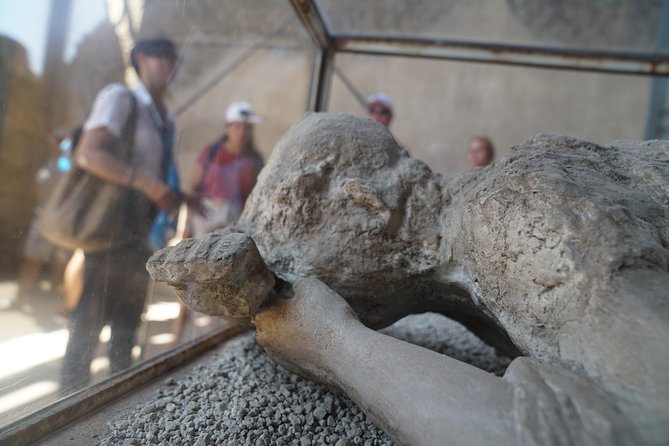
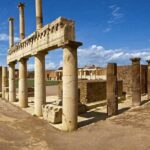
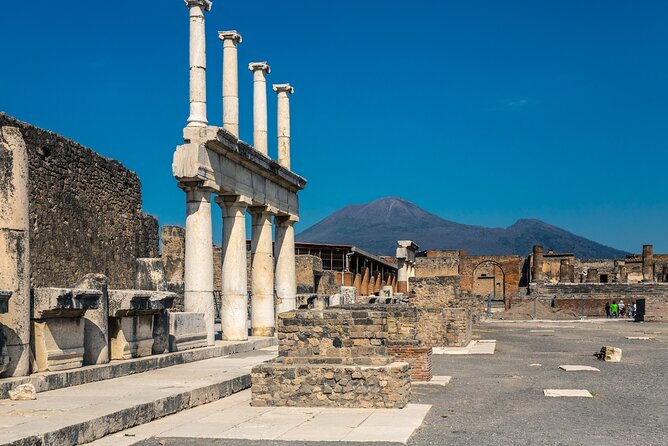
The day starts with the Archaeological Park of Pompeii, and then you zero in on the Foro de Pompeya (Civil Forum). This is where the Roman city life you imagine actually happened: civic administration, justice, business, trade, and worship were all tied together in one core.
In plain terms, the Forum is where you get the big-picture understanding of Pompeii fast. Instead of seeing isolated ruins, you start seeing systems: how people met, where decisions were made, where commerce happened, and where public religion anchored daily routine.
You’ll also get a useful visual backdrop: the ruins sit with the story of Vesuvius looming behind. It’s a reminder that this city’s destruction wasn’t abstract history—it was a real event in a real landscape.
Temple of Jupiter (and the view with Vesuvius behind it)
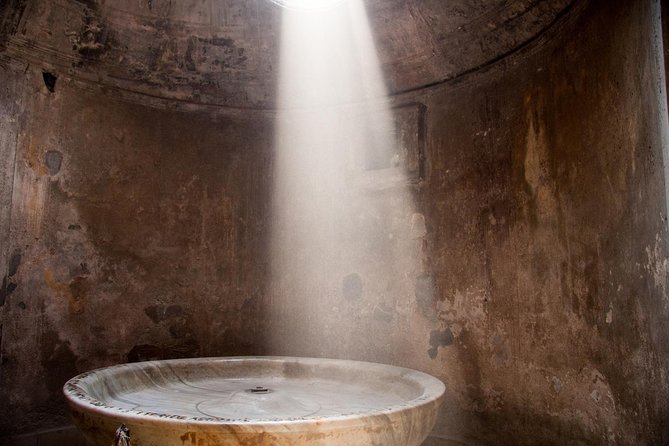
Next up: Tempio di Giove Capitolino, the Temple of Jupiter. It dominates the north side of the Forum, and what makes it extra interesting is the relationship between architecture and geography.
When the colony was founded (80 BC), the temple was renovated into a Capitolium-style complex with statues of Jupiter, Juno, and Minerva. The key detail is that these cult statues were placed on a high base so people could see them as they passed through the Forum square.
That means you’re not just looking at stone. You’re looking at how power and religion were designed to be seen.
And yes, you’ll also get that dramatic scene of Vesuvius rising behind the Forum. It’s one of those moments where your brain clicks: Pompeii isn’t only ruins; it’s a city designed to be framed by its environment.
Macellum and the mixed-purpose world of Pompeii
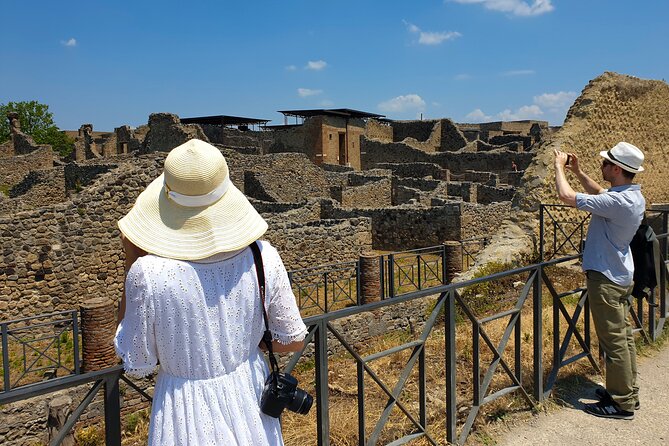
The Macellum is where the day-to-day reality gets even sharper. This marketplace structure isn’t just about shopping. It includes a layout that connects worship spaces with a commerce hub. You’ll hear how the building includes elevated areas for worship, niches that show copies of marble statues, and hints of an imperial cult presence.
The Macellum also fits the way Pompeii worked: public religion, status, and business were not separate worlds. They blended.
A good reason to take this stop with a guide: marketplaces are easy to gloss over when you’re tired. But explained properly, you start noticing how the structure channels movement and signals what kind of authority is operating here.
You can also read our reviews of more tours and experiences in Sorrento
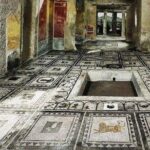
Via dell’Abbondanza: the main street vibe in a few steps
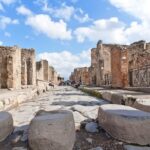
Then comes Via dell’Abbondanza, Pompeii’s ancient main street (also called the decumanus maximus). It ran east/west, linking the Forum area to the Porta Sarno.
This is your sensory break from the formal public buildings. You’re looking at a route that, in ancient times, would have been crowded with shops, workshops (officinae), snack bars, cafés, and restaurants. It’s noisy in your imagination now, not in real life.
The short visit still gives you something valuable: a sense of scale and direction. You start to understand where people would go after a meeting in the Forum—straight down the main drag toward daily life.
Stabian Baths: how Pompeii handled hot, cold, and social time
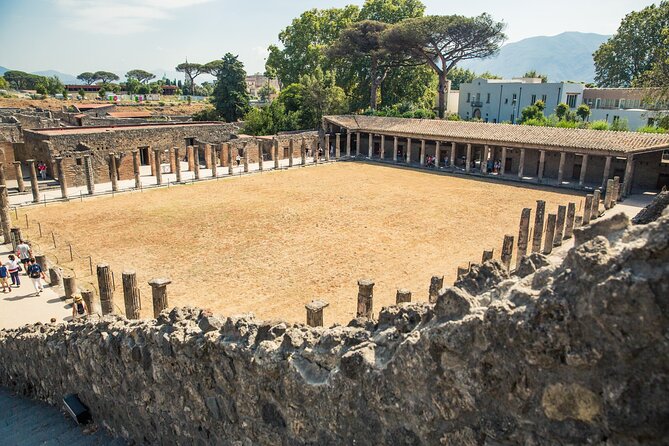
The Stabian Baths (Terme Stabiane) add a different side of Roman culture. These baths date to just after Pompeii’s veterans colony was founded. The site layout includes separate entrances for women and men, plus changing and bathing zones.
You’ll see the structure of rooms like the apodyterium (dressing room), and how it connects to different temperatures: tepidarium (medium), frigidarium (cold), and calidarium (hot).
Also, the baths were damaged during the earthquake of 62 AD, which gives you that sobering sense that destruction wasn’t one sudden event. Pompeii had survived shocks before the eruption sealed its fate.
Casa del Fauno: wealth, taste, and the Alexander Mosaic
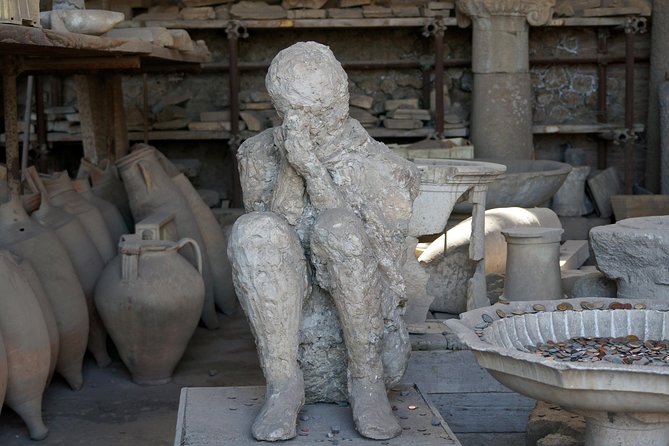
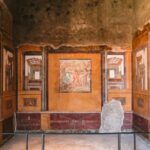
If you care about what everyday ruins can’t show, go straight to the Casa del Fauno (House of the Faun). This is one of Pompeii’s largest and most luxurious private residences, taking up an entire city block.
The house’s fame connects to a bronze dancing faun statue found in the main atrium, and—more importantly for many people—the Alexander Mosaic, depicting the battle between Alexander the Great and Darius III.
You’ll also hear the names and connections tied to ownership, including that it belonged to Quintus Poppaeus Sabinus of the Poppei family, relatives connected to Empress Poppea Sabina, Nero’s second wife. That helps the house feel anchored in real social networks, not just architecture.
Why this stop is worth your time: it shows you that Pompeii wasn’t only public life. There was private art, elite taste, and serious wealth—right alongside the streets.
Lupanar: a complicated stop, explained with context
The Lupanar (also known as Lupanare Grande) is one of Pompeii’s most famous—and most talked about—spaces. It was a brothel, and it’s especially known for its erotic wall paintings.
The tour description includes the Latin meaning of lupanar and even the type of workers: many were Greek and Oriental slaves. It also mentions the payment range in asses, with a comparison to the cost of wine.
This is where you’ll want a guide. Without context, the site can turn into shock value. With context, it becomes part of Pompeii’s social reality—how economics, power, and exploitation were built into city life.
Teatro Grande and Basilica: where culture and justice met
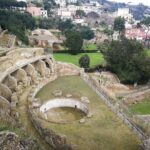
Next comes Teatro Grande (Large Theater). It was built on a hill slope and shaped to take advantage of a natural depression, with seating divided into five sectors. The theater’s role was cultural—tragedies of Greco-Roman tradition on the stage.
Then you move to the Basilica, a major Forum building with a massive space used for business and administration of justice. It was the most sumptuous building in the Forum area, and it gives you a strong sense of how Roman governance and commerce shared the same “room.”
Together, these stops round out the Pompeii picture. You go from civic power (Forum) to religion and marketplaces (temples and Macellum) to daily social life (street and baths) to private wealth (Casa del Fauno) and public performance and law (theater and basilica).
Mt. Vesuvius: drop-off height, uneven paths, and real crater drama
After Pompeii, you head to Vesuvius by private vehicle. You’ll be dropped off in the Vesuvius National Park area at about 1,000 m, and then you’ll move toward the crater edge at about 1,280 m.
Here’s what matters for planning your body: the path surface is described as uneven. That’s not a reason to skip it. It’s a reason to wear shoes with solid grip.
You’ll also get a front-row view from the crater edge with a panorama over the Gulf of Naples. The tour frames Vesuvius in its real scientific and historical context: the Roman cities of Pompeii and Herculaneum were destroyed in 79 AD, and there’s mention of monitoring activity as scientists study the magma system.
Even if you know the basics already, seeing the crater edge up close makes the story feel less like a textbook and more like a physical place.
Time reality check: you’ll want to pace the crater walk
Vesuvius time is limited on this format, so go into it with a strategy:
- Move steady on the climb.
- Spend your crater time looking first, then photos.
- If you’re slower, make that clear early so the driver and guide can pace accordingly.
There’s a real-world lesson from scheduling: the most common pitfall isn’t the volcano. It’s how people manage time when they’re moving between parking, trail, and viewpoint.
Driver + guide quality: what makes or breaks the day
The structure is strong, but the experience lives or dies on delivery. In this kind of tour, Pompeii guidance matters most, because the ruins are complex and easy to misread if you’re just scanning.
The good news is that the guide experience here tends to be very personal. People often highlight names like Vincenzo and Paola for friendly, detailed explanations that make Pompeii feel alive. On the driving side, Fabio is described as professional and smooth, with the helpful added touch of local information during transit.
One caution: the driver side controls the time buffer. If you’re planning to take your time on Vesuvius, watch for a too-rushed handoff between parking and the trail. I’d rather you say it up front than hold your breath and hope.
Price and value: is $635.61 per person worth it?
At $635.61 per person for an approximately 8-hour private tour, this is not a budget choice. But it’s also not just a taxi to ruins.
What you’re paying for:
- Private transportation with an English-speaking driver
- Private guide for Pompeii
- Priority access at Pompeii and priority access at Vesuvius
- Entrance tickets included for Pompeii and Vesuvius
- Hotel pickup and drop-off in the Sorrento area
If you add up the tickets plus the hassle of timed entry and the value of someone walking you through key structures (Forum, temples, baths, houses), the pricing starts to make more sense—especially for couples and small groups where private logistics can save real time.
If you’re traveling solo on a tight budget, a cheaper group tour or independent entry might be tempting. But if your top goal is maximum sight value with less stress, the private “skip-the-line” focus is the point.
Also, the tour is commonly booked around 65 days in advance. If you want prime timing, book early and lock in your pickup.
Food, breaks, and what to pack for a crater day
Food and drinks aren’t included. So plan like an adult: bring water, and consider a snack plan so you’re not stuck hungry while everyone else pretends they’re fine.
For packing, aim for “uneven trail plus ruins” basics:
- Comfortable shoes with grip for the uneven path at Vesuvius
- A light layer, because the volcano can feel cooler than the coast
- Sunscreen and a hat for Pompeii’s open areas
One practical caution from real-day experience: the base area around the hike can have limited restroom options, and one stop is described as having a very poor restroom situation. So if you care about comfort, use facilities before you start the uphill rhythm.
Who this tour suits best (and who might prefer something else)
This is a great fit if:
- You want Pompeii + Vesuvius in one day without fighting lines
- You prefer a private guide over “read-this-sign-yourself” tourism
- Your priority is context: why each structure mattered
It may be less ideal if:
- You struggle with uneven walking or steep climbs
- You want a slow museum pace with lots of downtime
- You’re extremely sensitive to time pressure around the crater viewpoints
If you’re traveling with older adults or anyone with mobility limits, tell your guide/driver early so the pacing matches your group.
Should you book this private Pompeii and Vesuvius tour?
I’d book it if you’re the kind of traveler who wants the big highlights with minimal friction: priority entry, a guided Pompeii walk that connects the dots, and a crater-edge payoff on Vesuvius.
I wouldn’t book it if you’re aiming for a lazy day with long breaks and lots of “optional” time. This tour works best when you move with the plan and save energy for the view at the top.
FAQ
How long is the Pompeii and Mount Vesuvius private tour from Sorrento?
The tour runs for about 8 hours (approx.).
Is hotel pickup and drop-off included?
Yes. The tour offers door-to-door pickup from hotels in the Sorrento area, and it returns you by private vehicle. The activity also ends back at the meeting point.
Do I need tickets for Pompeii and Vesuvius?
No. Admission tickets for the Pompeii stops are included, and Mt. Vesuvius entrance ticket is included as well.
Is this a private tour or shared group?
It’s a private tour/activity. Only your group participates.
Is skip-the-line or priority access included?
Yes. You get priority access to the Pompeii Archaeological Site and priority access to Mt. Vesuvius.
What language options are available?
The tour is offered in English, and the Pompeii portion operates in the selected language. The driver speaks English or Italian.
How much time do you spend at Pompeii?
You spend about 2 hours at the Archaeological Park of Pompeii, with additional short scheduled stops during the guided walk.
How much time do you spend at Mount Vesuvius?
The plan includes about 1 hour at the park drop-off area around 1,000 m, plus about 30 minutes to reach the crater edge at 1,280 m for the panorama.
What isn’t included in the price?
Food and drinks are not included.
Where does the tour start?
The meeting point is Piazza Torquato Tasso, 16, 80067 Sorrento NA, Italy.
You Might Also Enjoy



More Private Tours in Sorrento



More Tours in Sorrento





More Tour Reviews in Sorrento
- Sorrento Farm and Food Experience including Olive Oil, Limoncello, Wine tasting
★ 5.0 · 2,524 reviews