REVIEW · POMPEII
Pompeii and Herculaneum small group tour – skip the line
Book on Viator →Operated by PompeiIn · Bookable on Viator
Two cities, one unforgettable Roman day. This small-group Pompeii and Herculaneum tour combines skip-the-line access with a live guide, so you get Roman daily life made clear as you move from forums to houses and bath complexes. I like how the pacing keeps you seeing the big anchors of both UNESCO sites without turning it into a checklist.
The main catch is the body part: expect lots of walking on uneven ground, and a stroller isn’t a smooth solution. If you’re traveling with limited mobility, you’ll want to plan for rough surfaces and stairs.
In This Review
- Key takeaways before you go
- Skip-the-line access that actually matters
- Pompeii start: meeting at Porta Marina Superiore and getting your bearings
- The first Pompeii stops: Basilica, the Forum, and the city’s daily rhythm
- Casa del Menandro and the best kind of house tour: design you can spot
- Terme del Foro and the Roman obsession with baths
- Casa del Fauno, Teatro Piccolo, and Teatro Grande: culture beyond the street
- Pompeii to Herculaneum: the train transfer that keeps the day on track
- Lunch time: quick break energy management
- Herculaneum starts: houses, courtyards, and what preservation looks like up close
- Partem Domus lignea and the wooden detail you can’t ignore
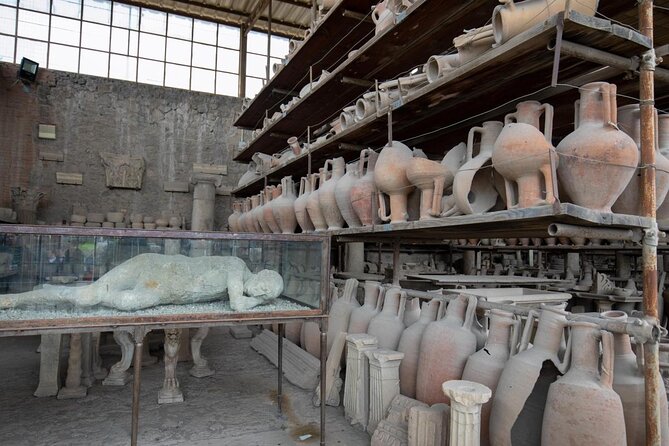
- House of the Skeleton: the human cost inside an archaeological story
- Central Thermae: separate entrances for men and women
- Casa del Salone Nero and carbonized doorposts: a rare snapshot
- Casa Sannitica to Casa del Bel Cortile: layout tells the culture
- House of the Grand Portal: charred remains and a final Herculaneum impression
- Price and value: $119.85 for two sites, two guides worth of time
- Who this tour suits best
- What to pack and how to survive the walking
- Should you book this Pompeii and Herculaneum small-group tour?
- FAQ
- What’s included in the Pompeii and Herculaneum tour price?
- How long is the tour?
- Where do we meet in Pompeii, and where does the tour end?
- Is lunch included?
- How big is the group?
- What’s the cancellation policy?
Key takeaways before you go
- Skip-the-line entry in Pompeii and Herculaneum keeps your time focused on the ruins
- Max 20 people means your guide can actually answer questions as you walk
- Two UNESCO sites in one day gives you contrast between Pompeii and Herculaneum
- Train transfer included (one-way via Circumvesuviana) saves you from sorting transit mid-trip
- Short stop times mean breadth over deep lounging in one single area
Skip-the-line access that actually matters
Pompeii and Herculaneum are popular. That’s why I like tours that handle the lines for you. With this one, you get skip-the-line tickets in both places, plus a mobile ticket, which helps you get moving fast at each entrance.
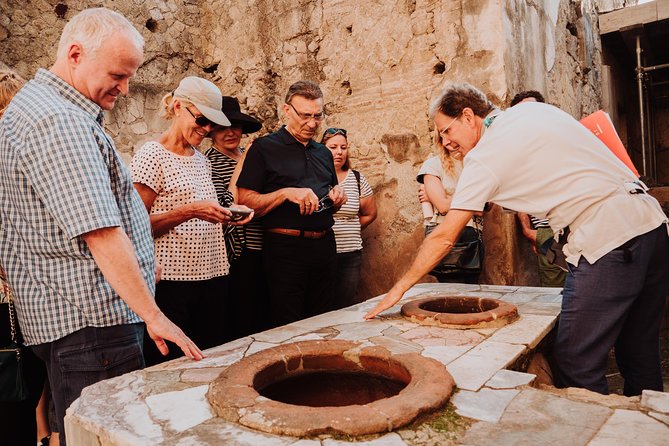
The other value move is the group size. Maximum 20 travelers is small enough for a real conversation on the move. In practice, that means you’re not just hearing facts from the front—you can ask what you’re looking at and get quick answers before you walk past it.
You can also read our reviews of more tours and experiences in Pompeii
Pompeii start: meeting at Porta Marina Superiore and getting your bearings
You start in Pompeii at Piazza Esedra, 4, and your guide meets you at the main entrance of the Pompeii Archaeological Park, at Porta Marina Superiore. The guide holds a sign with the company name Askos Tours, which is a nice detail if you like clear wayfinding.
From there, the tour hits the highlights in an efficient order. Many stops are about 10 minutes, with Pompeii’s theater time slightly longer. That short timing isn’t a bad thing. It keeps energy up, and it lets you cover the sites’ strongest clusters in one session.
The first Pompeii stops: Basilica, the Forum, and the city’s daily rhythm
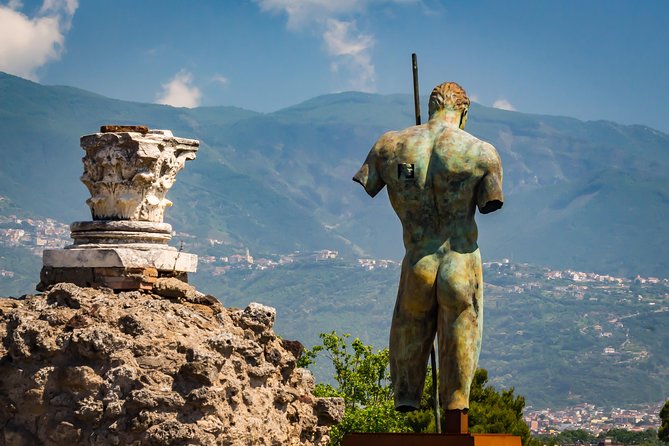
Early on, you move through spaces that explain what life looked like on the street level. The Basilica stop is worth paying attention to because it wasn’t just a building. It was an open portico area that gave shelter to merchants and other activities, which means it helps you picture commerce and foot traffic—not just stone walls.
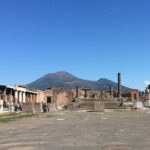
Next comes the Foro de Pompeya, the ancient main square. When you stand in a forum, you’re seeing the social engine of a Roman town: gathering, announcements, and constant movement. Even with a brief stop, the guide’s context is what turns it from ruins into a working scene.
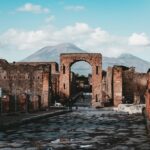
Then you walk the main street of Pompeii. That kind of linear movement is one of the easiest ways to understand the layout. You’re not stuck staring at one façade; you’re learning the city by walking its connective tissue.
Casa del Menandro and the best kind of house tour: design you can spot
If you want proof that Pompeii wasn’t only about temples and big monuments, the private homes do the job. Casa del Menandro is one of the richest houses in Pompeii for its architecture, decoration, and contents. The value here is that you’re not only told it was impressive. You see what made it feel high-status in the rooms and display areas.
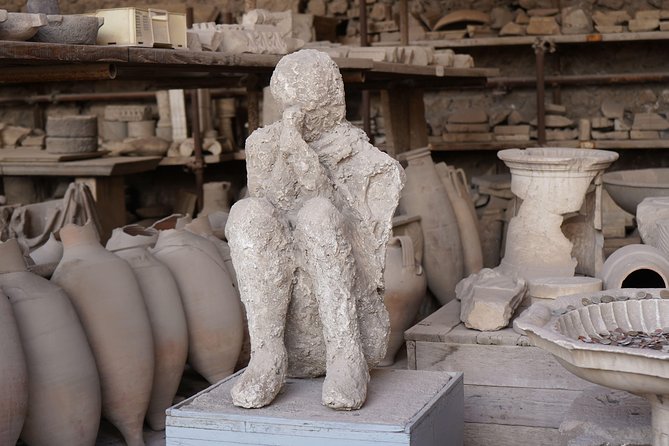
You’ll also get more texture from the next cluster around food, storage, and public services. Granai del Foro covers the granary area, where you can see marble tables and baths for fountains that adorned entrances of houses. It also includes casts of victims of the eruption, and the stop notes a dog and a tree. That mix is heavy, but it makes the site emotionally real while still grounded in what’s actually preserved.
Terme del Foro and the Roman obsession with baths
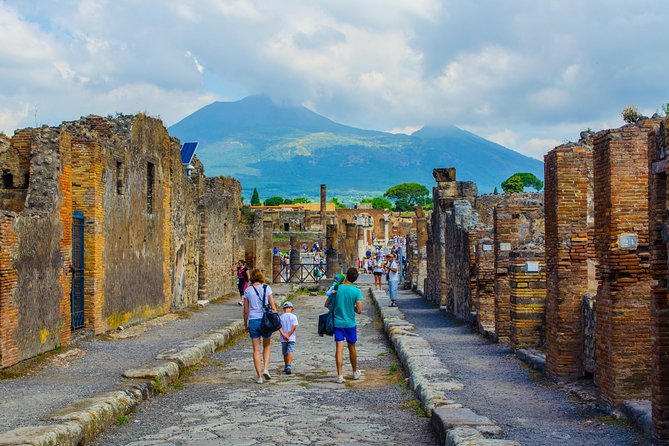
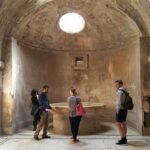
Roman baths show up in both Pompeii and Herculaneum, and this tour places you inside the right kind of setting. Terme del Foro occupies a vast area between major street intersections. It’s described as the oldest thermal complex in the city, and that alone gives it weight.
For me, bath complexes are one of the best ways to understand daily life because they weren’t only about cleanliness. They were a social hub. You’re seeing space designed for repeated routine, with architecture meant to move people through different zones.
And then you pass the most famous brothel in Pompeii. It’s another dose of the same point: people lived whole lives here—work, leisure, commerce, relationships—inside a city that had everything.

Casa del Fauno, Teatro Piccolo, and Teatro Grande: culture beyond the street
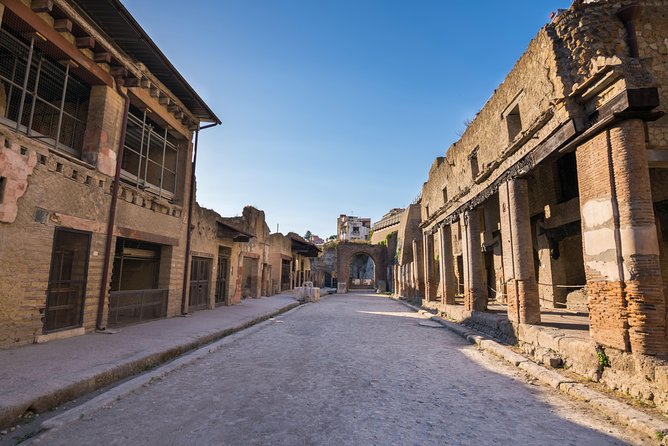
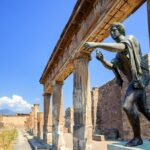
Next you hit more elite housing and then culture. Casa del Fauno is described as one of the largest and most impressive private residences in Pompeii. That matters because it helps you compare scale and taste.
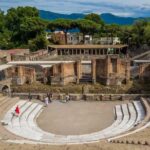
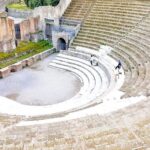
Then you shift to theater. You’ll get a look at Teatro Piccolo and later visit Teatro Grande, the most important theater in Pompeii. A theater stop is more than seating rows. It’s how you picture entertainment as scheduled public life. Even if your time inside is brief, you’ll walk away with a better sense of how much space Romans gave to public events.
Pompeii to Herculaneum: the train transfer that keeps the day on track
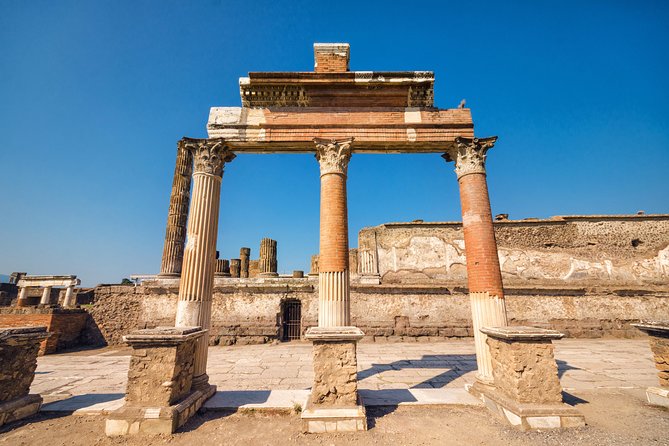
After Pompeii, you transfer by train to Herculaneum. The trip is listed as about 30 minutes by train plus roughly 10 minutes of walking to reach the meeting place inside the Herculaneum ruins.
The tour notes that the meeting place is the Ticket Office of the Herculaneum ruins. It also gives practical options to reach that area:
- By car via via Pignalver, with not guarded parking very close (if you’re driving)
- By train via Corso Resina 1, with the Circumvesuviana station about a 10-minute walk away
One practical note from recent experience reports: the Circumvesuviana station at Ercolano has been under renovation at times, so follow the posted signs instead of relying on memory. And yes, strikes or disruptions can slow things down, so I’d keep a little mental buffer for the return leg.
Lunch time: quick break energy management
The schedule includes a quick lunch break if required. Meals aren’t included, but the timing is built in so you’re not forced to eat standing over a map.
This is where I recommend a simple strategy: fill your water bottle early and plan to use toilets before you settle into the next chunk. Heat and long walking can sneak up on you fast.
Herculaneum starts: houses, courtyards, and what preservation looks like up close
Herculaneum feels different because the tour moves you through many houses with named features. Casa dei Cervi is one of the first stops, named from marble statues of stags/deer found in the peristyle. That naming style is useful: it tells you what to look for when you’re trying to orient yourself.
Then you move to La Terrazza di M. Nonio Balbo, College of the Augustales, and Casa del Rilievo di Telefo. Some of these stops are described with recurring language about marble statues of deer in the peristyle. Even so, the takeaway is clear: these houses had decorative details that visitors and scholars could identify, and you’re walking through spaces that were made to show off status.
Partem Domus lignea and the wooden detail you can’t ignore
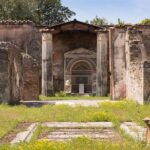
One stop you’ll likely remember is Partem Domus lignea – Casa del Tramezzo di Legno. It’s described as important for an elegant wooden partition that remained. That’s a powerful contrast to the stone-only feel you might expect from ruins.
When you see mention of surviving wooden elements, you get a reminder that Pompeii and Herculaneum aren’t just about what fell. They’re about what stayed long enough to be found.
House of the Skeleton: the human cost inside an archaeological story
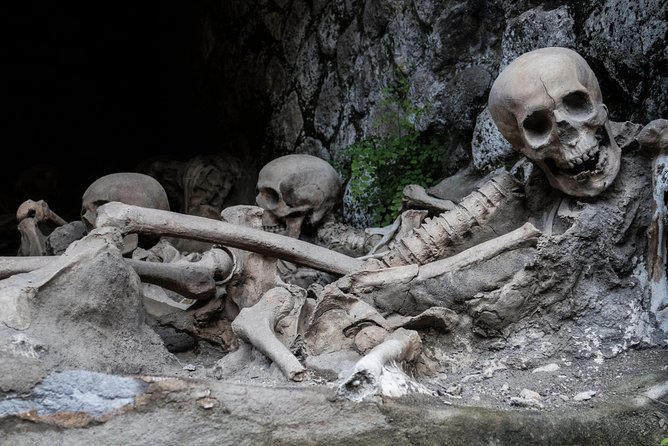
The House of the Skeleton is named from human remains discovered in a second-floor room in 1831. This is one of those stops where the guide’s framing matters. It’s not just a spooky label—it’s a reminder that these were living people caught in a catastrophic event.
If you feel your attention tightening during this stop, that’s normal. I’d use it as a moment to slow down, take one steady look, and let the context land before moving on.
Central Thermae: separate entrances for men and women
Central Thermae gives you the most structured example of how the bath system worked. The tour notes these baths were built around the beginning of the 1st century AD and included separate entrances for men’s and women’s baths.
That detail is the kind that makes the site feel like a real institution, not just a pretty ruin. You can picture routines, rules, and daily patterns—things that repeated often enough for the architecture to reflect it.
Casa del Salone Nero and carbonized doorposts: a rare snapshot
Casa del Salone Nero, the House of the Black Hall, is described as one of Herculaneum’s more luxurious mansions. The stop points to a monumental entrance that still retains carbonised remains of doorposts and lintel.
That kind of preservation detail is exactly why Herculaneum is such a strong match for Pompeii on the same day. You’re not only seeing rooms. You’re seeing traces of how the houses functioned at the entry point—where movement began.
Casa Sannitica to Casa del Bel Cortile: layout tells the culture
Casa Sannitica is described as typical of the Samnites, with a splendid atrium skirted by a gallery with Ionic columns, plus fresco decorations. Casa del Bel Cortile is also distinctive: it has a courtyard with a stairway and a stone balcony instead of an atrium.
These layout differences help you read the site as a set of living designs. When you understand the role of the atrium or courtyard, the rest of the rooms make more sense in your head.
House of the Grand Portal: charred remains and a final Herculaneum impression
The last Herculaneum cluster includes the House of the Grand Portal, noted as a beautiful domus with collonnati, frescoes, and everywhere-at-Herculaneum charred remains of wooden parts.
Then your tour ends at the Archaeological Park of Herculaneum, Corso Resina, 187 in Ercolano.
Price and value: $119.85 for two sites, two guides worth of time
At $119.85 per person, this tour isn’t the cheapest option. But it also isn’t just a ticket. It’s guided time through two UNESCO sites, plus skip-the-line access in both places, plus one-way Circumvesuviana train tickets from Pompeii to Herculaneum.
Your money is buying three big things:
- Less wasted time at entrances
- Less stress figuring out the move between sites
- A guide to connect the dots between streets, houses, baths, and public buildings
You pay extra for meals and your transport to and from Pompeii at the start, plus from Herculaneum at the end. But if you’d otherwise spend time researching transit and standing in lines, the price starts to look like good sense.
Who this tour suits best
This is a strong fit if you:
- Want Pompeii and Herculaneum in one day
- Like walking tours with clear explanations
- Value small groups and time-saving skip-the-line entry
It’s less ideal if you:
- Need a lot of step-free surfaces
- Want stroller-friendly routes (the day involves uneven walking)
- Prefer long, slow museum-style pacing over a guided hit of major sites
What to pack and how to survive the walking
Bring water. The tour is long enough that you’ll feel it, and good footwear matters because ruin paths can be uneven. Use the toilet before you start when you can.
If you want one extra practical move: during the Pompeii walk, there’s an opportunity to refill from an ancient Roman water spring. So plan your bottle early and you won’t be hunting for water at the worst moment.
Should you book this Pompeii and Herculaneum small-group tour?
Yes—if you want a guided, efficient day with skip-the-line entry and a real small-group feel. The big win is simple: you’re covering the major anchors of Pompeii and Herculaneum with a guide who can keep the story straight as you move.
But book with eyes open. It’s a long day with uneven walking, and it’s not built for strollers or limited mobility. If you’re comfortable with active touring, this is a high-value way to see both UNESCO sites without losing hours to queues.
FAQ
What’s included in the Pompeii and Herculaneum tour price?
The tour includes guided time in both ruins, skip-the-line tickets in Pompeii and Herculaneum, and one-way Circumvesuviana train tickets from Pompeii to Herculaneum.
How long is the tour?
The duration is listed at about 5 hours 30 minutes, with a train transfer to Herculaneum (about 30 minutes by train plus around 10 minutes of walking) included in the schedule.
Where do we meet in Pompeii, and where does the tour end?
Meet at Piazza Esedra, 4, 80045 Pompei NA, Italy. The tour ends at the Archaeological Park of Herculaneum, Corso Resina, 187, 80056 Ercolano NA, Italy.
Is lunch included?
Meals are not included. The schedule does include a quick lunch break if required, but you’ll need to cover your own food.
How big is the group?
The tour has a maximum of 20 travelers.
What’s the cancellation policy?
Free cancellation is available up to 24 hours in advance of the experience start time for a full refund. If you cancel less than 24 hours before, the amount paid is not refunded.