REVIEW · SORRENTO
Skip the line Pompeii Guided Tour
Book on Viator →Operated by Buyourtour di Amo Italy Travel · Bookable on Viator
Pompeii in four focused hours. This guided tour lines up the key sights you want to see fast—Forum buildings, baths, the brothel, and the theatre—while an English guide keeps the story clear. You also get headsets, which matters when crowds get loud and you want to follow every stop without craning your neck.
I like the practical pacing. You spend about 2 hours inside the main archaeological park, then move on to short, targeted looks at standout places like the Temple of Jupiter and Via dell’Abbondanza. One drawback to keep in mind: this is a group plan, and while it’s usually smooth, there was at least one documented case where transportation changed on the fly, which can cut into time and cause a bit of confusion.
In This Review
- Key things that make this Pompeii tour work
- Price and what you really get for $96.38
- Meeting up in Sorrento or Naples (and why location matters)
- The route: a fast-hit Pompeii that still feels guided
- Archaeological Park of Pompeii: your 2-hour orientation
- The Forum (Foro di Pompeya): where power and daily life meet
- Temple of Jupiter: the dramatic view with Vesuvius behind it
- Macellum and Via dell’Abbondanza: markets and movement
- Stabian Baths: how the Romans heated up
- The brothel and Teatro Grande: the unusual and the impressive
- Who this Pompeii tour suits best
- The guide matters: why this tour wins when the narration clicks
- Practical tips so you get the most from the day
- Should you book Skip-the-Line Pompeii Guided Tour?
- FAQ
- How long is the Pompeii guided tour?
- Is the tour offered in English?
- What does the price include?
- Is lunch included?
- How many hours are spent inside Pompeii?
- What sites are included in the itinerary?
- Do I get a mobile ticket?
- What group size should I expect?
- Is weather important for this experience?
- Can most people participate?
Key things that make this Pompeii tour work
- Headsets included so you can actually hear the guide during busy sections of the site
- Admission to Pompeii is included, meaning one less step to manage at the entrance
- A tight route that hits the Forum, baths, brothel, and Teatro Grande without letting you get lost
- Transfers from Sorrento or Naples reduce the hassle of figuring out transport on your own
- Maximum group size of 100 keeps it more manageable than the mega-tours
Price and what you really get for $96.38
At $96.38 per person for about 4 hours, this tour is aimed at one thing: compressing a lot of Pompeii into a half-day that still feels guided. You’re not just buying a ticket to wander. Your price bundles the big three pieces that are hard to recreate on your own in the same amount of time: a guide (authorized English guide for 2 hours), entry to Pompeii, and pickup/transfer from Sorrento or Naples.
There’s also a small-but-important detail: you’ll have a mobile ticket. That saves time at check-in and reduces paper fuss when you’re already juggling a day trip.
Is it expensive? For Pompeii, it’s in the “pay for convenience” zone. If you’re short on time or you don’t want to risk missing an entry window, paying for the package usually makes the day feel easier.
You can also read our reviews of more guided tours in Sorrento

Meeting up in Sorrento or Naples (and why location matters)
This is a pickup-and-go style experience. You’ll meet at a designated meeting point in Sorrento or Naples, and the tour includes a 30-seater bus.
Why I think that detail matters: Pompeii is not a quick stop. Getting the transport right is half the battle on a day trip. If you want an easy workflow—meet, ride, tour, ride back—this format fits.
One thing to watch, based on real feedback: occasionally, transportation plans can shift if something breaks. In at least one case, guests were moved from the bus to a private car substitution, and that led to confusion and lost time. That’s not the norm you should plan around, but it’s smart to keep it in your mental checklist: if you’re the type who hates schedule changes, build in buffer time on your Pompeii day.
The route: a fast-hit Pompeii that still feels guided
This tour is structured as a sequence of high-value stops rather than a slow museum-style walk. The times are short after the main park segment, so you’ll move with purpose.
That works best if you want to understand Pompeii’s layout and social life without spending the entire day walking every alley. If you want to read every wall inscription, take long detours, and linger in buildings for ages, you’ll likely wish you had more hours on your own.
Here’s how the day unfolds.
Archaeological Park of Pompeii: your 2-hour orientation
Your first stop is the Archaeological Park of Pompeii, with about 2 hours and admission included. This is where you get your bearings. Pompeii isn’t small, and even seasoned ruins fans can feel overwhelmed if they arrive without a plan.
The big advantage of starting here: you begin with a guide-led walk through excavated streets and houses, and you can start placing what you see into context. You’ll learn that the city was buried under meters of ash and pumice after the eruption of Mount Vesuvius in 79 AD, and that so much survives because of how the eruption preserved parts of daily life.
What to expect on the ground: you’ll be walking through outdoor archaeological areas with uneven surfaces and crowds. Wear comfortable shoes. Bring water. And if you’re someone who likes photos, you’ll still get them—just know the guide will keep the group moving.
The Forum (Foro di Pompeya): where power and daily life meet
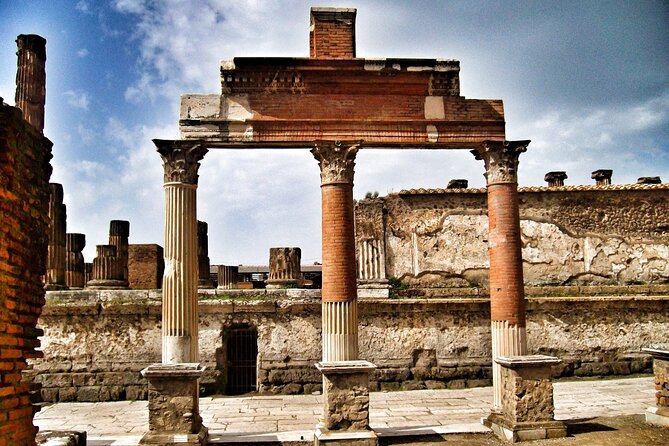
Next comes a quick stop at the Civil Forum, about 10 minutes. In Pompeii, the Forum is the central stage for public life: administration, justice, business, commerce, and civic worship.
A short visit here can feel rushed if you’re the type who wants to study every corner, but it’s also a smart use of time. The Forum is one of the places where Pompeii’s social system becomes obvious. You go from houses and streets into the reality of how the city ran.
You can also read our reviews of more tours and experiences in Sorrento


Temple of Jupiter: the dramatic view with Vesuvius behind it
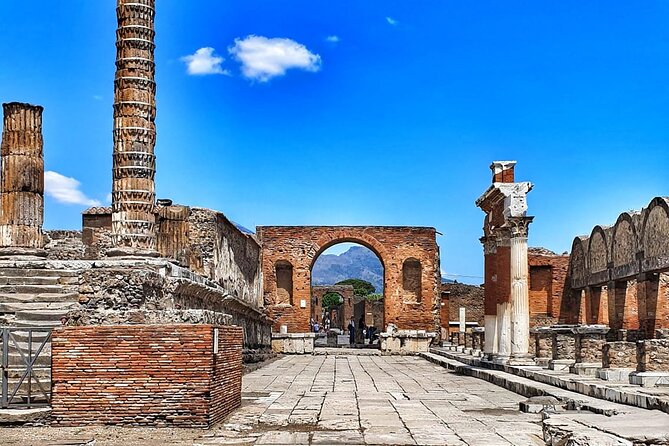
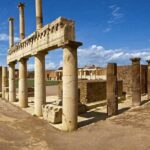
The Temple of Jupiter Capitoline takes about 15 minutes, also with ticket access included. The temple sits on the northern side of the Forum, and what makes it special is the alignment of architecture and landscape: you get the sense of how commanding that space was, with Vesuvius rising behind.
This stop is less about lingering and more about understanding why the temple was such a statement. After Pompeii became a colony in 80 BC, the site underwent major renovation, taking on a Roman-style Capitolium role. You’ll hear about the cult statues of Jupiter, Juno, and Minerva placed on a high base to be seen by people moving through the Forum square.
Even in a time-crunched tour, this is the kind of stop that makes Pompeii feel bigger than it looks on a map.
Macellum and Via dell’Abbondanza: markets and movement
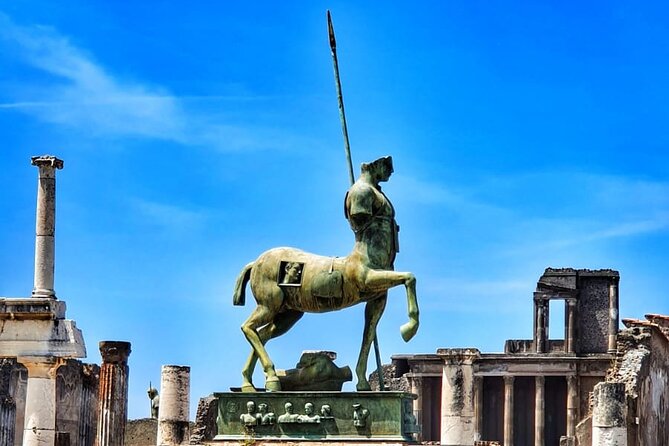
You’ll spend 15 minutes at the Macellum, Pompeii’s market complex. It was a food marketplace where people bought what they needed to live day to day. The porticoes and decorative wall scenes (including everyday selling scenes and mythological subjects) give you a peek at how Roman life mixed commerce with spectacle.
Then you’ll move to Via dell’Abbondanza, about 10 minutes. This is one of Pompeii’s main streets, connecting the Forum to the Amphitheatre. Why that matters: walking a major route helps you understand flow—where crowds likely moved, where activities concentrated, and how people got from civic life to entertainment.
If you like the “how people actually lived” angle, these are solid stops. If you only care about the biggest headline ruins, you might wish the tour spent longer at each. But as a fast guided sampler, it makes sense.
Stabian Baths: how the Romans heated up
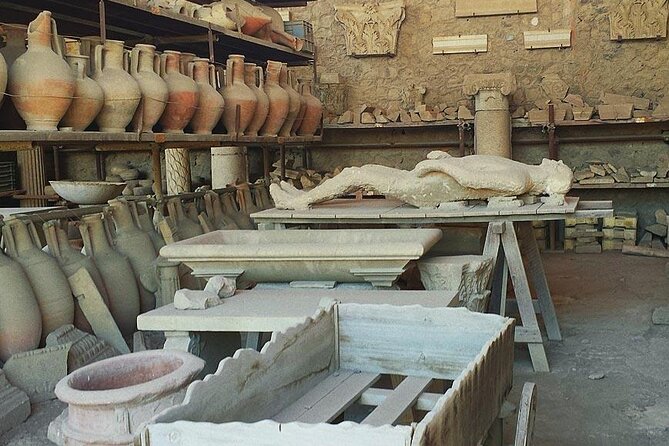
The Stabian Baths (Terme Stabiane) are allotted 15 minutes, and they’re a standout for me because they’re functional. This isn’t just a pretty ruin. It’s a window into routine.
You’ll hear that the baths were built in phases, with early construction dating back to the 4th century BC and later expansions. The layout is a practical lesson in Roman bathing sequence: entrance leads to a courtyard, and then you move through zones that include dressing and cold, warm, and hot bathing areas.
Even the heating system is worth noting. Hot air circulated through walls and double floors, with heat coming from furnaces and braziers. The men’s and women’s quarters were organized similarly, though the women’s areas were smaller and less decorated.
In 15 minutes, you won’t study every room like a scholar, but you’ll walk away understanding the basic logic of the building. That helps when you look at other bath sites elsewhere in the Roman world.
The brothel and Teatro Grande: the unusual and the impressive
Two stops round out the experience.
First is the brothel of Pompeii, about 15 minutes. This building is famous for its erotic paintings and its layout: rooms across two floors, with built-in beds in the lower rooms. The building’s name comes from Lupa, a Latin word tied to prostitution. You may find this stop either fascinating or uncomfortable, depending on your comfort level. Either way, it’s one of the clearest reminders that Pompeii wasn’t only temples and wealthy villas—it included everyday realities.
Then you’ll finish at Teatro Grande (Large Theatre), about 15 minutes. This theatre was built around the mid-2nd century BC and restored in Roman style. It hosted comedies and tragedies of Greek Roman tradition. One particularly striking point is that it was among the public buildings that were freed from eruption deposits early, which is part of why it survives to be staged as a major stop.
Who this Pompeii tour suits best
This is a strong fit if you:
- Want a guided “greatest hits” route and don’t want to plan transport on your own
- Are time-limited and want Pompeii in about 4 hours
- Like hearing the story and context, not just staring at stones
- Have kids or a stroller and appreciate that the group moves with support (there was a review praising how the operator helped with a pram during the walk)
It’s not the best fit if you:
- Want to wander freely for hours at your own pace
- Hate any chance of schedule changes due to transportation issues
- Prefer avoiding gift stops or shopping interruptions (in one negative experience, a gift shop stop ate time)
The guide matters: why this tour wins when the narration clicks
The value of this tour rises or falls with the guide. That’s not just “nice to have” for ruins. Pompeii is a complex site, and having a guide who can explain what you’re looking at turns the whole experience from photos into understanding.
Real examples from the feedback include guides such as Gino, praised for being very informative and for delivering an excellent overall tour. I also saw mention of an operator named Giovanna in relation to helping with family logistics. When a guide is fluent, confident, and quick on their feet, it helps the group keep moving and makes the short stops feel meaningful instead of rushed.
Practical tips so you get the most from the day
Pompeii is outdoors, and you’ll be walking between sites. A few things make this easier:
- Wear comfortable shoes with grip (stones and slopes can surprise you)
- Use your time early in the day if possible, because Pompeii can get hot fast
- Don’t expect long rest breaks between stops; the tour works as a sequence
- Bring water and a hat, then rely on the guide for the route and the story
If you’re sensitive to pace, tell yourself this is a “taste” tour. It’s designed to cover major places in a half-day.
Should you book Skip-the-Line Pompeii Guided Tour?
If you want the best chance of enjoying Pompeii without stress, I think this is a smart choice. You’re paying for a guided route, admission included, and round-trip transfers from Sorrento or Naples. The headsets are a practical win, especially when the crowd noise makes it hard to hear.
I would hesitate only if you’re very schedule-sensitive—because group transportation can occasionally change—and if you strongly dislike shopping detours or losing time. But for most first-timers who want structure and context, this kind of 4-hour format is a good balance between seeing a lot and still coming away with a clear understanding of what mattered.
If your Pompeii day is your one chance to get it right, book this. Just go in knowing it’s a guided sampler, not a slow, self-paced marathon.
FAQ
How long is the Pompeii guided tour?
It runs for about 4 hours.
Is the tour offered in English?
Yes. It includes an authorized English-speaking guide.
What does the price include?
The package includes pickup at the meeting point in Sorrento or Naples, a 30-seater bus, an authorized English-speaking guide for 2 hours, headsets, and the entrance ticket to Pompeii.
Is lunch included?
No, lunch is not included.
How many hours are spent inside Pompeii?
About 2 hours are allocated for the Archaeological Park of Pompeii stop, with additional shorter guided stops at specific sites.
What sites are included in the itinerary?
You’ll stop at the Archaeological Park of Pompeii, the Civil Forum (Foro), the Temple of Jupiter Capitoline, the Macellum, Via dell’Abbondanza, the Stabian Baths, the brothel of Pompeii, and Teatro Grande.
Do I get a mobile ticket?
Yes. A mobile ticket is included.
What group size should I expect?
The experience has a maximum of 100 travelers.
Is weather important for this experience?
Yes. The tour requires good weather. If it’s canceled due to poor weather, you’ll be offered a different date or a full refund.
Can most people participate?
The tour notes that most travelers can participate.
You Might Also Enjoy




More Guided Tours in Sorrento


More Tours in Sorrento





More Tour Reviews in Sorrento
- Sorrento Farm and Food Experience including Olive Oil, Limoncello, Wine tasting
★ 5.0 · 2,524 reviews