REVIEW · POMPEII
Pompeii Tour & Admission included in a Small Group
Book on Viator →Operated by Grand Tour Experience · Bookable on Viator
Pompeii can overwhelm you fast. This small-group tour keeps it focused and human, starting at the Porta Marina entrance with Vesuvius in view and moving through major streets, forums, temples, and baths. I like that Pompeii admission is included (so you don’t waste time sorting tickets) and that you get an expert, English-speaking guide with a headset when it gets busy. One thing to plan for: there’s real walking on uneven ground, so bring shoes you trust and expect some curbs and step-ups.
The itinerary hits the city’s big story in about two hours, then leaves you with names and context so you can wander with confidence afterward. The group limit is listed as up to 15, and that’s the sweet spot for hearing explanations without constantly stopping.
In This Review
- Key things I’d watch for before you go
- What this Pompeii tour does especially well
- Price and what you really get for $66.01
- Meeting at Villa of the Mysteries and getting your bearings
- Stop 1: Archaeological Park of Pompeii (the core “story” stop)
- What you’ll see here
- The main drawback to consider
- Stop 2: Tempio di Venere (Temple of Venus)
- Stop 3: Basilica (center of business and justice)
- Stop 4: Sanctuary of Apollo
- Stop 5: Forum – Main Square (Pompeii’s daily-life center)
- Stop 6: Temple of Jupiter and the Vesuvius view
- Stop 7: Macellum and the plaster casts
- Stop 8: Terme del Foro (Forum Baths)
- Stop 9: Thermopolium of Vetuzio Placido (an ancient diner)
- Stop 10: Casa del Fauno and House of the Vettii (seasonal surprises)
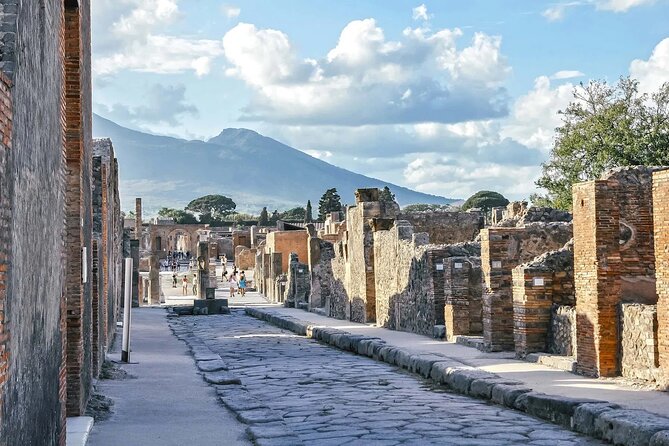
- Stop 11: Via dell’Abbondanza (the main street)
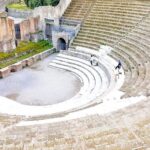
- Stop 12: Teatro Grande (Greco-Roman performance culture)
- Guide quality: why it can make or break Pompeii
- What to pack and how to make this tour easier
- Should you book this Pompeii Tour & Admission in a Small Group?
- FAQ
- How long is the Pompeii Tour & Admission for?
- What is included in the ticket price?
- Does the tour start and end at the same place?
- Is the tour in English?
- What group size is this tour?
- Is bottled water included?
- What should I expect for walking conditions?
- Can I get a full refund if I cancel?
- Are all the houses on the route guaranteed to be open?
Key things I’d watch for before you go
- Headsets for crowded moments so you can actually hear the guide through the noise and foot traffic
- Admission included plus time on the ground inside the Archaeological Park, not outside it
- Porta Marina start gives you a clear sense of where the city began and where the public heart lay
- Forum area concentration including Basilica, baths, and the square where civic life happened
- Vesuvius-linked viewpoint moments that make the eruption story easier to understand
- Seasonal site risk for certain houses, since some areas open and close by season
What this Pompeii tour does especially well
If you’ve only got a short window in Pompeii, you need two things: the right order of sights and enough explanation to make them click. This tour is built around both.
You start at the Villa of the Mysteries meeting point (near public transportation), then move into the Archaeological Park through the main entrance at Porta Marina. From there, the guide ties the physical layout of Pompeii to what happened in 79 AD: where people walked, where they traded, where they worshiped, and where public decisions played out.
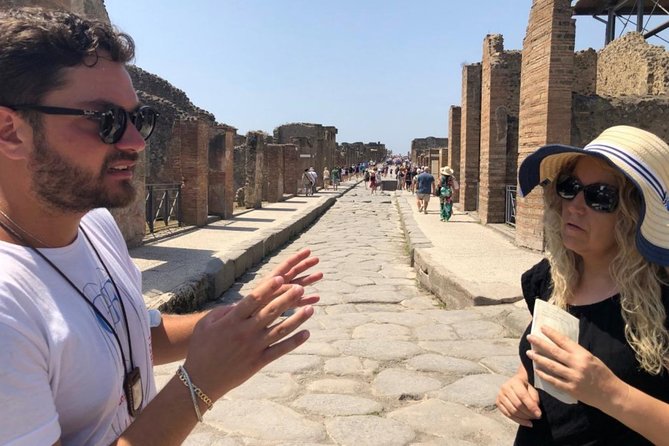
The best part is how the tour avoids the common problem of “great ruins, weak context.” With a guide and headset support, you’re not just looking at stones. You’re learning how those spaces worked day to day, and why the eruption changed everything.
You can also read our reviews of more tours and experiences in Pompeii.

Price and what you really get for $66.01
At $66.01 per person for about two hours, the value is the mix of what’s included:
- Entry ticket to the Pompeii site
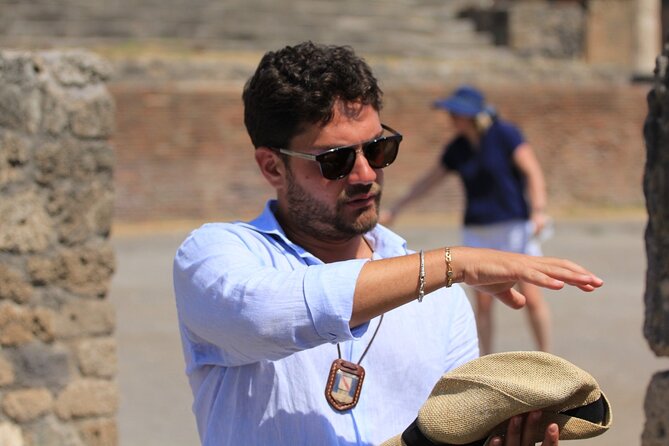
- Authorized guide / archaeologist
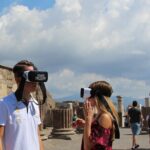
- Headset if crowds make it hard to hear
- Pompeii paper map
What that means for you: you spend less mental energy on logistics and more on the actual experience. Pompeii admission alone isn’t the bargain piece here. The guide time is. And the headset matters more than it sounds. Pompeii can get loud and crowded in patches, so being able to follow details without straining makes the whole tour better.
The one thing not included is bottled water. That’s a small miss, but easy to fix. I’d plan a water plan on your own, especially in warmer months.
Meeting at Villa of the Mysteries and getting your bearings
The tour begins at Villa of the Mysteries, Via Villa dei Misteri, 2, 80045 Pompei NA, Italy. That’s useful because it puts you near a well-known landmark, and it’s close to public transportation.
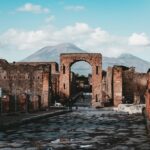
Once you’re in the right spot, your guide takes over. The start at Porta Marina isn’t random. It frames the city like a lived place, not a museum grid. With Vesuvius rising in the background, the guide can point out how the geography and city plan shaped daily life—and why the final moments of 79 AD hit as they did.
Practical note: you’ll be moving through the park in multiple stops, so show up ready to walk. If you tend to run late on tours, this is the kind where being early pays off.
Stop 1: Archaeological Park of Pompeii (the core “story” stop)
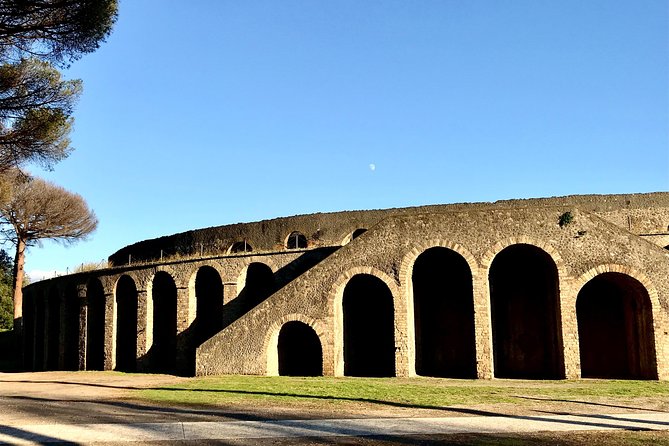
This is the big one. You’ll enter with admission included and spend the first chunk of your time moving through a wide range of highlights.
Here’s what makes this section work so well:
- You get the eruption context tied to real locations, not just a timeline.
- You walk major public routes and key buildings, so Pompeii starts to feel navigable.
- You hit a mix of civic, religious, and daily-life spaces—so it’s more than a list of famous ruins.
What you’ll see here
Expect to cover the Roman Forum, the Basilica, a market area, and major temples along the main route.
Along the Decumanus Maximus, you’ll visit a Roman bath complex that’s described as recently reopened. That matters because reopened areas can feel less overrun and more readable, and it gives the tour a “fresh” feeling even if you think you know Pompeii.
Then there’s a focus on domestic and commercial Pompeii:
- A domus recently opened (the guide frames it as one of the most beautiful)
- Roman shops, including places like thermopolia and bakeries
And you’ll see major “public performance” and military-adjacent spaces too:
- Large and Small Theatres
- Gladiators’ Barracks
The main drawback to consider
This section can be a lot of movement in a short time. One review note that really lines up with what you should expect: Pompeii has uneven terrain, with sidewalk curbs and stepping stones. You’ll want solid footwear and the willingness to slow your pace when the ground shifts.
Stop 2: Tempio di Venere (Temple of Venus)
Next up is the Tempio di Venere, a temple dedicated to Venus, described as the patron goddess of Pompeii.
This stop is short, but it’s helpful. It shows you that Pompeii’s public identity wasn’t only civic and commercial. Religion and patron gods were part of everyday street life. Even in brief segments, these temple stops give your brain something to “attach” symbolism to as you move through the city.
Admission here is free as part of the itinerary timing, so you’re not paying again for each individual feature.
Stop 3: Basilica (center of business and justice)
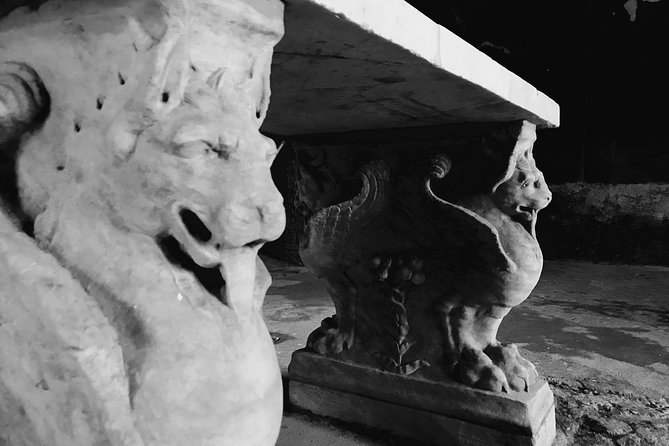
The Basilica in Pompeii is where business and administration of justice happened. That may sound abstract, but it becomes clear when you stand in the right space: a place built for public gathering and decisions.
This stop is also free during the tour, which keeps the pacing efficient. You get a better understanding of what “forum life” meant beyond worship and sightseeing.
Stop 4: Sanctuary of Apollo
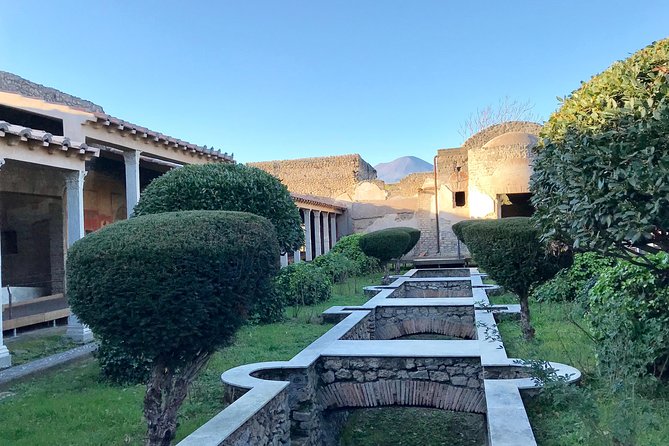
The Sanctuary of Apollo is among the older worship places in Pompeii, and it sits at a strategic point along the street leading from Porta Marina up toward the public heart.
This is one of those stops that helps you read the city like a route. If you’ve ever walked around ruins thinking, so where am I actually supposed to be, this is the kind of “why this location” explanation that fixes that.
Stop 5: Forum – Main Square (Pompeii’s daily-life center)
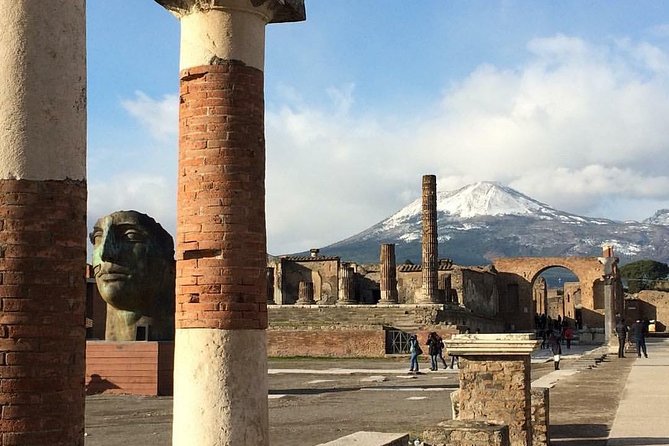
This stop is basically Pompeii’s social and civic pulse. The Forum – Main Square represents the center of daily life, and the tour keeps it tied to what people did there, not only what it looks like.
If you remember one concept from this tour, I’d make it this: the forum wasn’t just a monument. It was a working space for public life.
Stop 6: Temple of Jupiter and the Vesuvius view
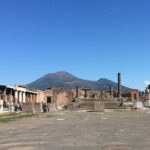
The Temple of Jupiter dominates the northern side of the Forum, and behind it rises Vesuvius in a scenic framing.
Even if you know the eruption story already, this stop helps you understand why it was so intense. Pompeii’s buildings and the volcano weren’t “separate facts.” They’re part of the same visual and geographic story.
Stop 7: Macellum and the plaster casts
The Macellum was a monumental food and consumer-products market building. That’s a key daily-life point because it’s where you’d imagine buying food, browsing, and running errands.
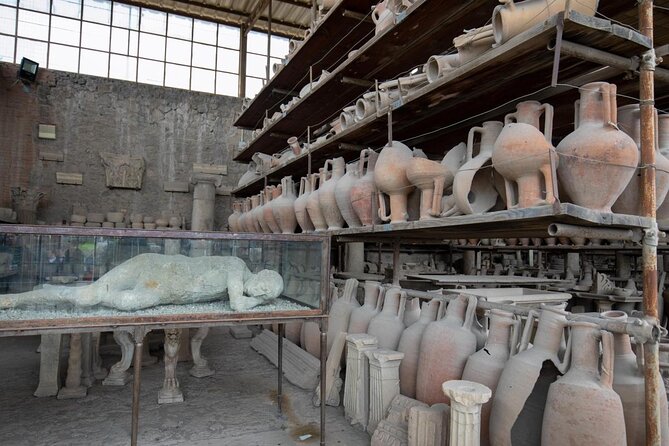
This is also where you may see plaster casts of ancient bodies—described as an archaeological method used to show people as they were at the moment of the eruption.
Why this matters: Pompeii can turn into an architectural highlight tour unless you anchor it in human reality. These casts do that, and the guide’s handling of the topic can strongly affect how the experience lands. This isn’t a stop to rush. It’s a stop to slow down and actually look.
Stop 8: Terme del Foro (Forum Baths)
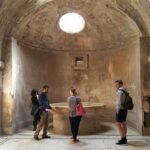
The Forum Baths are described as one of the best-preserved elements of the city. There are separate parts for men and women, each with different entrances.
This is one of the best stops for understanding routine life. Baths were public and social spaces, tied to hygiene and daily rhythm. Seeing the layout makes it easier to imagine the city moving even after the eruption ended everything.
Stop 9: Thermopolium of Vetuzio Placido (an ancient diner)
A thermopolium was like an old-style diner or refreshment spot. At this stop, you’re seeing the kind of place people could grab something hot and eat on the go.
It’s an easy mental bridge for modern visitors: you might not know the Latin term, but you understand the function instantly. These are the stops that make Pompeii feel less like a history lecture and more like a place where normal people ate, drank, and chatted.
Stop 10: Casa del Fauno and House of the Vettii (seasonal surprises)
You’ll hear about two major houses:
- Casa del Fauno: one of the largest houses in Pompeii, with a welcome inscription (HAVE) in Latin on the sidewalk
- House of the Vettii: one of the richest and most famous in Pompeii, placed under the protection of Priapus, god of prosperity
A key practical note: both houses are subject to seasonal openings and closings. So even with a great guide, you might not see the same level of access every time of year. If a house is closed, the guide can only do so much. Still, this is a strong inclusion because houses show you the gap between everyday street spaces and elite private life.
Stop 11: Via dell’Abbondanza (the main street)
Via dell’Abbondanza is described as the ancient main street, also known as the Decumanus Maximus.
This is where your mental map starts to form. Streets are how Pompeii “reads” as a city. Once you walk this route, the forum and major buildings stop feeling scattered and start feeling connected.
Stop 12: Teatro Grande (Greco-Roman performance culture)
The tour ends at the Teatro Grande, where comedies and tragedies in the Greco-Roman tradition were performed.
This stop is a great final note because it shows a side of Pompeii that isn’t about commerce or worship. It’s entertainment, social gathering, and culture—plus it makes the city feel lived in, not just discovered after the fact.
The activity ends back at the meeting point, so you’re not left wandering with no plan.
Guide quality: why it can make or break Pompeii
The guide is a big part of why this tour is consistently rated so highly. Names you might encounter include Livio, Antonio, Riccardo, Ornella, Annalisa, Angelo, and others. Across those names, the common thread is clear: passion plus careful explanation.
You’ll also get good pacing. Even on a day where things happen—crowds, schedule constraints—the guide approach is often the difference between feeling rushed and feeling oriented.
If you’re bringing kids or you want to stay engaged without reading signs for hours, this kind of guide-led storytelling tends to work well. Just know the tour is still a walk through a large archaeological site, so breaks are limited.
What to pack and how to make this tour easier
Pompeii rewards preparation. You don’t need special gear, but you do need sensible basics:
- Walking shoes with traction (uneven stones and step-ups are real)
- A water plan (bottled water isn’t included)
- A small layer if it’s breezy near open areas
- If you’re sensitive to crowds, keep your expectations flexible. The headset helps a lot, but movement is movement.
And here’s a smart mindset: your goal isn’t to see every single structure. It’s to see enough in the right order that you understand how the city functioned.
Should you book this Pompeii Tour & Admission in a Small Group?
Book it if:
- You want admission included and don’t want to waste time figuring things out.
- You’d rather have an archaeologist-style explanation than read your way through alone.
- You want a highlights route that still covers real daily-life spaces like markets, baths, diners, and streets.
- You appreciate small-group learning, especially with headsets when Pompeii gets loud.
Skip it or rethink it if:
- You’re hoping for a slow, deep excavation-focused tour. This route is built for breadth in about two hours.
- You have mobility limits that make uneven paving hard. Most travelers can participate, but the ground isn’t smooth.
My take: for first-time Pompeii visitors, this is a strong way to get meaning fast without turning the visit into a blur. You’ll leave with a clearer mental map—and that makes any later self-guided wandering much more rewarding.
FAQ
How long is the Pompeii Tour & Admission for?
It runs for about 2 hours.
What is included in the ticket price?
Your price includes admission to the Pompeii site, an authorized guide, a headset if the site is crowded, and a Pompeii paper map.
Does the tour start and end at the same place?
Yes. It starts at the Villa of the Mysteries and ends back at the meeting point.
Is the tour in English?
Yes, it is offered in English.
What group size is this tour?
The maximum group size is listed as 15 travelers.
Is bottled water included?
No. Bottled water is not included.
What should I expect for walking conditions?
There is walking on uneven terrain, including curbs and stepping stones, so sturdy shoes help a lot.
Can I get a full refund if I cancel?
You can cancel up to 24 hours in advance for a full refund.
Are all the houses on the route guaranteed to be open?
Some house access is described as seasonal, so openings and closings can affect what you see.