REVIEW · POMPEII
Pompeii Small Group Tour with an Archaeologist
Book on Viator →Operated by Askos Tours · Bookable on Viator
Pompeii makes more sense with a real guide. I like that this tour is led by a licensed archaeologist guide who explains what you’re seeing in plain language, and I like the Pompeii Express skip-the-line entry that gets you moving without wasting time. The one thing to think about is the ground: you’re on uneven ruins with steps and ramps, so it’s not ideal if you have mobility limits.
You’ll meet at the Porta Marina Superiore entrance with a small group (up to 20 people). Then you’ll walk through Pompeii’s big names and its quieter clues, with enough structure to keep the site from feeling like a blur. Expect lots of talking, good pacing, and a route that ends inside the park.
Key things to know before you go
- Small group size (max 20): less waiting, more time for questions.
- Skip-the-line entry: you get Pompeii Express tickets so you can start quickly.
- Archaeologist-led storytelling: you’ll connect buildings to daily life and the 79 CE eruption.
- Headsets for larger groups (16+): easier to hear your guide on busy walkways.
- A tight highlight route in ~2 hours: Basilica, Forum areas, baths, brothel, houses, and the theaters.
- Comfort rules matter: wear sturdy shoes and bring water because shade is limited.
In This Review
- Pompeii With a Guide: Why This 2-Hour Plan Works
- Meeting at Porta Marina Superiore and Getting In Quickly
- Basilica and Forum: Learning the City’s Public Heart
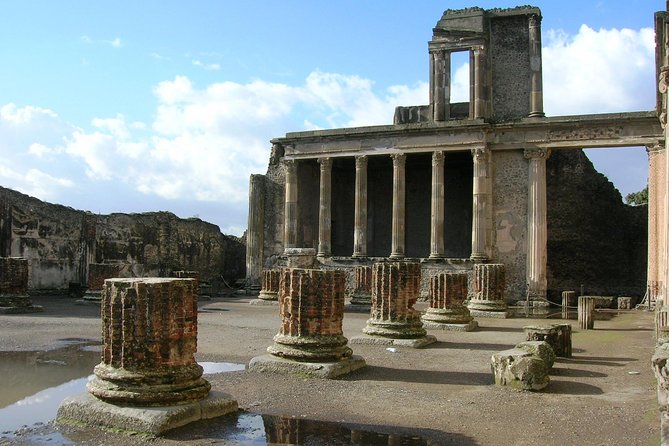
- The Basilica
- The Forum
- Granaries of the Forum: Victim Casts and Brutal Reality
- House of Menander: One of Pompeii’s Richest Home Interiors
- Stabian Baths: The Oldest Thermal Complex You Can Still Read
- Lupanar and Brothel Lane: A Look at the Most Famous Ruins
- House of the Faun and Teatro Piccolo: Homes to Stages
- Teatro Grande: Pompeii’s Largest Theater and Its Crowd Energy
- Price and Value: Is This Tour Worth $35.67?
- Pacing, Questions, and What a Good Guide Actually Does Here
- What to Bring and How to Stay Comfortable in Pompeii
- Who This Tour Suits Best
- Should You Book This Pompeii Archaeologist Tour?
- FAQ
- How long is the Pompeii Small Group Tour with an Archaeologist?
- Where do you meet for the tour?
- What language is the tour offered in?
- What is the group size?
- Do I get a ticket to enter Pompeii?
- Is there skip-the-line entry?
- Are headsets included?
- What sites are visited during the tour?
- Are food and transportation included?
- What should I wear or bring?
- Is the tour available year-round and in bad weather?
Pompeii With a Guide: Why This 2-Hour Plan Works
Pompeii is huge, and it’s easy to get overwhelmed. The ruins are spread out, labels are brief, and without context you can end up “looking at stones” instead of understanding a city. This tour is designed to solve that problem fast.
You’ll cover core zones of the archaeological park and learn what each place was for. The biggest value here is not just seeing famous sites like the Forum and the theaters. It’s learning how they worked together: public meeting spaces, merchant activity, household life, and the shock of the eruption that ended everything.
The tour is also short enough that you can still explore on your own afterward. That’s a smart way to handle Pompeii. You get a guided backbone, then you can roam with better instincts.
Meeting at Porta Marina Superiore and Getting In Quickly
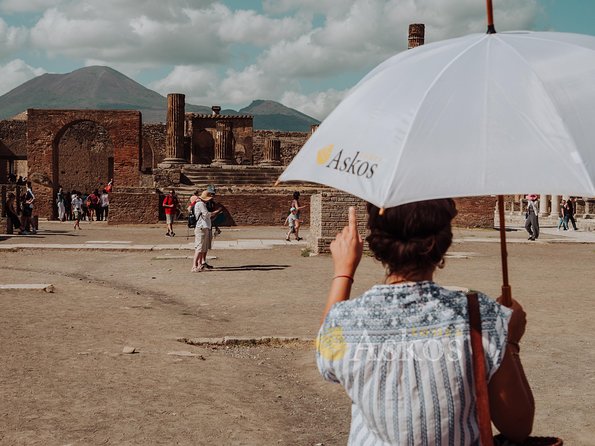
The tour starts at Porta Marina Superiore, where your guide holds an Askos Tours sign. This matters because Pompeii’s entrance area can feel chaotic, and arriving at the right meeting point is half the battle.
From there, you go straight into the ruins. You’ll have a mobile ticket and a skip-the-line Pompeii Express entry, so you spend less time stuck at the start. In a place like Pompeii, those minutes add up.
Also pay attention to timing. The experience is designed around a smooth flow through the park, so if you show up late, you may miss part of the route. If you’re traveling from elsewhere, I’d build in extra buffer time just to be safe.
You can also read our reviews of more tours and experiences in Pompeii.


Basilica and Forum: Learning the City’s Public Heart
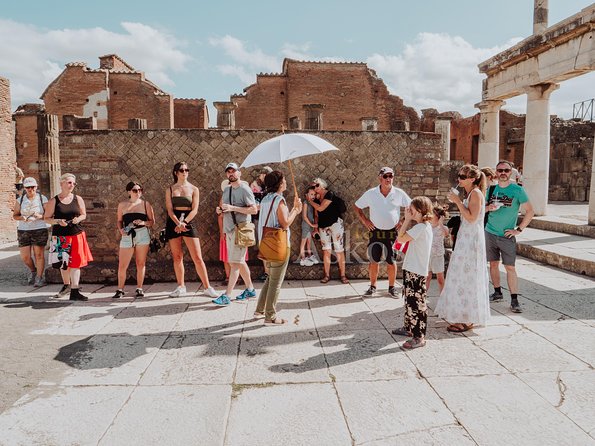
Your first major stops help you build the mental map of Pompeii.
The Basilica
The Basilica was an open portico that offered shelter for merchants and everyday activity. Standing there, you’ll see how “public” didn’t mean just politics. It meant commerce, meetings, and routine business that gave the city its rhythm. It’s the kind of building that sounds boring until someone explains how people used it.
The Forum
Then you’ll move to the ancient main square, the Forum area. This is where the city’s public life concentrated. The guide’s job is to turn it from a wide open space into a series of understood functions: who gathered, what happened here, and why the architecture looks the way it does.
Even with only about ten minutes allotted per major area, the goal is not to rush past. It’s to give you context so that when you look back later, you can read the site without needing a printed guide.
Granaries of the Forum: Victim Casts and Brutal Reality
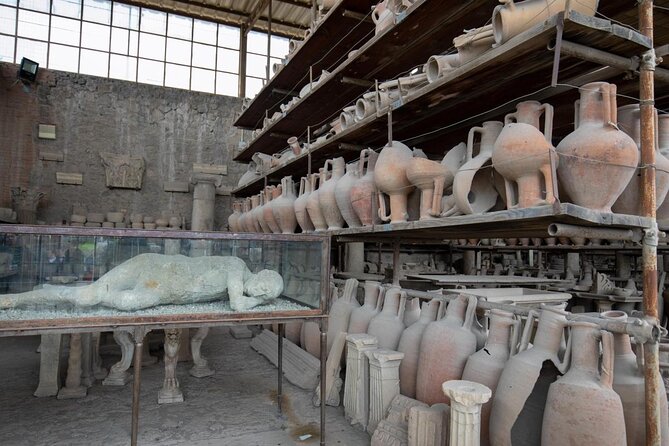
One of the most emotionally heavy parts of Pompeii is not the dramatic buildings. It’s the evidence left by the eruption—and the Granaries of the Forum are where you’ll encounter it.
Inside this area, you’ll see marble tables and baths for fountains that adorned entrances of houses. It’s a reminder that people cared about beauty and daily comfort right up until the end. Then the focus shifts, and you’ll pause to ponder the plaster casts of victims—plus details like a dog and a tree. Seeing those casts in context is powerful, because it’s not just an abstract tragedy. It’s specific, local, and physical.
This stop is also why an archaeologist guide is worth it. The story isn’t only about catastrophe. It’s about what Pompeii was, and how the eruption froze the ordinary into something we can still study.

House of Menander: One of Pompeii’s Richest Home Interiors
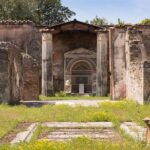
Next you’ll head to the House of Menander, one of the most impressive private residences in Pompeii. This isn’t a “see a hallway and move on” stop. The house is notable for architecture, decoration, and the surviving contents.
What I like about this stop is that it changes your perspective. You move from public spaces (merchants, squares, civic life) to a household environment shaped by taste and status. Pompeii’s homes can look similar from a distance, but with the guide’s explanation you start noticing how space signals wealth, how rooms were used, and how decoration worked as more than decoration.
You’ll get a focused visit, and you’ll likely leave wanting to come back later for slower time. That’s a good sign in Pompeii.
Stabian Baths: The Oldest Thermal Complex You Can Still Read
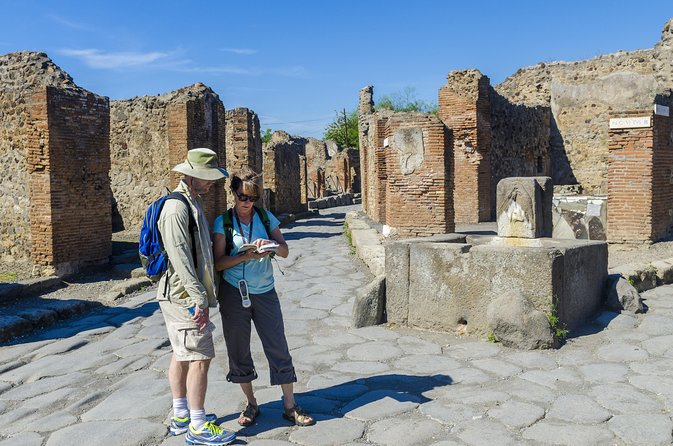
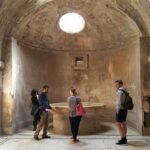
After the houses, you’ll step into the world of routine self-care and socializing at the Stabian Baths. These cover a vast area and are known as the oldest thermal complex in Pompeii.
Baths in Roman cities weren’t just about hygiene. They were a social engine: people gathered, talked, relaxed, and spent time. Standing in the bath complex, you start to understand why the Romans treated this as a central part of life rather than an occasional luxury.
The practical side is that baths give you a break from the most intense sun exposure. Even then, keep your hat and water ready, because Pompeii doesn’t give consistent shade.
Lupanar and Brothel Lane: A Look at the Most Famous Ruins
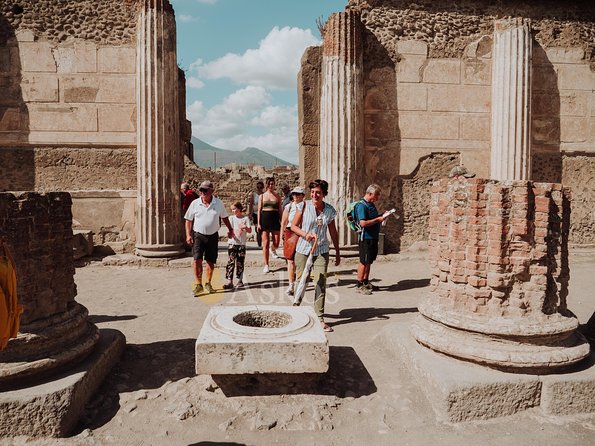
Then comes the Lupanar, the most famous brothel ruins in Pompeii. This can feel intense because it’s private life made public in the aftermath. Still, it’s important because it adds realism to the city’s story.
The guide’s role is to keep it from turning into a shock-and-awe photo stop. You’ll see how the site reflects the economics of sex work in the Roman world, and how the layout and design connect to function.
A note: if you’re uncomfortable with explicit or adult themes, this is still a public archaeological site. You’ll be walking through it as part of a historical route, not as entertainment.
House of the Faun and Teatro Piccolo: Homes to Stages

After the brothel ruins, you’ll move on to the House of the Faun, one of Pompeii’s largest and most impressive private residences. This stop keeps your focus on how elite households were organized and how they expressed identity through space.
Then you’ll get a brief look at the Teatro Piccolo. It’s a smaller theater, but it helps you see that Pompeii had more than one stage. Entertainment wasn’t rare or special; it was part of how the city connected people and ideas.
I like that the tour doesn’t try to cram every building into two hours. It gives you a sequence that builds from home life and public recreation into major performance culture.
Teatro Grande: Pompeii’s Largest Theater and Its Crowd Energy
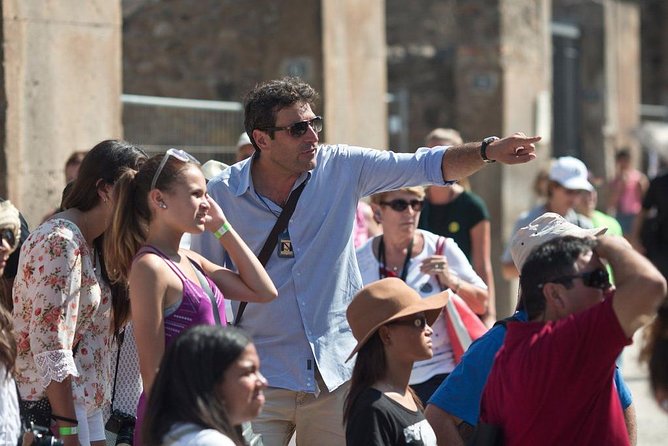
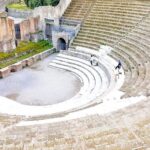
The tour ends with a visit inside the city’s most important theater, the Teatro Grande. This stop is your payoff. The architecture makes it easier to picture crowds, noise, and the excitement of public events.
A theater like this wasn’t only about acting. It was a public gathering space that reinforced social structure. When you’re inside, you can start to understand how Roman cities used performance to unify people around shared experiences.
Because you’re there at the end, you also finish with a sense of momentum. The tour concludes inside the ruins, so plan to have time after the tour if you want to keep wandering.
Price and Value: Is This Tour Worth $35.67?
At around $35.67 per person for about two hours, this is mostly a value-and-efficiency play.
You’re paying for three things you usually can’t DIY as well:
- A licensed archaeologist guide who interprets the site for you.
- Skip-the-line entry via the Pompeii Express ticket, which matters in a high-traffic place.
- A tight route that hits the Basilica, Forum areas, baths, Lupanar, major homes, and the theaters without demanding you plan the whole day yourself.
If your goal is to see Pompeii’s highlights while still understanding what you’re looking at, this is a strong deal. If you already know Roman architecture and you love walking slowly with a full-day plan, you might prefer a self-guided visit. But for most people, having a guide for the first run is the fastest route to “I get it” instead of “I saw it.”
Also, pay attention to group size. This tour caps at 20 people per guide, which is a big factor in whether the experience feels smooth. If you want maximum question time, aim for a smaller group departure when possible, but the stated limit helps either way.
Pacing, Questions, and What a Good Guide Actually Does Here
One of the strongest themes from guide performance is storytelling and clarity. Some guides you might hear about include Alessandra, Paolo, Teresa, Vincenzo, Antonio, and Julia. The common thread is pacing that doesn’t feel like a race.
A great archaeologist guide does a few things well:
- Points out details you’d otherwise miss.
- Explains what a room or building was for, not just what it looks like.
- Helps you connect public spaces to private life and civic routines.
You’ll also have time to ask questions during the walking and stop points. The tour is structured, but it’s not a lecture-only experience.
Still, keep one reality in mind: Pompeii is shared space. Even with a small group, you may pause for regrouping or for everyone to see key elements. That’s normal in ruins. If you’re the type who hates waiting, choose a tour time that fits your energy level, and wear shoes that let you move confidently.
What to Bring and How to Stay Comfortable in Pompeii
This is not a museum you can enjoy in sneakers that you only wear for casual walks.
Bring:
- Sturdy, comfortable shoes for uneven ground.
- Sunglasses and sunscreen in sunny months.
- A small bottle of water.
- A hat if you get sun easily.
Even in winter, Pompeii can feel exposed, and the walking adds up. You’ll be on steps, ramps, and varied surfaces, so avoid anything with slick soles.
If you have mobility concerns, the tour notes that it’s not recommended due to steps and ramps. If that’s you, I’d ask about a private alternative designed for your needs.
Who This Tour Suits Best
This is a great fit if:
- You want a structured tour that hits the real highlights.
- You care about context, not just photos.
- You like asking questions and getting explanations on the spot.
- You want a manageable time commitment without feeling like you’re giving up the whole day.
It’s also a smart choice for families with teens, as long as everyone can handle walking and the uneven surfaces.
If you want a slow, solitary experience where you linger for an hour in one house, this might feel short. But as a first taste of Pompeii, it’s very effective.
Should You Book This Pompeii Archaeologist Tour?
Book it if you want the best odds of leaving Pompeii with real understanding in only two hours. The combination of an archaeologist-led route, skip-the-line entry, and a highlight plan that covers the Forum areas, baths, brothel ruins, major houses, and the biggest theater makes this a strong value.
Skip it if you’re mainly after slow wandering, or if mobility issues make uneven ruins a problem for you. In that case, you’d be better off asking for a tailored visit.
If you’re on the fence, here’s my simple test: if you want to read Pompeii like a story, not a pile of stones, this tour is the right kind of start.
FAQ
How long is the Pompeii Small Group Tour with an Archaeologist?
It’s about 2 hours.
Where do you meet for the tour?
You meet at the Pompeii archaeological park entrance called Porta Marina Superiore, with the guide holding an Askos Tours sign. The meeting location address listed is Via Villa dei Misteri, 2, 80045 Pompei NA, Italy.
What language is the tour offered in?
The tour is offered in English.
What is the group size?
The tour is a small group with a maximum of 20 travelers per guide.
Do I get a ticket to enter Pompeii?
Yes. You receive an included Pompeii Express entrance ticket, and you’ll use a mobile ticket.
Is there skip-the-line entry?
Yes. The tour includes a Pompeii Express entrance ticket designed to help you enter without waiting in line.
Are headsets included?
Headsets are included for groups of 16 or more.
What sites are visited during the tour?
The route includes key Pompeii highlights such as the Basilica, the Forum area, the Granaries of the Forum, the House of Menander, the Stabian Baths, the Lupanar (brothel ruins), the House of the Faun, and the Teatro Grande (with a brief look at Teatro Piccolo).
Are food and transportation included?
No. Food and drinks, and transportation, are not included.
What should I wear or bring?
Wear comfortable shoes with good grip. Bring sunscreen and sunglasses in summer, and bring a small bottle of water.
Is the tour available year-round and in bad weather?
Yes. The tour is available all year around with rain or shine.