REVIEW · POMPEII
Pompeii Private Tour with an Archaeologist and Skip The Line – 3 hours
Book on Viator →Operated by ELIANA SANDRETTI · Bookable on Viator
Pompeii clicks when someone explains it. This private, 3-hour visit gives you structured access to the top sights, with an archaeologist guide who turns street-level ruins into stories you can actually follow. I also like the practical skip-the-line setup at the ticket office, plus the chance to hear a guide-style like Eliana Sandretti or Luisa: clear, story-driven, and tuned to questions.
The main thing to watch is cost clarity: the tour price covers the guide, but the Pompeii entry ticket is not included for adults. And the walk involves plenty of steps and uneven, sometimes slippery surfaces—so plan for that.
In This Review
- Key takeaways before you go
- What you’re really paying for in Pompeii
- Meeting at Porta Marina Superiore (and finishing nearby)
- A step-by-step Pompeii walk your archaeologist guides you through
- 1) Porta Marina entry area: Pompeii Archaeological Park
- 2) Odeon / Teatro Piccolo: the small theater moment
- 3) Teatro Grande: the large theater highlight
- 4) Main street of Pompeii
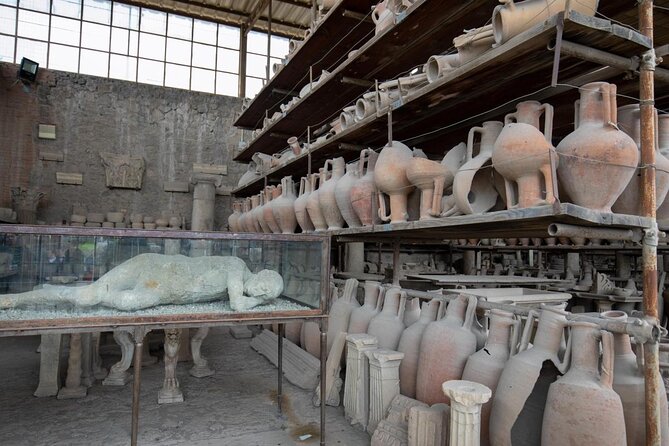
- 5) Granai del Foro: archaeological deposits near the forum
- 6) Stabian Baths (Terme Stabiane): Pompeii’s bath/spa world
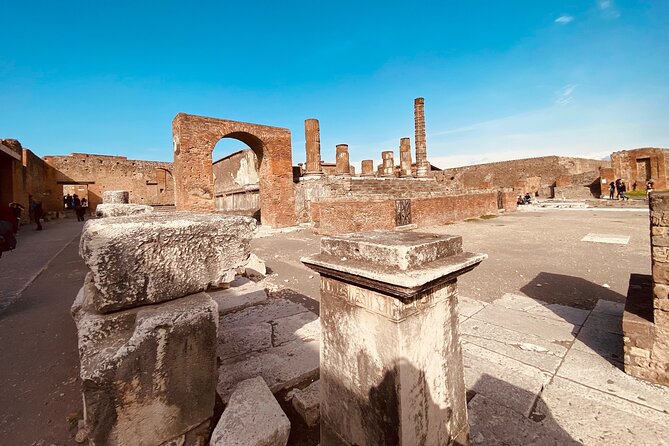
- 7) Forum (Foro di Pompei): the city’s core
- 8) Basilica / Court of Justice
- 9) Temple of Jupiter
- 10) Quadriporticus of the theaters: gladiators’ barrack area
- 11) Lupanar: prostitution area
- 12) Temple of Venus
- 13) Casa del Poeta Tragico: the Cave Canem mosaic
- 14) Macellum: meat and fish market
- 15) Edificio di Eumachia: wool market
- 16) Casa del Menandro: frescoes and mosaics
- 17) Termopolio di Vetuzio Placido: take-away fast food counter
- 18) Fullonica di Stephanus: laundry
- Final “temple” stop and return flow
- Why a private archaeologist guide is worth it here
- Tickets and skip-the-line: avoid the most common confusion
- Price and logistics: is $302.32 actually good value?
- Who this Pompeii tour suits best
- Should you book this Pompeii private tour?
- FAQ
- FAQ
- How long is the Pompeii private tour?
- Is this tour private?
- What language is the tour offered in?
- Where do I meet the guide?
- Where does the tour end?
- Are Pompeii entry tickets included in the price?
- Does the tour include skip-the-line tickets?
- Is a mobile ticket provided?
- Is transportation included?
- What happens if the weather is bad?
- Can I get a refund if I cancel?
Key takeaways before you go
- Skip-the-line help is available at the ticket office on request in advance.
- A 3-hour private route keeps you from wandering and missing the big landmarks.
- Major Pompeii stops on one walk: theaters, forum area, baths, markets, and houses with famous mosaics.
- Mobile ticket + real-time assistance before and during the tour.
- Guides can adapt pace when needed, including working around mobility limits.
- Good footwear matters: you’ll face steps and slick stones.
What you’re really paying for in Pompeii
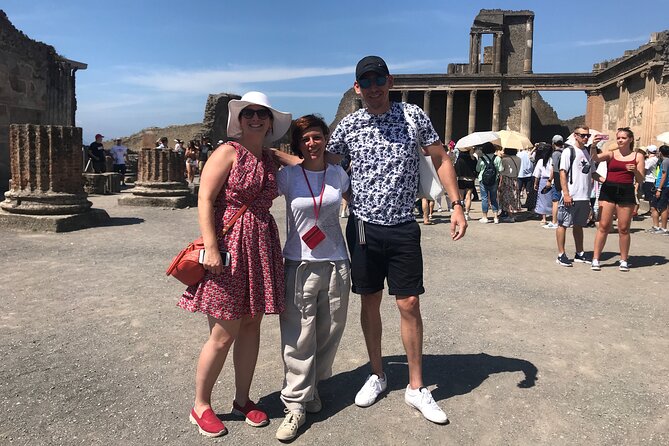
This tour is priced at $302.32 per group for about 3 hours, and it’s private, meaning it’s just your party. What you’re buying is not just a checklist of ruins. You’re buying a plan: a focused route, an archaeologist-style interpretation, and help getting inside fast.
A key included piece is skip-the-line support at the ticket office, but it’s only triggered if you request it in advance. You’ll also get a mobile ticket, plus assistance before and during the tour. In plain terms: you spend more time looking at Pompeii and less time figuring out tickets.
One more value note: the big entrance fee is separate. The Pompeii site ticket is not included in the tour price. Adults pay 19 euros per person (and under-18s are free, per the tour info). You’ll want to budget that on top of the tour cost, even though the meeting and entry flow are handled with guidance.
And just so you’re not surprised: meals and drinks aren’t included, and private transportation isn’t included either.
You can also read our reviews of more private tours in Pompeii


Meeting at Porta Marina Superiore (and finishing nearby)
Your meeting point is Hortus Pompei, Restaurant & Garden Bar, near Piazza Porta Marina Superiore 1 (also listed around Piazza Esedra). The start and end are set inside the park region too: the walk begins at Porta Marina Superiore and ends at Porta Marina Inferiore—then you return back to the meeting point.
Why that matters: Pompeii is big, and getting turned around wastes time you’d rather spend at the best sights. A tight start point helps you get your bearings fast, and a clear finish point means you’re not stuck hunting for your guide at the end.
The tour is in English, and it’s designed for “most travelers,” with service animals allowed. It also runs only when weather cooperates, since the experience requires good conditions.
A step-by-step Pompeii walk your archaeologist guides you through
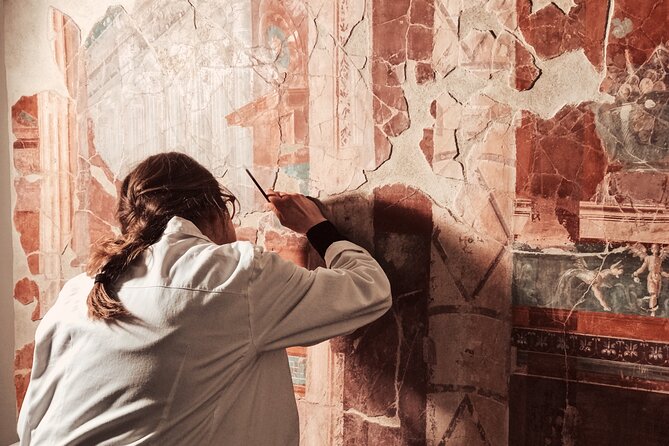
Your route is built around the most recognizable Pompeii experiences: public buildings, everyday commerce, and then the homes and details that show how people actually lived.
Below is the stop sequence you’ll move through, with what each part gives you—and where you should be ready for rough ground.
1) Porta Marina entry area: Pompeii Archaeological Park
The tour starts at Porta Marina Superiore and uses that entry flow to get you into the heart of the park. This first phase sets the tone: your guide frames what you’re about to see, so later stops land harder.
This is also where I’d set your expectation for the walking reality: Pompeii means steps, uneven paths, and occasional slick spots. I’d treat the opening minutes as your warm-up for balance.
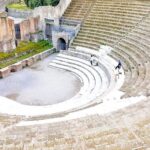
2) Odeon / Teatro Piccolo: the small theater moment
Next up is the Odeon (Teatro Piccolo), a short stop (about 5 minutes). The size helps you notice how theaters function as social spaces—without getting bogged down.
Even if you’re not a theater person, a small theater is a great breather stop in a long circuit. You get a major landmark without a long slog.
You can also read our reviews of more tours and experiences in Pompeii

3) Teatro Grande: the large theater highlight
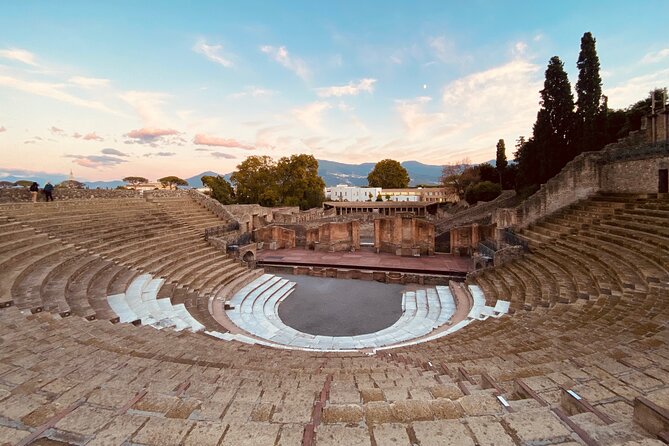
Then you’ll move to the Teatro Grande for about 15 minutes. This is one of those stops where context matters. A guide can explain what you’re looking at so you don’t just see stone seats and call it a day.
Plan for a bit of step work and slow footing here. This is where good shoes pay off.
4) Main street of Pompeii
You’ll also cover the main street of Pompeii as a distinct segment. This is where Pompeii stops feeling like separate buildings and starts feeling like a real town—moving from public entertainment into the everyday flow of city life.
If you like street-level travel, this is the part that usually makes people say the city finally feels real.
5) Granai del Foro: archaeological deposits near the forum
A short segment (about 15 minutes) brings you to the Granai del Foro, described as an archaeological deposit. Think of this as an in-between stop: it helps explain what the site preserves, and how excavation and storage play into what you can still see.
6) Stabian Baths (Terme Stabiane): Pompeii’s bath/spa world
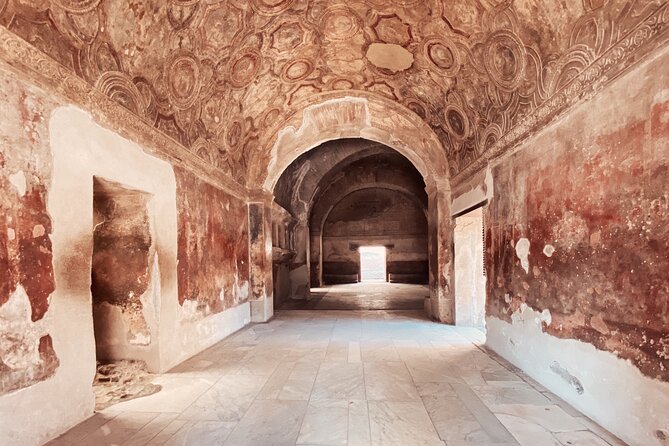
Then comes the Stabian Baths, the first baths in your route (about 15 minutes). Baths sound simple, but they’re loaded with clues about routine and the way buildings supported daily habits.
It’s also a useful pacing pause because it gives your body a different type of visual focus than theaters and street walking.
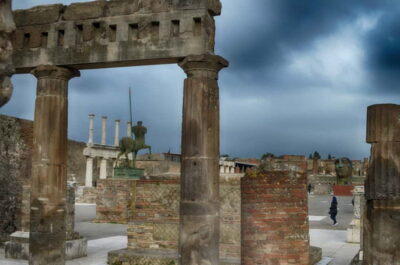
7) Forum (Foro di Pompei): the city’s core
Next is the Forum for about 15 minutes. This is the “center of gravity” stop. A guide can help you see how different structures relate to each other, instead of treating every arch and column as a random photo-op.
If you’re short on time in Pompeii, this is one of the most important areas to hit.
8) Basilica / Court of Justice
You’ll add the Pompei La Basilica (also described as court of justice) for about 15 minutes. This pairing—forum + justice space—helps you understand how power and public life were organized.
9) Temple of Jupiter
You’ll also see the temple identified here as Temple of Jupiter. The tour info doesn’t assign a specific time, but it’s clearly a “must-see” religious centerpiece on your walk.
For best results, treat this as a moment to look up and around, not just forward and down.
10) Quadriporticus of the theaters: gladiators’ barrack area
After that, you’ll reach the Quadriporticus of the theatres, described as gladiators’ barracks (about 15 minutes). This stop is where Pompeii starts talking about entertainment behind the scenes.
It’s one of those sections where a guide’s stories help the space make sense fast.
11) Lupanar: prostitution area
Next is Lupanar, described as the brothel / prostitution area, for about 15 minutes. Expect this stop to feel different emotionally. Even with a guide, it’s not a gentle stroll-through.
I’d go into it ready for frank, factual interpretation, and for the guide to keep you moving at a respectful pace.
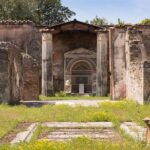
12) Temple of Venus
Then you’ll see the Temple of Venus. Again, time isn’t specified, but it’s positioned as a major religious stop after Lupanar, which helps you follow the city’s planning logic through different kinds of spaces.
13) Casa del Poeta Tragico: the Cave Canem mosaic
You’ll hit Casa del Poeta Tragico for about 5 minutes, with a focus on the Cave Canem mosaic. This is a quick but memorable hit—mosaic details can be small, so having someone point out what to look for saves you from missing the best part.
14) Macellum: meat and fish market
Then it’s the Macellum (meat and fish market) for about 10 minutes. If you care about everyday Roman life, markets are where the ruins start behaving like a living town.
This is also where your guide’s storytelling can connect public buildings to meals people ate and goods people bought.
15) Edificio di Eumachia: wool market
You’ll stop at Edificio di Eumachia, described as the wool market, for about 5 minutes. Short and focused, but it adds an important piece: Pompeii wasn’t just temples and theaters. It was commerce and production.
16) Casa del Menandro: frescoes and mosaics
Next is Casa del Menandro, with frescoes and mosaics, for about 20 minutes. This is one of your longest single-home stops, and it’s where your guide can help you read decoration, layout clues, and what these homes suggest about status and daily routines.
Give yourself mental room here. It’s easy to rush when you’re excited, but this is where taking a breath pays off.
17) Termopolio di Vetuzio Placido: take-away fast food counter
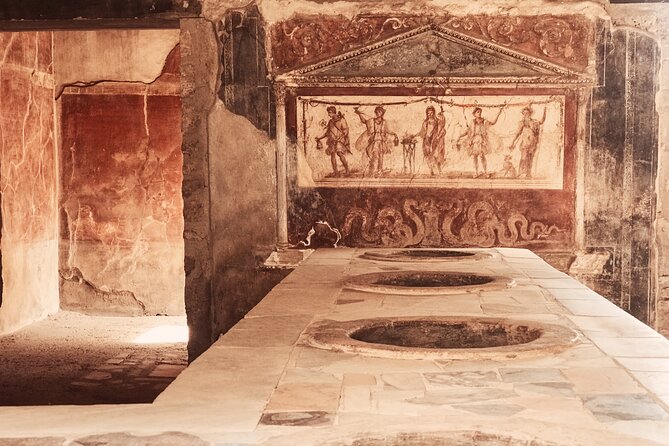
You’ll reach Termopolio di Vetuzio Placido, described as a take-away shop & fast food, for about 15 minutes. Even if the idea sounds modern, the point is practical: you’re seeing a built environment for quick meals.
18) Fullonica di Stephanus: laundry
Then comes Fullonica di Stephanus, the laundry, for about 15 minutes. It’s a classic example of how Pompeii shows work, not just leisure.
When you see these production spaces on the same walk as theaters and temples, the city’s everyday rhythm becomes clearer.
Final “temple” stop and return flow
Your route ends with one more temple segment (time not listed), and then you complete the walk toward the end point near Porta Marina Inferiore, returning to the meeting area.
Why a private archaeologist guide is worth it here
Pompeii punishes guesswork. If you wander without structure, you’ll either miss major areas or spend too much time on the wrong details. A private guide fixes that with an intentional path and constant interpretation.
From the guides associated with this operator, the recurring strengths are pretty consistent: strong storytelling, architectural reading of spaces, and the ability to adjust pace when someone needs help. People often highlight how the guide stays patient with questions and physical limitations, and how the route can be shaped to reduce crowd pressure when possible.
I also like that you get assistance during the tour, not just a handshake at the start. That matters when you hit steps, slow down, or need a breather.
And yes, you’ll walk. Multiple people point out that there are lots of steps and slippery surfaces, so your guide’s tone and pace aren’t just nice—they keep the visit enjoyable.
Tickets and skip-the-line: avoid the most common confusion
Here’s the clean way to think about it:
- The tour includes skip-the-line at the ticket office only if it’s arranged on request in advance.
- The Pompeii entry ticket (admission fee) is not included in the tour price for adults.
- You’re given a link to buy entrance tickets in advance, and you’re expected to handle that part.
If you want the smoothest arrival, do this before you go:
- Buy your park admission online.
- Make sure your booking request aligns with the skip-the-line assistance at the ticket office.
That way you don’t end up standing around trying to figure out entrance payment on the day. Pompeii already has plenty to deal with.
Price and logistics: is $302.32 actually good value?
At first glance, $302.32 per group sounds steep. But you’re not paying just for “someone who can read a map.”
You’re paying for:
- a specialized archaeologist guide
- 3 hours private pacing
- skip-the-line support
- hands-on help before and during the tour
So the real value question is simple: do you want Pompeii to be a self-guided scramble, or do you want a route that turns the site into a coherent story?
This is also a good fit if you:
- have limited time in the area
- want to maximize the stops that matter (theaters, forum, baths, markets, houses)
- prefer asking questions rather than trying to guess what you’re looking at
If you’re comfortable going on your own and have already planned a route, you might choose to skip the guide. But if you’d rather not waste your hours, this private format can feel like the smart spend.
Who this Pompeii tour suits best
This tour is especially practical for you if you like:
- a structured walk through a big site
- explanation tied to recognizable Pompeii categories: theaters, civic spaces, baths, markets, homes
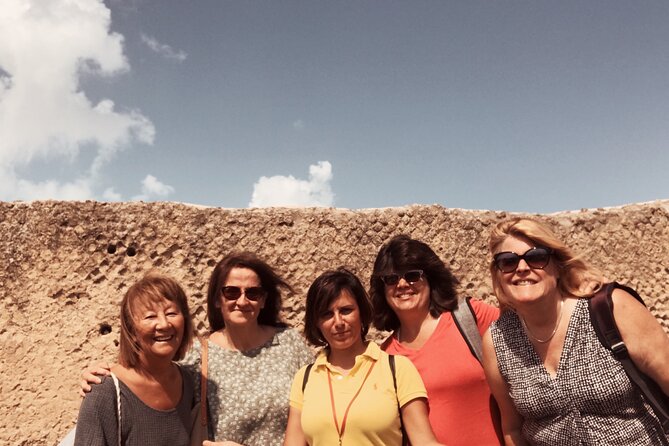
- a guide who can handle questions and keep moving
It also makes sense if you’re traveling with someone who might need patience with pace. The tour has been described as adaptable for mobility challenges, which is a big deal on Pompeii’s uneven ground.
Should you book this Pompeii private tour?
If you want Pompeii to feel like a real city instead of random ruins, I’d book it. The combination of a private archaeologist-style guide, a tight 3-hour route, and skip-the-line help is exactly how you stretch your time at the site.
Just be sure you plan for the one major catch: entrance tickets are separate for adults, and the walking is real. If you show up with good shoes and your tickets sorted, you’ll spend your energy looking, not figuring.
FAQ
FAQ
How long is the Pompeii private tour?
The tour runs for about 3 hours.
Is this tour private?
Yes. It’s a private tour, and only your group participates.
What language is the tour offered in?
The tour is offered in English.
Where do I meet the guide?
Meet at Hortus Pompei, Restaurant & Garden Bar, near Piazza Porta Marina Superiore 1 (Pompeii).
Where does the tour end?
It ends back at the meeting point after finishing near Porta Marina Inferiore.
Are Pompeii entry tickets included in the price?
No. Entrance fees are not included. Adults pay 19 euros per person, while under 18s are free.
Does the tour include skip-the-line tickets?
Skip-the-line at the ticket office is available on request in advance, and you’ll also be provided a link to buy entrance tickets in advance.
Is a mobile ticket provided?
Yes, you’ll receive a mobile ticket.
Is transportation included?
No. Private transportation is not included.
What happens if the weather is bad?
The experience requires good weather. If it’s canceled due to poor weather, you’ll be offered a different date or a full refund.
Can I get a refund if I cancel?
You can cancel for a full refund up to 24 hours before the start time.