REVIEW · POMPEII
Late Afternoon Best time to visit Pompei on a private tour
Book on Viator →Operated by Alex Tour · Bookable on Viator
Pompeii at sunset feels different. This late-afternoon private tour lets you dodge the worst heat and heavy crowds, and it does not require an early wake-up. With licensed guide Alex, you’ll get a focused route through Pompeii Archaeological Park and key sights, starting at Porta Marina and ending back near the pickup spot.
I like how Alex frames the site right away, with a clear look at the AD 79 eruption dynamics before you start walking. I also love the pacing: you’ll cover big hitters fast, but you’re not rushed into silence—Alex stops to answer questions and slow your pace when the group needs it.
One thing to plan for: the entrance ticket is not included in the price, so you’ll want to budget about €18 for adults. And since this is an outdoor visit, weather matters; poor conditions can mean a different date or a refund.
In This Review
- Key highlights you’ll actually feel
- Why late afternoon is the smarter way to tour Pompeii
- Your private guide (Alex) and what “private” changes at Pompeii
- Getting your bearings: the Porta Marina start and the eruption lesson
- Stop by stop: what each Pompeii highlight gives you
- The Forum and the center of city life
- Temple of Apollo and the city’s mythology
- Stabian Baths (Terme Stabiane): Roman life in a public space
- Teatro Grande: Greek theater in Roman Pompeii
- Casa del Menandro: mosaics and the voice of wealth
- Panificio di Popidio Prisco: a bakery that still feels like work
- Termopolio di Vetuzio Placido: ancient street food stop
- Orto dei Fuggiaschi: the plaster casts and the weight of history
- The pacing: fast enough to see a lot, slow enough to learn
- What you should wear and plan for (late-afternoon reality)
- Price and value: is $249 worth it?
- Where to start, where it ends, and how tickets work
- Should you book this late-afternoon private Pompeii tour?
- FAQ
- Do I need to buy Pompeii entrance tickets separately?
- How long is the private late-afternoon Pompeii tour?
- Where does the tour start and where does it end?
- Is the tour really private for just my group?
- What main sights will I see during the 2-hour route?
- Is the entrance ticket included for all stops?
- What if the weather is bad?
- Does it include a guide and mobile ticket?
Key highlights you’ll actually feel
- Late-afternoon timing for comfort: cooler temperatures and softer light, without the 7 a.m. grind
- Alex’s storytelling of AD 79: you start with the why, then you see the ruins with better context
- A private route with real flexibility: quick overview, plus stopping when you want details
- Major stops in about two hours: Forum, Apollo, Stabian Baths, theaters, houses, and the victim casts
- Golden light at the right moments: great for photos and for noticing details people miss in midday crowds
Why late afternoon is the smarter way to tour Pompeii
Pompeii is famous for a reason, but it can also be a sweat-fest. The advantage of this late-afternoon slot is simple: you’re touring when the sun angle changes and the park often feels more manageable. You still get the drama of a big ancient site, but with less discomfort and fewer elbows.
The other win is mental. When you arrive later in the day, you tend to look at the ruins less like checklist items and more like a living story. That’s exactly what Alex does. You start with the eruption basics, then the rest of the tour makes sense as you move from public spaces to everyday life and, finally, the plaster casts.
This isn’t a long, slow meander. It’s a tight two-hour program, so you get breadth rather than one tiny section studied for ages. If you want the kind of tour where you can sit for an hour in one spot, this may not match your style. If you want to see a lot while still learning what you’re looking at, it fits nicely.
You can also read our reviews of more private tours in Pompeii


Your private guide (Alex) and what “private” changes at Pompeii
With a private tour, you avoid the biggest Pompeii problem: fighting your way through crowds while trying to hear explanations. Here, it’s just your group with a private licensed guide, so the pacing and stops are tuned to you.
Alex’s style shows up in the feedback people gave. The repeated theme is that he’s energetic, answers questions, and keeps groups engaged—even when families bring kids or teens. Another pattern: he adjusts when the group slows down. That matters at Pompeii, where uneven ground and sudden crowds can make “normal” tour timing unrealistic.
You’ll also notice the balance. The tour moves quickly through high-demand highlights, but it’s not a race. Alex has a way of pointing out what matters before you pass it, and he’ll stop when your group asks for context. That approach turns a famous site into something you can actually follow.
Getting your bearings: the Porta Marina start and the eruption lesson
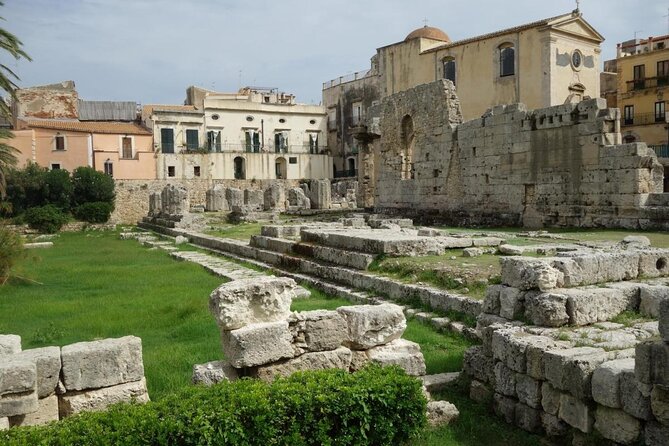
The tour kicks off at Via Villa dei Misteri, 2 and heads into the park from Porta Marina, the sea gate. Starting there is helpful because Pompeii can feel confusing at first. The gate gives you a “this is where people entered and moved in” reference point.
Before you hit the big sights, you get an introduction to the eruption and the city’s background. This part is valuable because Pompeii stops being just “old stones and sad faces.” You begin to connect what you see—streets, homes, public buildings, and the famous casts—to what happened in AD 79.
One practical note: the tour’s first stop includes intro and early highlights, but the entrance ticket is not included in the tour price. So you’ll need to handle the entry ticket ahead of time (or ask the guide about skip-the-line options if you want to reduce waiting).
Stop by stop: what each Pompeii highlight gives you
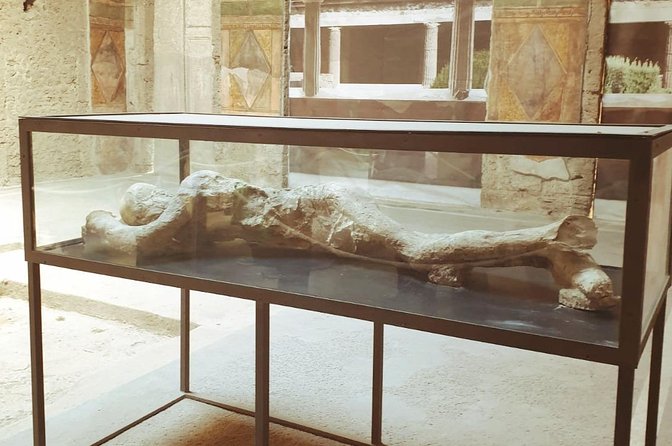
This is the real heart of the experience. In about two hours, you’ll hit a sequence of places that cover Pompeii’s public life, entertainment, everyday commerce, and the tragedy of the eruption.
The Forum and the center of city life
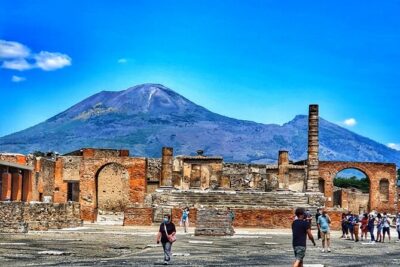
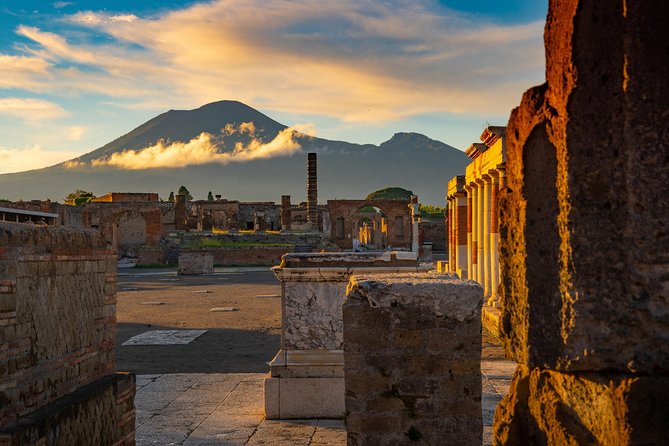
You’ll spend time at the Forum, Pompeii’s main square—political, economic, religious, and social life in one concentrated area. This is the place where Pompeii feels most “city-like.” Even though the buildings are ruins, you can still sense how people used it: announcements, gatherings, activity, and power.
Why it’s worth your time: it gives structure. Once you understand the Forum, it’s easier to read the rest of the site and understand where different types of people likely spent their day.



Temple of Apollo and the city’s mythology
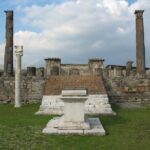
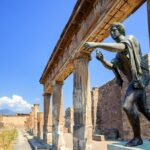
Next up is the Temple of Apollo. This stop is short, but it’s a useful reminder that Pompeii wasn’t only about daily chores and commerce. It also had formal religious life, and Apollo’s presence shows how mythology was built into the city’s identity.
Drawback to consider: with only about five minutes here, you won’t get the kind of slow photo session some people want. If Temple details are your main obsession, you may want extra time on your own afterward.
Stabian Baths (Terme Stabiane): Roman life in a public space
At the Stabian Baths, you get a glimpse of a Roman world that was very social and very physical. Roman baths weren’t just hygiene—they were routine, news, and relaxation rolled into one.
You get about fifteen minutes, which is enough to appreciate the layout and what kind of bathing complex you’re looking at. It’s also a nice rhythm break, because baths feel different from forums and temples. They’re a reminder that people lived with comfort and routine even in a city that would eventually vanish.
Teatro Grande: Greek theater in Roman Pompeii
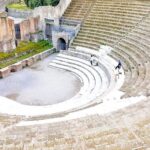
The Teatro Grande is the Greek-style theater, and you’ll have around fifteen minutes here. The effect is big: the seating layout and the open space help you imagine crowds, performances, and the city’s appetite for entertainment.
Tip: look at it as an architecture lesson first. The better you understand how the theater was designed for viewing and sound, the more “real” it feels.
Casa del Menandro: mosaics and the voice of wealth
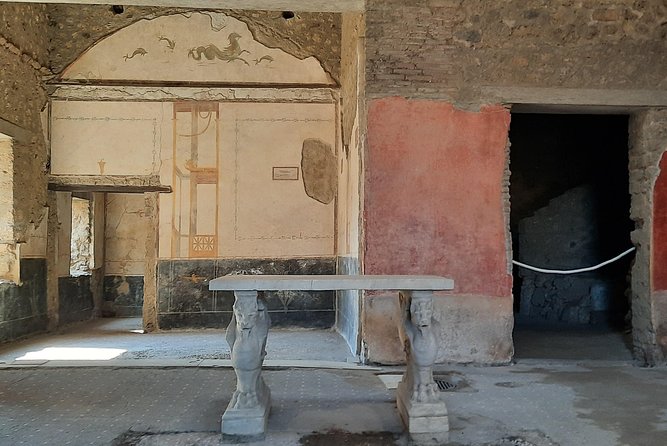
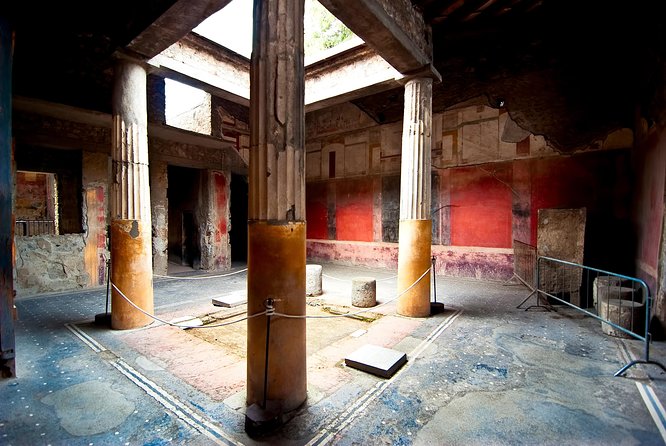
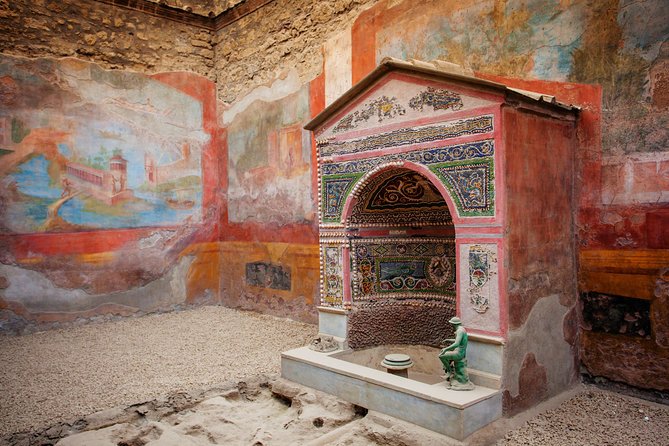
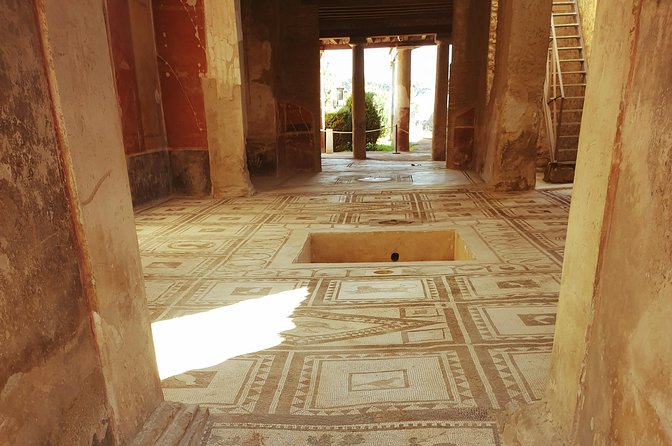
At Casa del Menandro, you’re in a rich Roman domus with fresco paintings and mosaics, with about twenty minutes to explore. This is a step into private life, where you can contrast the public spaces you saw earlier.
Why this stop matters: it shows Pompeii’s social differences. Not everyone lived like this, and Pompeii’s wealth isn’t subtle. The artistry tells you that taste and status mattered, even in everyday space.
Possible drawback: houses can get crowded on busier days. This tour aims to avoid heavy crowd flow, but you should still expect some level of walking and tight viewing lines when you arrive near popular rooms.
Panificio di Popidio Prisco: a bakery that still feels like work
A couple of the most memorable stops are the ones that show real daily business. The Panificio di Popidio Prisco is a 2,000-year-old bakery, complete with oven and mills, with around ten minutes.
This stop is great because it’s hands-on imagination. You can almost picture the grind, the heat, and the repeated work. Even if you’re not a “food history” person, you’ll likely find it surprisingly moving.
Termopolio di Vetuzio Placido: ancient street food stop
Then you’ll see the Termopolio di Vetuzio Placido, about five minutes. A termopolium is like an ancient street-food and drink counter. It’s a quick hit, but it adds humanity. People didn’t just attend civic events; they ate and drank in quick places like this.
This stop is also useful for photos, because the context makes the scene feel almost like a snapshot of a normal day.
Orto dei Fuggiaschi: the plaster casts and the weight of history
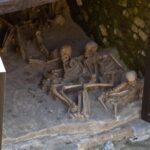
The tour ends at Orto dei Fuggiaschi, with about fifteen minutes at the plaster casts of victims of the eruption. This is the heavy stop. It’s not “fun,” and it shouldn’t be. But it’s essential, and Alex’s storytelling helps you face it with understanding instead of just shock.
What I think makes this stop powerful (and worth the time): you see the tragedy in a way that connects the eruption lesson to the real human outcome. You leave with a clearer sense of scale and urgency.
If you’re sensitive to this kind of content, give yourself a little mental buffer before you reach it. A shorter lunch or snack beforehand helps too, since you’ll be walking and absorbing a lot.
The pacing: fast enough to see a lot, slow enough to learn
This is an approximately two-hour tour, so you’ll cover a serious chunk of Pompeii. The upside is clear: you don’t need a whole day to get meaningful highlights and context. The downside is also clear: you won’t linger for an hour in each building.
Alex typically keeps the momentum, moving quickly through the site so you can see as many major stops as possible. Then, when you have questions or when something catches your eye, he’ll pause and explain. That’s the sweet spot for most people: you don’t waste time, but you also don’t feel like you’re herded.
One extra note that shows up in the feedback: if your group is slower—kids, teens, or anyone who stops for details—Alex appears to adapt. At Pompeii, that adaptability can be the difference between a tour that feels stressful and one that feels enjoyable.
What you should wear and plan for (late-afternoon reality)
Late afternoon helps, but Pompeii still includes a lot of walking. You’ll want comfortable shoes with grip and socks you trust. Surfaces can be uneven, and the park is outdoors for the whole route.
If you like photos, the sunset light is a plus. Golden light makes ruins look dramatic and can help you notice textures. Even if the sky turns cloudy or stormy (it can happen), cooler air often makes the walk feel better.
Bring water. The tour is only two hours, but the physical effort is real and Pompeii walking adds up fast.
Price and value: is $249 worth it?
At $249, the tour is priced for a private experience, which means you’re paying for a guide and a tailored route, not just general admission sightseeing. Since Pompeii entrance is separate (about €18 for adults), your true spend is the tour price plus entry.
So when does this make sense?
- If you want a guided plan and you care about understanding what you see
- If you’re traveling as a small group and want to avoid crowd chaos
- If you don’t want to spend a full day figuring out route logic
- If you value a guide who can answer questions and adjust pacing
When might it not be ideal?
- If you only want a slow, self-guided wander with lots of time per stop
- If you’re on a tight budget and would rather spend money only on entrance and transit
For most people choosing Pompeii for a first trip, a well-led two-hour private route can feel like the most time-efficient way to get both highlights and context.
Where to start, where it ends, and how tickets work
The tour starts at Via Villa dei Misteri, 2, 80045 Pompei NA, Italy. It ends back at the same meeting point.
You’ll receive a mobile ticket. The entrance ticket is not included in the tour price. If you want to reduce waiting, ask about skip-the-line tickets, which the guide can buy on request.
Also note: it’s near public transportation, and service animals are allowed. It’s designed so most travelers can participate.
Should you book this late-afternoon private Pompeii tour?
Book it if you want Pompeii in a smart, human-scaled chunk of time. The combination of late-afternoon comfort, a private guide, and a route that hits the Forum, Apollo, baths, theaters, daily life stops (bakery and street food), and the plaster casts is exactly the kind of “best-of” structure that pays off.
Skip it if you’re the type who needs long stays in one building, or if you want a self-directed day with zero structure. Also, if you’re extremely sensitive to the tragedy shown in the Orto dei Fuggiaschi casts, you might prefer a different kind of tour with a lighter emphasis.
If you want Pompeii without the worst heat and crowd friction, and you care about understanding what you’re looking at, this private late-afternoon plan is a strong call.
FAQ
Do I need to buy Pompeii entrance tickets separately?
Yes. The tour price does not include entrance tickets. Adults are listed at €18, while under 18 are free. You can also request skip-the-line tickets through the guide.
How long is the private late-afternoon Pompeii tour?
It lasts about 2 hours.
Where does the tour start and where does it end?
It starts at Via Villa dei Misteri, 2, 80045 Pompei NA, Italy and ends back at the same meeting point.
Is the tour really private for just my group?
Yes. It’s a private tour/activity, so only your group participates.
What main sights will I see during the 2-hour route?
You’ll visit Pompeii highlights including the Forum, Temple of Apollo, Stabian Baths, Teatro Grande, Casa del Menandro, Panificio di Popidio Prisco, Termopolio di Vetuzio Placido, and Orto dei Fuggiaschi, with time allocated for each.
Is the entrance ticket included for all stops?
The overall tour notes say the entrance ticket is not included, with adult entry listed at €18. The itinerary marks which stops rely on entry, so plan on having the admission covered separately.
What if the weather is bad?
This experience requires good weather. If it’s canceled due to poor weather, you’ll be offered a different date or a full refund.
Does it include a guide and mobile ticket?
Yes. It includes a private licensed guide, and you’ll receive a mobile ticket. Confirmation is received at the time of booking.