REVIEW · POMPEII
Pompeii Walking Tour: The Real History of the Ruins
Book on Viator →Operated by InStazione · Bookable on Viator
Pompeii hits hard the moment you arrive. This two-hour walking tour turns a volcanic tragedy into a clear day-by-day look at Roman city life, buried in AD 79, with an English guide taking you through theaters, homes, bathhouses, a preserved street, and the Forum.
I especially like how the route includes both big public stages and everyday spots: Teatro Grande for performances and the Casa del Menandro for how wealthy families actually lived. I also love that the guide puts the sights into context—so when you see things like erotic wall art in the Lupanar, it comes with meaning instead of just shock value.
One thing to consider: the timing is tight. Several stops are brief (often around 5–15 minutes each), so if you want long, quiet wandering, you’ll need to plan extra time before or after the tour. Also, it requires good weather.
In This Review
- Key points I think you’ll care about
- How the 2-hour Pompeii walk tells the AD 79 story
- Meeting at InStazione and reaching Porta Anfiteatro
- Teatro Grande (and the Odeon): where comedies and pantomimes happened
- What to watch for
- Via Stabiana: the perfectly preserved cobbled street moment
- Casa del Menandro: a wealthy domus with a named identity
- Drawback to keep in mind
- Stabian Baths (Terme Stabiane): the oldest bath complex in the city
- Quick practical tip
- Lupanar: mercenary pleasure as a visible institution
- Foro de Pompeya: temples, courts, and trade in one open hub
- Temple of Jupiter (Capitolium identity)
- Basilica: the indoor forum for rainy days and legal power
- Temple of Apollo and the granaries: worship and measured trade
- Price and value: $42.05 for tickets plus a guided route
- Who this Pompeii tour suits best (and who should skip it)
- Should you book this Pompeii Walking Tour?
- FAQ
- FAQ
- How long is the Pompeii Walking Tour?
- Where does the tour depart, and when?
- Where does the tour start inside Pompeii?
- Are entrance tickets included?
- What are the main stops on the route?
- Is lunch included?
- Is the tour offered in English?
- What happens if the weather is bad or I need to cancel?
Key points I think you’ll care about
- Tickets bundled into the tour so you spend less time figuring out entry on the day
- A short, structured route built for first-timers who want the essentials
- Teatro Grande plus the Odeon to understand how Pompeii staged entertainment
- Terme Stabiane, the oldest bath complex in the city and very visual even in ruins
- Lupanar walls with famous erotic scenes explained as a Roman institution, not just scandal
- Forum highlights including Temple of Jupiter, Basilica, Apollo, and granaries for how the city ran
How the 2-hour Pompeii walk tells the AD 79 story
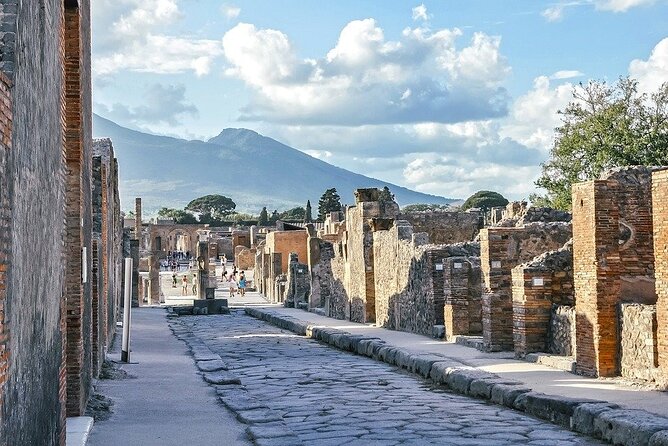
This is a focused, guided sprint through Pompeii’s most meaningful zones. The big value isn’t just seeing ruins; it’s learning how the city worked—where people gathered, worked, shopped, worshiped, and played.
You’ll move from entertainment to housing to public life fast. That can feel intense, but it also helps you avoid the common Pompeii problem: standing in front of a wall and thinking, now what?
Also, this tour keeps you moving on foot through major areas inside the archaeological park, which is perfect if Pompeii is a “one or two visits max” stop on your trip.
You can also read our reviews of more walking tours in Pompeii

Meeting at InStazione and reaching Porta Anfiteatro
The tour departs daily at 10:30 am from the InStazione help desk area. After registering, you walk together with the guide to the entrance at Porta Anfiteatro, where your Pompeii route starts.
The end point is at Scavi di Pompei, Viale delle Ginestre. That matters because you’re not getting pulled back and forth repeatedly—your afternoon plans should be easier to shape once you’re done.
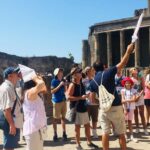
Group size is capped at 35. That’s large enough for a lively group but small enough that your guide can still manage the flow around the busiest ruins.
Teatro Grande (and the Odeon): where comedies and pantomimes happened
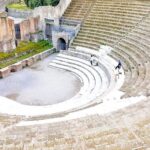
Your tour includes the Teatro Grande, a Roman theater buried by Vesuvius and later uncovered through excavations. Inside it, performances included comedies, mimes, pantomimes, and the atellane style of comedy.
The stop is short, but the payoff is big: theaters are one of the best places to see how Roman culture mixed entertainment with civic identity. When you understand who came to watch and what kinds of shows were staged, the space starts to make sense.
This stop also pairs with the Odeon, described as dating to the period when Pompeii shifted into a Roman colony. Even if you only have minutes here, the two venues together help you grasp the range of performance spaces you’d have found in the city.
What to watch for
If you’re taking photos, aim for quick angles that show the scale of the seating area before the group moves on. This is one of those spots where the “whole shape” matters more than any one detail.
Via Stabiana: the perfectly preserved cobbled street moment
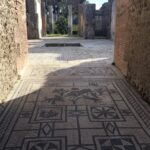
After the theaters, you head along Via Stabiana, described as a perfectly preserved cobblestone street with sidewalks and pedestrian walkways. It’s dotted with spaces that once held shops and homes.
This is one of my favorite parts of any Pompeii walk because it’s the closest thing to time travel in plain sight. Standing on an original street surface helps you picture movement—foot traffic, deliveries, errands, and casual stopping points—things you miss when all you see are building ruins.
It also helps you reset between “big building” stops. Streets give you a mental timeline: entertainment district vibe, then a commercial and residential rhythm.
You can also read our reviews of more historical tours in Pompeii
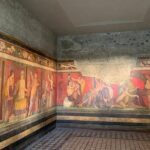
Casa del Menandro: a wealthy domus with a named identity
Next comes Casa del Menandro, a large urban domus of nearly 1,800 m²—a huge clue that this wasn’t a modest home. It was excavated between 1926 and 1932, and it’s often treated as a prime example of how wealthy families lived.
You’ll learn the meaning behind its name. It doesn’t come from the owner; it comes from an image of the Greek poet Menander found there.
A domus stop can go one of two ways: either you get a quick “nice house” and move on, or you get the layout and why it mattered. Here, the tour is built to keep the interpretation moving, not just point at rooms.
Drawback to keep in mind
Because it’s timed (about 15 minutes), you won’t have time to fully “read” the house like an architecture student. Plan to treat this as a guided orientation, then revisit areas later if you want slower detail.
Stabian Baths (Terme Stabiane): the oldest bath complex in the city
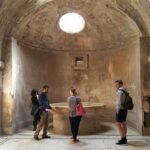
The Stabian Baths are a Roman bath complex buried by Vesuvius and later excavated. The tour notes that they’re the oldest building in Pompeii, which instantly raises their historical importance.
You’ll get time here (about 15 minutes), and the guide focuses on what makes the space easy to picture: male and female sectors are reported as perfectly preserved.
That separation is a key reason bathhouses are so memorable. You aren’t just seeing a building—you’re seeing how Romans structured privacy and routine inside daily life.
Quick practical tip
Wear shoes you can trust on uneven stone. Even though the tour is short, the ground conditions can vary inside the park.
Lupanar: mercenary pleasure as a visible institution
Then comes the Lupanar, described as a house of tolerance where mercenary sexual pleasure was offered. This is one of the tour stops that people tend to remember most, largely because some erotic scenes on the walls are still visible.
The tour doesn’t treat it like shock tourism. The point is understanding how Roman society handled sex, commerce, and business-like transactions in a built environment.
It’s a short stop (about 10 minutes), but it can still feel like a lot because the site is so direct. If you prefer your Pompeii explanations framed around institutions—work, law, worship—this stop fits that pattern.
Foro de Pompeya: temples, courts, and trade in one open hub
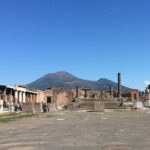
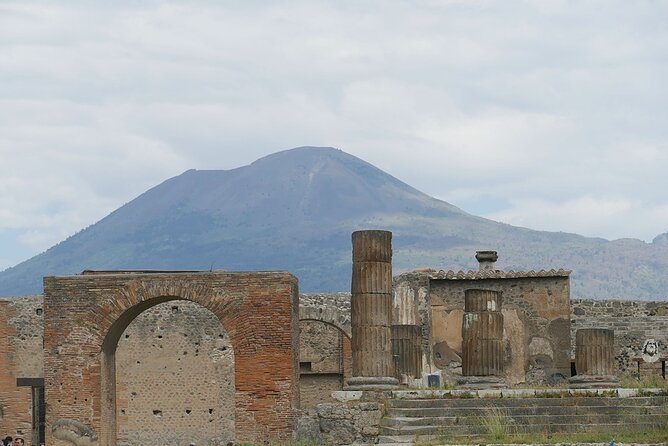
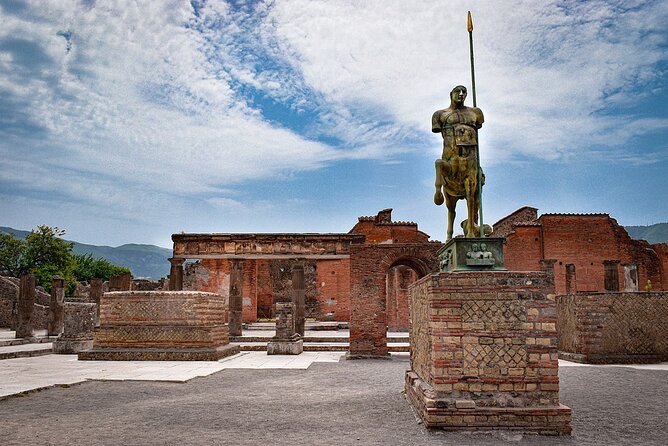
The Forum of Pompeii is where you go to understand the city’s engine room. The tour explains that it was built around the 4th century BC in the Samnite era near major road junctions (roads toward Neapolis, Nola, and Stabiae).
After Roman conquest, it was rebuilt and enlarged, especially in the 2nd century BC. The tour also notes the transition from a space with shops and a perimeter tied to the Temple of Apollo, to a more political and religious center with major buildings around the square.
Temple of Jupiter (Capitolium identity)
At the forum, you also cover the Temple of Jupiter, later associated with Capitolium identity and dedicated to Jupiter, Juno, and Minerva. The tour points out that the erarium (the public treasure) was stored in the temple basement, alongside sacred furnishings and votive offerings.
This is a strong moment for context: you’re not only looking at religion. You’re seeing how the city connected money, power, and worship.
Basilica: the indoor forum for rainy days and legal power
The Basilica is an imposing 2nd century BC building. It’s basically an indoor forum: when the weather pushed public life inside, this was where many activities moved.
You’ll learn about the tribunal area where judges sat above the parties, and how the judge’s platform was reached by a mobile wooden staircase—specifically to reduce the risk of someone attacking the judge.
Even if you only see the outline for a few minutes, this kind of detail is what makes Pompeii feel less like a museum and more like a functioning system.
Temple of Apollo and the granaries: worship and measured trade
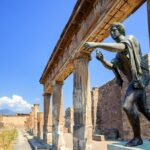
After the Basilica section, you hit the Temple of Apollo. The tour notes the cult of Apollo reached Italic populations through the Greek world. Right before the eruption, the tour explains that Apollo’s following had waned as Jupiter’s importance grew.
You’ll be able to spot a bronze statue of Apollo as an archer, and the tour also notes a visible statue of Diana in front of it.
Then you move to the granaries area, described as a deposit of materials found during excavations. In the past, it served as the market for cereals and legumes, and the tour includes a key interpretive point: no plaster traces were found there, so it’s believed the structure wasn’t finished when the eruption happened.
There’s also a practical trade angle. The tour highlights a ponderary table—a place where tools were kept to help ensure correct exchanges and to convert measurement units from across the empire into units used in Pompeii.
That’s the kind of detail I love because it turns “ruins” into “how people actually bought, sold, and measured things.”
Price and value: $42.05 for tickets plus a guided route
At $42.05 per person for about 2 hours, this tour is priced for value if you’re short on time and want the park essentials covered in a logical order.
The biggest value lever is that the tour includes an entrance ticket and guided tour, with ticket inclusion noted for multiple stops. That means you’re not juggling separate entry timing while you’re already inside Pompeii.
It also helps that the tour is set up with an English-speaking guide and a group limit of 35, which often leads to better pacing than large open-bus crowds.
Who this Pompeii tour suits best (and who should skip it)
This is a great match if you:
- want a structured 2-hour plan for first-time Pompeii visits
- like explanations that connect buildings to Roman daily life
- prefer a guide’s humor and clarity in English (guides such as Grace, Frederica, Vincenzo, and Igor are highlighted as especially engaging)
It may be less ideal if you:
- want long, slow photo sessions at every stop
- dislike walking between sites on a tight schedule
- need extra time for accessibility, since several areas are visited briefly
Should you book this Pompeii Walking Tour?
If Pompeii is on your itinerary for a short window, I’d book this. You get a well-paced mix of entertainment (Teatro Grande), home life (Casa del Menandro), daily routine (Stabian Baths), and the city’s public center (Forum with Jupiter, Basilica, Apollo, and granaries). The tour structure makes the ruins easier to understand, not just easier to look at.
I’d only hesitate if you know you’ll want to linger for 30–60 minutes at a time in just one section. This one is built for coverage, not for deep self-guided wandering. If you want both, do this tour first, then spend extra independent time afterward in the stops that hook you most.
FAQ
FAQ
How long is the Pompeii Walking Tour?
It’s about 2 hours (approx.).
Where does the tour depart, and when?
It departs daily at 10.30 am from the InStazione help desk.
Where does the tour start inside Pompeii?
After registering, you head together with the guide to the entrance at Porta Anfiteatro.
Are entrance tickets included?
Yes. The tour includes an admission ticket, and ticket inclusion is noted for the major stops.
What are the main stops on the route?
You visit places including Teatro Grande, Casa del Menandro, Stabian Baths (Terme Stabiane), Lupanar, and the Forum area with Temple of Jupiter, Basilica, Temple of Apollo, and the granaries area.
Is lunch included?
No lunch is included.
Is the tour offered in English?
Yes, it’s offered in English.
What happens if the weather is bad or I need to cancel?
The tour requires good weather. If it’s canceled due to poor weather, you’ll be offered a different date or a full refund. You can cancel up to 24 hours in advance for a full refund.