REVIEW · POMPEII
Guided Tours of Pompeii Excavations Historical and Cultural Itineraries
Book on Viator →Operated by Bruno Pisano · Bookable on Viator
Pompeii reads better with a guide in hand. I like how the tour spotlights Villa dei Misteri and its Dionysian fresco, and I also like the small group size (max 15) that keeps the pace human. The only real catch: the Pompeii entrance ticket isn’t included, so you’ll need to budget a separate admission.
This is more than a walk through stone. The route is presented with a historiographical and cultural lens, so you’re not just seeing monuments—you’re understanding how this Hellenistic city functioned in the wider Mediterranean world. The guide, Bruno Pisano, focuses on archaeology, history, and philosophy, and he’s known for explaining the daily logic behind what you’re looking at.
The tour runs about 4 hours 10 minutes, starting at 9:30 am. You’ll get a mobile ticket, and the meeting point is the Porta Marina audioguide official area on Via Villa dei Misteri (Via Villa dei Misteri, 2, 80045 Pompei NA). Plan to bring what you need for a few hours outside—snacks aren’t included, and you’ll want to stay comfortable as you move between sites.
In This Review
- Key points to know before you go
- Why this Pompeii route feels like a story, not a checklist
- Price and value: what you’re paying for at $57.62
- Starting at Porta Marina: how the 9:30 start works in real life
- Stop 1: Pompeii Archaeological Park suburban spas and the Nilotic pool
- Stop 2: Tempio di Venere and the Venus terrace view
- Stop 3: Pompei La Basilica, the large Tribunal, and why it feels ahead of its time
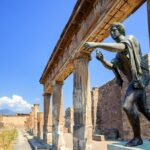
- Stop 4: Temple of Apollo with Greek design and bronze Apollo and Diana
- Stop 5: Foro de Pompeya and the Jupiter–Juno–Minerva power center
- Stop 6: Terme del Foro, Neronian stuccoes, and an Egyptian-origin alabaster labrum
- Stop 7: Casa del Fauno, a Hellenistic palace house and the Battle of Issus mosaic copy
- Stop 8: Casa dei Vettii and the Priapus and Cupids work-cycle
- Stop 9: Casa degli Amorini Dorati with Rhodian peristyle and an Isis shrine
- Villa dei Misteri: the Dionysian fresco that anchors the whole tour
- How much time you really have at each place
- Who this tour is best for
- Should you book this guided Pompeii tour?
- FAQ
- How long is the tour?
- What time does the tour start?
- Where does the tour meet?
- What is the tour group size?
- Is the Pompeii entrance ticket included in the price?
- Does the tour include Villa dei Misteri?
- Are snacks included?
- Is there a mobile ticket?
- Is confirmation provided after booking?
- What is the cancellation policy?
Key points to know before you go
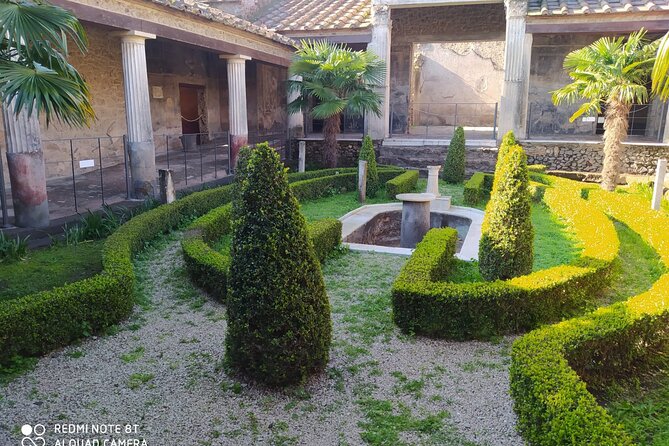
- Villa dei Misteri is the headline: the Dionysian fresco (first century BC) is included for a full stop with context.
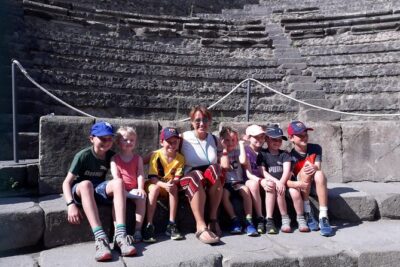
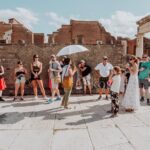
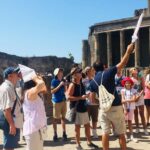
- Small group pace: max 15 travelers, with guide support throughout and more time for questions than big-bus tours.
- A true mix of sacred and everyday: temples, public buildings, baths, and elite homes all show different sides of Pompeii.
- Neronian-style wall art and mosaics: you’ll see highly specific details like the Priapus fresco cycle and the Nilotic spa imagery.
- Admission ticket not included: the guided part is priced clearly, but park entry is on you.
Why this Pompeii route feels like a story, not a checklist
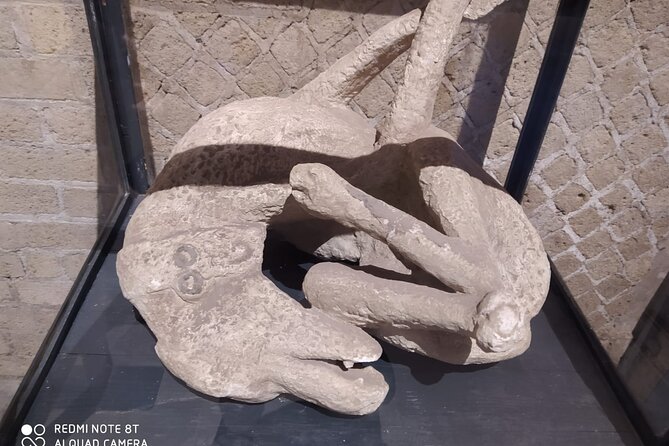
Pompeii can feel like a photo album: impressive, but easy to skim. This tour is built to prevent that. You’re guided through a sequence that links public power, religious life, leisure spaces, and domestic art—so the city starts to feel coherent.
What I really like about this approach is the emphasis on Pompeii as Hellenistic, not just a Greek look-alike or a Roman stage set. The tour frames Pompeii as a major commercial and industrial center with connections across the Mediterranean world—Asia Minor, Persia, and even references to far-reaching trade networks. That bigger picture changes how you read the art and architecture you’re seeing.
The interpretation also touches on the Mystery cult atmosphere (the Dionysian and Isiac Mystery traditions) and how religious ideas shaped daily life. It even gestures at how people might have understood the eruption through a spiritual lens—using strong biblical comparisons like Sodom and Gomorrah to explain how catastrophe can get translated into meaning.
You can also read our reviews of more guided tours in Pompeii

Price and value: what you’re paying for at $57.62
At $57.62 per person, you’re mainly paying for the guide, specialized interpretation, and the paced route across the park. The tour explicitly includes guide and assistance for the entire duration, and it’s led by someone specialized in archaeology, history, and philosophy.
The key value question is the separate Pompeii entrance ticket. Since entrance isn’t included, your real total will be higher than the tour price alone. If you already know you’ll want a guided experience, this can still be a good deal—because Pompeii is huge, and a specialist can help you see what you’d otherwise miss.
Snacks are not included either. That’s not a deal-breaker, but it does mean you should plan for an easy break during the tour window if your stomach needs it.
Starting at Porta Marina: how the 9:30 start works in real life

You meet at the Porta Marina audioguide official location near Via Villa dei Misteri, 2 (80045 Pompei NA). The start time is 9:30 am, and the tour ends back at the same address area on Via Villa dei Misteri.
Because the tour runs roughly 4 hours 10 minutes, you’ll want to arrive a few minutes early, get your bearings fast, and be ready to walk. Mobile ticket delivery helps reduce last-minute paper scrambling, and the tour notes it’s near public transportation.
Also, the group is small—maximum 15 people per guide. That matters at Pompeii, where crowd flow and viewing time can make or break your experience.
Stop 1: Pompeii Archaeological Park suburban spas and the Nilotic pool
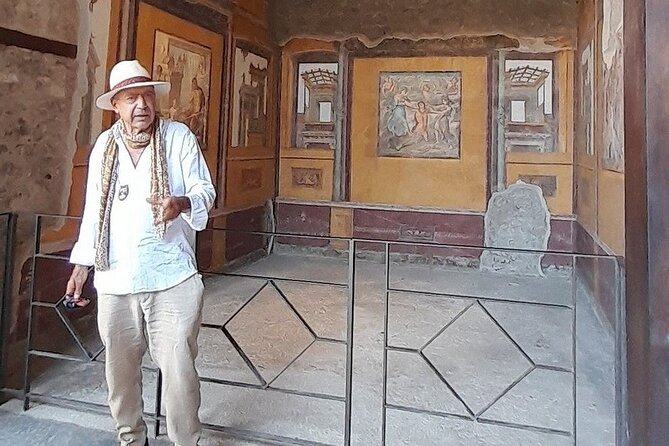
Your first stop is at Pompeii Archaeological Park, focusing on the suburban spa areas. The tour highlights the frigidarium, including a nymphaeum described as glass-paste and polychrome glazed tiles. It also points out a swimming pool frescoed with Nilotic subjects.
Why this stop matters: baths are where you learn how Romans and Hellenized Romans mixed health, social life, and decoration. A spa isn’t just plumbing—it’s theater for everyday relaxation.
Potential drawback: this is the kind of place where details are visually rich, but time is limited. With a 25-minute stop, you’ll get a guided orientation and some key points, but you won’t have endless time to stare at every surface.
Stop 2: Tempio di Venere and the Venus terrace view
Next is the Tempio di Venere. The tour frames it as a key religious stop tied to the Imperial cult and as the goddess associated with sailors. Architecturally, the temple sits on a terrace that dominates the surrounding area.
A standout detail here is a bronze statue depicting Daedalus by the Polish artist Igor Mitoraj. That contemporary sculpture adds a bridge between modern art and ancient myth, and it’s a useful moment to reset before moving into more densely packed public spaces.
Possible consideration: if you’re sensitive to stairs or uneven ground, be prepared for temple terrain. The stop is still short, but Pompeii’s topography is real.
You can also read our reviews of more historical tours in Pompeii
Stop 3: Pompei La Basilica, the large Tribunal, and why it feels ahead of its time
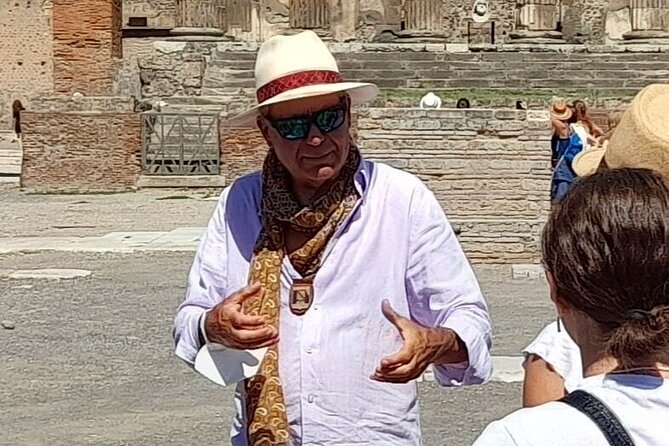
Then you’re at Pompei La Basilica, described as the great Tribunal of Pompeii and the largest public building in the city. The tour notes it has three naves and anticipates the typology of later Christian basilicas.
This is the stop where Pompeii starts to feel like a functioning system, not just preserved ruins. Here you can imagine legal and administrative life—where rules were made, decisions were issued, and public identity mattered.
Time reality: you’ll get a guided overview and the main architectural cues, but this isn’t a slow museum moment. It’s a fast, informative stop designed to keep the story moving.
Stop 4: Temple of Apollo with Greek design and bronze Apollo and Diana
At the Temple of Apollo, the focus is ethical and prophetic worship. The structure is described as a magnificent building of Greek design, with a stupendous architectural and plastic configuration.
You’ll also see two dominant bronze statues: Apollo and Diana. This is another “look up and take it in” stop, because these religious images anchor what the temple meant to people.
Drawback: bronze statues and decorative elements can get crowded with sight-lines. With a tight stop window, you’ll want to stand where the guide points, then shift only if it doesn’t block others.
Stop 5: Foro de Pompeya and the Jupiter–Juno–Minerva power center
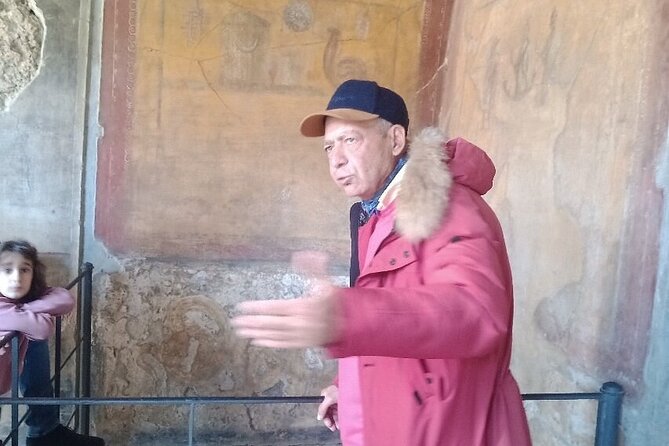
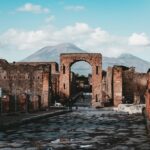
Next up is the Foro de Pompeya, the city’s commercial, administrative, and religious hub. The tour describes it as an urban complex with majestic grandeur, dominated by the Temple of Jupiter, Juno and Minerva.
This stop is important because the forum is where civic identity, religion, and daily business overlapped. Even if you don’t speak Latin or know every office, the physical layout tells you who mattered and what ceremonies shaped public life.
Consideration: the forum can feel like open-air walking plus constant context. If you’re the type who likes to pause and read every marker independently, you may find you have to trust the guide’s pacing instead.
Stop 6: Terme del Foro, Neronian stuccoes, and an Egyptian-origin alabaster labrum
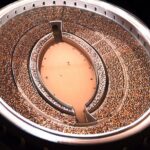
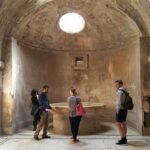
The tour shifts from civic space to wellness at Terme del Foro (the Forum Baths), described as a wellness center and SPA for the community. Here the stop focuses on the tepidarium, including stuccoes from the Neronian school, and on the calidarium with a grand alabaster labrum of Egyptian origin.
This combination is fascinating for two reasons. First, it shows how tastes and aesthetics travelled. Second, it reinforces how elite life mixed comfort with status—decor was part of the experience, not decoration afterthought.
Possible drawback: the stop is only 25 minutes, so you’ll get guided highlights rather than deep manual inspection of each finished surface.
Stop 7: Casa del Fauno, a Hellenistic palace house and the Battle of Issus mosaic copy
At Casa del Fauno, you’re entering a major domestic space—described as the largest palace house in Pompeii from the Hellenistic era. This is where the tour leans into elite wealth and art ownership.
One key feature is an excellent copy of a famous Roman-world mosaic: the Battle of Issus (333 BC) depicting Alexander the Great against Darius III of Persia.
Why it matters: this is not just about pretty pictures. It’s about how elite households used art to signal connections to legendary power and imperial narratives. You start to see Pompeii as a city where culture, politics, and branding lived under the same roof.
Time consideration: domestic interiors can feel like multiple rooms inside one stop. Your guide will help you prioritize what to notice.
Stop 8: Casa dei Vettii and the Priapus and Cupids work-cycle
Next is Casa dei Vettii, known on this tour for its fourth Pompeian style frescoes. You’ll learn about the famous Priapus of the Neronian school and a majestic hall filled with Cupids intent on working activities.
The tour also points out a grander pictorial cycle from the Neronian school, including mythological paintings such as Daedalus and the Minotaur.
This stop is a great example of what makes Pompeii special: art that feels story-driven and slightly human. Even when the myth is famous, it’s the domestic setting that makes it stick.
Potential drawback: frescoes and wall paintings can be fragile and sometimes viewed from specific angles. That means you should focus on the guided viewing points rather than expecting total freedom to move.
Stop 9: Casa degli Amorini Dorati with Rhodian peristyle and an Isis shrine
In Casa degli Amorini Dorati, the tour highlights a perfectly preserved Pompeian domus with a Rhodian peristyle. It also mentions obsidian mirrors, plus a dedicated shrine for the cult of Isis.
You’ll also see a lararium—the protector gods of the house—and the tour notes frescoes connected to the Trojan War.
This stop helps you understand religion at the household scale. Public temples matter, but daily worship, protective practices, and identity rituals were also built into homes.
Time consideration: domus interiors can feel like one room after another. In a guided 25 minutes, you’ll get the emotional and symbolic meaning, plus a few concrete visual anchors.
Villa dei Misteri: the Dionysian fresco that anchors the whole tour
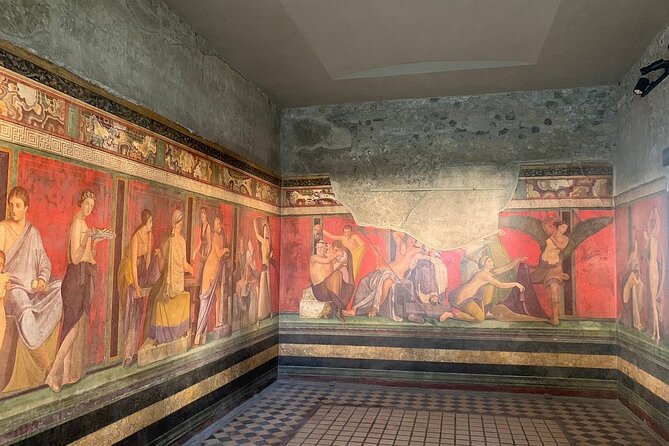
The final stop is Villa dei Misteri, including the famous Dionysian fresco from the first century BC. The tour emphasizes its exceptional state of conservation, and it’s presented as unique in the world for how well it survives.
This is the stop that gives the route its name and its mood. Earlier stops show the city’s public and private machinery; Villa dei Misteri gives you a window into the kind of spiritual symbolism people wanted to hold close. If you like culture and belief systems, this is where the city becomes more than architecture.
Practical note: since this is the last major visual centerpiece, I’d treat it like your payoff stop. Slow your attention a notch. Let the guide finish the story before you start mentally packing up your camera roll.
How much time you really have at each place
Every stop is listed at about 25 minutes, including the Villa dei Misteri stop. That schedule adds up to the tour’s approx. 4 hours 10 minutes, with a quick rhythm through multiple zones.
This can be ideal if you want expert interpretation without turning your day into an all-day endurance test. It can also be limiting if you’re the type who wants to wander slowly and read every corner on your own.
My advice: go in wanting the main points and a clear mental map. Then, if you love the place, plan a return later for extra time in the specific areas that caught you.
Who this tour is best for
This guided experience is a strong fit if you want:
- A specialist guide focused on archaeology, history, and philosophy
- A small group pace (max 15) that helps you actually process what you’re seeing
- A Pompeii visit that connects daily life with religion and art, including Mystery cult themes
- A route that treats Pompeii as Hellenistic—a commercial and cultural hub rather than a simple Roman backdrop
It also seems well suited for families in the sense that the guide’s style is described as mixing ancient life with modern ways of understanding human behavior. If you’re traveling with younger kids, this kind of storytelling can make the ruins feel less abstract.
Should you book this guided Pompeii tour?
If you’re choosing between a self-guided wander and a guided structure, I’d book this. The route is built around meaningful stops—spas, temples, the forum, elite houses—and it finishes with Villa dei Misteri, the one site that most people remember even after the rest blurs.
Do one careful check before you go: because the Pompeii entrance ticket isn’t included, confirm what you’ll pay overall once you add admission. If you’re already planning to buy tickets anyway, this tour price plus the specialist guidance can be a very solid value for a half-day.
If you hate group pacing and want long, private time inside each building, you might prefer a slower option. For most people who want Pompeii to make sense fast, this one is a smart bet.
FAQ
How long is the tour?
The guided tour lasts about 4 hours 10 minutes (approx.).
What time does the tour start?
The start time is 9:30 am.
Where does the tour meet?
You start at Porta Marina audioguide official, Via Villa dei Misteri, 2, 80045 Pompei NA, Italy.
What is the tour group size?
The maximum is 15 travelers per guide.
Is the Pompeii entrance ticket included in the price?
No. The entrance ticket to the Pompeii Ruins is not included.
Does the tour include Villa dei Misteri?
Yes. Villa dei Misteri is included, including the famous Dionysian fresco.
Are snacks included?
No. Snacks are not included.
Is there a mobile ticket?
Yes, the tour features a mobile ticket.
Is confirmation provided after booking?
Confirmation is received within 48 hours of booking, subject to availability.
What is the cancellation policy?
Free cancellation is available up to 24 hours in advance for a full refund. If you cancel less than 24 hours before the start time, the amount paid is not refunded.