REVIEW · POMPEII
Private Pompeii and Vesuvius with Wine Tasting and Full Tickets
Book on Viator →Operated by Leisure Italy · Bookable on Viator
Pompeii and Vesuvius feel like two trips in one. This private day pairs guided Roman ruins with a driver-led run up Mount Vesuvius, then ends with a family-run winery lunch and tasting at the volcano’s slopes.
I especially like that the itinerary is guided and stop-based, so you get the key sights without the usual wandering. I also like the wine-and-lunch structure because it turns the day’s walking into a real break, not just a stop for snacks.
One consideration: you do need moderate fitness, since you’ll walk a fair amount in Pompeii and climb a gravel-and-ash trail on Vesuvius in sun and wind.
In This Review
- Key things that make this tour worth your time
- Why This Private Pompeii + Vesuvius Day Works
- The Pompeii Route: Picked Highlights Without the Guesswork
- What you’ll likely feel
- A practical heads-up
- Stops Worth Your Time: From Porta Marina to the Forum Baths
- Kid-Friendly Pompeii: The Pompeii for Kids Approach
- Climbing Vesuvius: Gravel, Wind, and a Short Volcanologist Talk
- Cantina del Vesuvio Winery Lunch and Tasting on Volcanic Slopes
- Lunch menu: simple, local, and filling
- Wine tasting: plan for a slow finish
- Price and Logistics: Is $701.99 a Smart Value?
- Who This Tour Fits Best (and Who Should Think Twice)
- Should You Book This Private Pompeii and Vesuvius Tour?
- FAQ
- FAQ
- How long is the private Pompeii and Vesuvius tour?
- Does this tour include tickets for Pompeii and Vesuvius?
- Is pickup available, and from where?
- Is the tour private or shared?
- Will I have a guide, and is English available?
- Is there a kid-friendly option for Pompeii?
- What’s the Vesuvius climb like?
- What if someone doesn’t want to climb Vesuvius?
- Can I cancel for a full refund?
Key things that make this tour worth your time
- Private transport that keeps you moving with pickup offered from Naples, Sorrento, Pompeii, train stations, and even cruise terminals/ports
- Full Pompeii ticketing included and a guide who selects highlights rather than listing everything
- Vesuvius walking with a built-in volcanologist talk (English, short, and repeated in the schedule)
- Wine tasting plus a set lunch at Cantina del Vesuvio in the Vesuvius National Park area
- A kid-focused Pompeii option built around activities for ages 6 to 11
- Short, frequent stops that make it easier to manage a long day (8 to 9 hours)
Why This Private Pompeii + Vesuvius Day Works
If you’ve ever tried to plan Pompeii on your own, you know the problem: the site is huge, you can’t see everything well, and you end up making tradeoffs with no clear way to choose. This tour solves that by being private and guided, with a clear sequence of places and admission handled for you.
You’ll also like the pacing. Pompeii gets about half the day, with many stops kept to tight windows. Then the Vesuvius component adds a nature-and-view payoff, and the winery lunch gives you something concrete to look forward to instead of a vague end-of-day promise.
And yes, it’s family-friendly in a real way: there’s an optional Pompeii for Kids format (for ages 6 to 11) that uses interactive activities so kids stay engaged instead of just getting dragged along.
The big “why” here is control: private transport, a guide who can steer the day where you want, and stops with included tickets. That’s a lot of stress removed on a trip that’s otherwise easy to overplan.
You can also read our reviews of more tours and experiences in Pompeii


The Pompeii Route: Picked Highlights Without the Guesswork
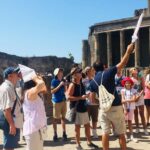
Pompeii shines when you understand what you’re looking at. A good guide helps you connect the dots fast: how people entered the city, where civic life happened, what they ate, and how daily routines worked. This tour builds those links by moving you through a mix of public spaces, religious sites, markets, baths, and homes.
The Pompeii stop is about 2 hours at the Archaeological Park, and the tour selects highlights for your walk. In other words, you’re not trying to cover the entire site like it’s a checklist. You’re learning the structure of Pompeii—its neighborhoods and rhythms—so the ruins feel less random.
You’ll also pass through major anchor points that help you build mental maps. Porta Marina e cinta muraria shows how access and defense worked near the port approach. The Forum area gives you the civic heartbeat. And the later theater and residential blocks help you see Pompeii as more than stone streets.
What you’ll likely feel
A guided Pompeii day can feel fast, but it’s usually the right kind of fast. Instead of getting lost, you keep moving from one “type” of place to another. That makes Pompeii easier to remember after you leave.
A practical heads-up
Some stops are only a few minutes long (for example, Porta Marina and Temple of Apollo are short). That’s not bad. It’s how you keep the full day from stretching into something exhausting.
Stops Worth Your Time: From Porta Marina to the Forum Baths
This itinerary doesn’t try to squeeze in every famous ruin. It targets places that explain how the city worked.
Here’s what each stop brings:
Porta Marina e cinta muraria (main gate and walls)
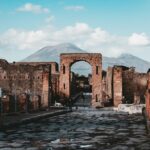
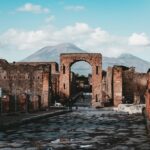
This is your entry point into the city’s “front door” story. Porta Marina was a key gate and a nearby connection to defensive walls. You can still see how people would have walked along original stone ramping and how Pompeii managed who came in—merchants, sailors, and visitors arriving from the Bay of Naples. It’s short, but it’s a strong orientation moment.
Temple of Apollo (religion tied to daily life)
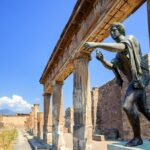
Apollo’s temple is one of Pompeii’s older and most important religious places. You’ll learn what it meant in civic-spiritual life—offers, guidance, and the kind of public religious space that wasn’t tucked away. Even the short time matters here because the guide can frame why temples were placed where they were.
Forum of Pompeii (the civic center, seen from the right angle)
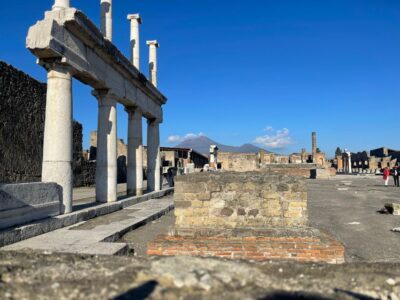
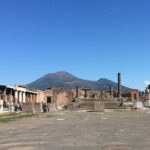
The Forum is where politics, religion, and commerce overlap in one monumental square. From the modern terraces and walkways, you can understand the layout between temples, administrative buildings, and market structures. The view is part of the point: you catch the whole square’s logic instead of only standing inside one doorway.
Macellum (Pompeii’s main food market)
This covered food market shows how supplies and daily hunger were organized. The layout of stalls, storerooms, and the central shrine helps you picture the market as both commerce and community. You’ll see excavated counters and marble tables that hint at how busy trade looked before the eruption.
Terme del Foro (the Forum Baths and Roman social life)
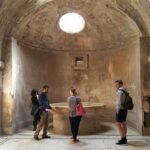
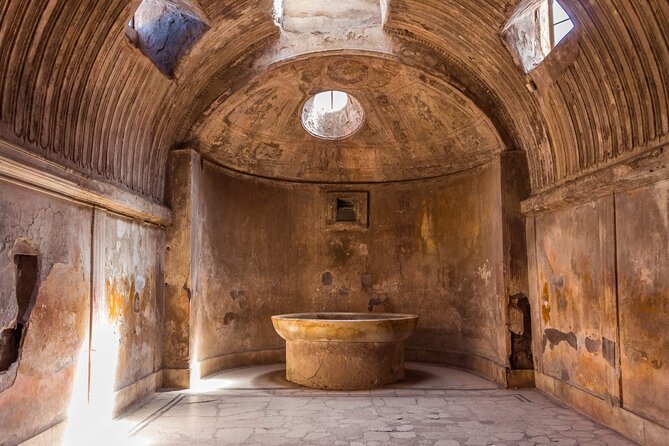
Baths weren’t just hygiene. They were a social and leisure space with warm and hot bathing halls, changing rooms, and cold plunge areas. The hypocaust heating system explains the engineering, while preserved stucco reliefs and vaulted ceilings show that public bathing could feel refined.
Casa dei Vettii (elite home with serious art)
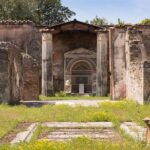
This aristocratic residence brings you into wealthy merchant life. Frescoes, atrium and peristyle layout, and the feel of an artistic home help you understand status in Pompeii—not just how people lived, but what they wanted to signal.
Insula dei Casti Amanti (a neighborhood frozen mid-routine)
This block is named after a vivid lovers’ fresco. It’s accessed via ramps so you can see below without damaging fragile surfaces. From above, you’ll picture workshops, storerooms, and domestic rooms connected to daily trade and family movement—exactly the kind of street-level “how it really worked” understanding Pompeii does best.
Teatro Grande (public entertainment with dramatic sightlines)
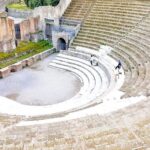
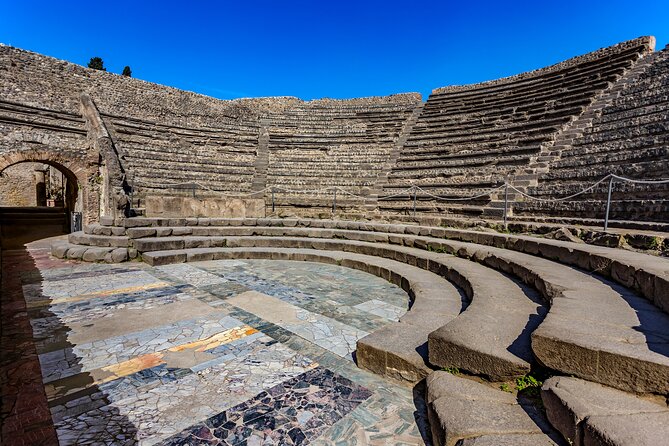
Theater isn’t just architecture. It’s a social event. The Teatro Grande’s seating tiers and stage area help you imagine performances and crowds. The view toward the city and Mount Vesuvius also gives your brain a link: today’s geography explains Pompeii’s setting.
Antiquarium di Pompei (a smart mental warm-up and a strong emotional frame)
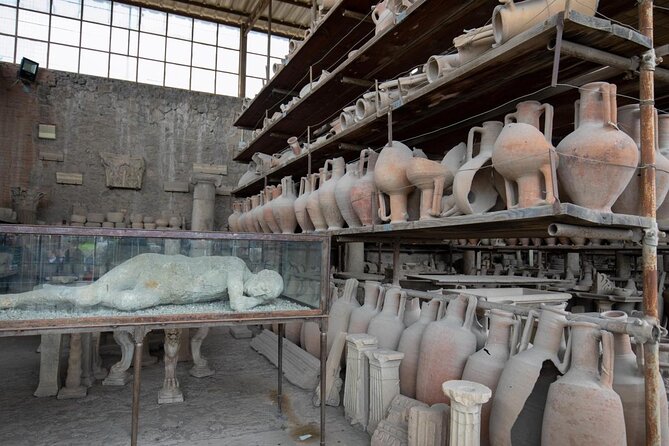
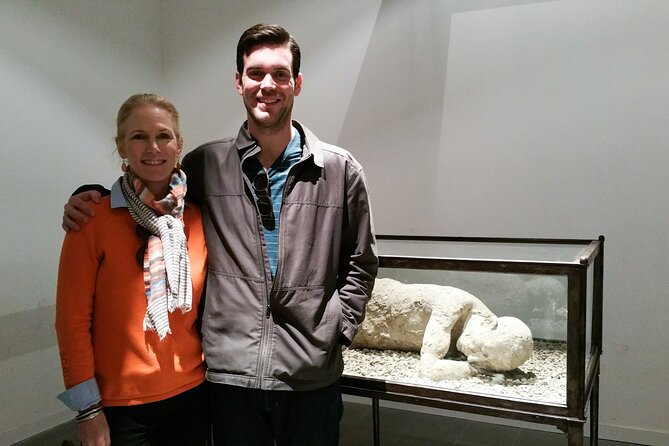
This museum-like stop helps you learn before you walk deeper. You’ll see statues, household objects, inscriptions, and jewelry, plus context panels and reconstructions. It also includes plaster casts of victims and eruption material in later rooms. That emotional turn is useful, because it keeps the ruins from becoming only “cool rocks.”
You can also read our reviews of more food & drink experiences in Pompeii




Kid-Friendly Pompeii: The Pompeii for Kids Approach
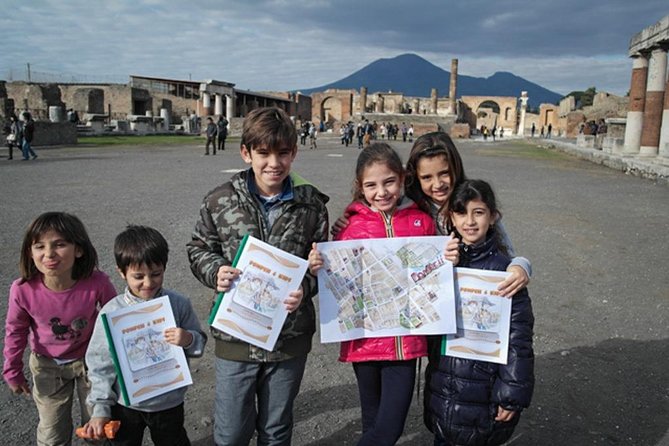
If you’re traveling with children, the optional Pompeii for Kids add-on is one of the strongest reasons to choose this operator. It’s recommended for kids ages 6 to 11 and focuses on activities and games that make the ancient town feel like something they can actually interact with.
The key thing for parents: this isn’t just a “shorter tour.” It’s built to turn learning into play during the hardest part of Pompeii—staying interested while walking and reading ruins.
If your kids are younger or less into museum-style details, you’ll still likely enjoy the private format because you can manage stops better. But if your group includes ages 6 to 11, this kids-focused option can make the day feel less like a chore.
Climbing Vesuvius: Gravel, Wind, and a Short Volcanologist Talk
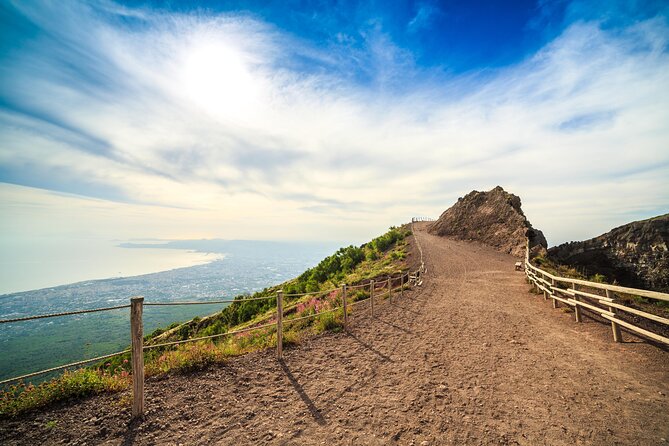
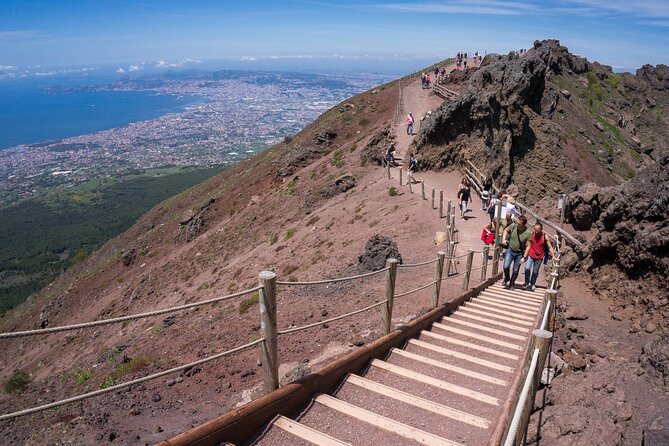
Vesuvius adds the “why it happened” layer. The driver handles tickets and takes you as close as possible to the trail’s start. The climb itself is about 30 minutes on a trail made of gravel and ash.
Expect sun and wind. That’s not a soft suggestion; it’s part of the experience. Come prepared, because comfort affects how much you enjoy the views when you’re up there.
At the top, you’ll get a live introduction from a volcanologist. It’s a shared talk in English that starts every few minutes, so you don’t feel like you missed it. After that, you can walk halfway around the crater on your own for about 30 minutes.
On a clear day, this is where your photos look good fast. When visibility is limited, you’ll still get the eruption context and the scale—but the view payoff depends on weather.
If you don’t feel like climbing, there’s a café by the parking lot. The tour structure includes the option, so you’re not stuck committing to the full hike.
Cantina del Vesuvio Winery Lunch and Tasting on Volcanic Slopes
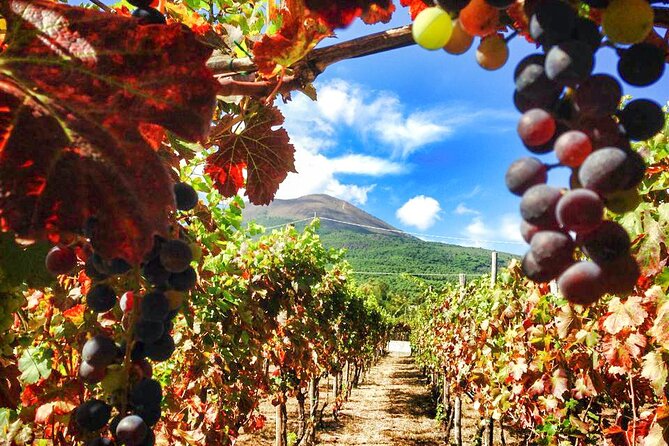
This is one of the most enjoyable parts of the day, because it’s timed for you to refuel before the final return from Vesuvius. The winery stop is at Cantina Del Vesuvio (Famiglia Russo), described as a family-run operation since 1930, perched on Vesuvius slopes.
You can explore the vineyards and taste signature wines in a setting that actually fits the place. Instead of driving to a random countryside cellar, you stay where the volcanic terroir theme stays real.
Lunch menu: simple, local, and filling
You get a set meal:
- Appetizers: bruschetta plus provolone cheese and cured meats
- Main: spaghetti with cherry tomatoes del Piennolo from Mt Vesuvius
- Dessert: pastiera (wheat and ricotta cake)
This isn’t a fancy “foodie tasting” in the abstract. It’s a straightforward local meal that makes the rest of the day easier.
Wine tasting: plan for a slow finish
You’ll taste multiple wines, including a rosé sparkling, white, rosé, red, red reserva, and a sweet dessert wine. Even if you’re not a heavy drinker, give yourself time to enjoy it, because the day is long and you’ll still need to get back down and meet the driver.
Price and Logistics: Is $701.99 a Smart Value?
Let’s talk value in the real world. At $701.99 per person for an 8 to 9 hour private day, you’re paying for three big things that add up quickly if you DIY Pompeii and Vesuvius.
1) Private transport that reduces planning friction
Pickup is offered from Naples, Sorrento, Pompeii, train stations, airports, and cruise terminals/ports. That kind of door-to-door routing can save time and headaches, especially if you’re staying outside the immediate Pompeii area.
2) Full tickets handled as part of the schedule
Admission is included across the main Pompeii stops and the winery and Vesuvius parts. It’s not you hunting down timed entry or trying to stitch together museum tickets on the fly.
3) Guide time that makes Pompeii make sense
Pompeii is confusing without context. A guide who chooses highlights keeps the day focused. That’s also why the short stops work—you’re seeing places that build a story, not just collecting “I stood here” photos.
The main tradeoff is obvious: it’s not cheap. If you’re traveling solo and don’t care about a guided framework, a group or self-guided approach could be less expensive. But if you value a smooth route, included entry, and a day that doesn’t turn into a logistics puzzle, this pricing can feel fair.
Who This Tour Fits Best (and Who Should Think Twice)
This is a strong fit if you:
- Want a private Pompeii day with a guide selecting the best highlights
- Are okay with walking and want moderate fitness for Vesuvius
- Like wine and want lunch included, not just a stop to buy food
- Travel as a family with kids around ages 6 to 11 and want the Pompeii for Kids option
- Want hotel or cruise pickup so your day starts clean
You might think twice if:
- You’re hoping for a mostly sit-down day. Pompeii walking adds up.
- You strongly dislike windy, sun-exposed outdoor time. Vesuvius includes both.
- You want to move at a very slow pace with lots of free time in one spot. The itinerary runs as a set sequence.
One more note: the tour is described as family-friendly and private, but it still moves. If your group gets impatient with short stop windows, you may prefer a version with fewer site changes.
Should You Book This Private Pompeii and Vesuvius Tour?
I’d book it if your top goals are these: Pompeii that actually feels understandable, Vesuvius without ticket stress, and a winery meal that ties the day together.
It’s especially worth it if you want the “guided story” approach rather than the “I’ll wander and hope for the best” approach. The win here is control: private transport, a guide who keeps Pompeii focused, and a volcanologist talk that adds meaning to the climb.
If you’re on the fence, focus on one decision point: are you comfortable with moderate walking plus an outdoor climb in sun and wind? If yes, the day has a clear payoff loop—ruins, crater views, and then real lunch and wine at Cantina del Vesuvio.
FAQ
FAQ
How long is the private Pompeii and Vesuvius tour?
The tour runs about 8 to 9 hours.
Does this tour include tickets for Pompeii and Vesuvius?
Yes. Admission tickets are included for the Pompeii stops, the Antiquarium, the winery lunch/tasting, and the Vesuvius National Park portion.
Is pickup available, and from where?
Pickup is offered from Naples, Sorrento, Pompeii, hotels or vacation rentals, train stations, airports, and cruise terminal/port areas. You need to specify your pickup place when booking.
Is the tour private or shared?
This is a private tour/activity, meaning only your group participates.
Will I have a guide, and is English available?
Yes, you’ll have a guide, and the tour is offered in English.
Is there a kid-friendly option for Pompeii?
Yes. There’s an option recommended for kids from 6 to 11 years with Pompeii for Kids activities and an interactive tour book.
What’s the Vesuvius climb like?
You’ll take a trail made of gravel and ash for about 30 minutes up, and you’ll be in sun and exposed to wind. At the top, you’ll hear a live introduction from a volcanologist in English, then you can walk halfway around the crater for about 30 minutes.
What if someone doesn’t want to climb Vesuvius?
There is a café by the parking lot if someone does not feel like climbing up.
Can I cancel for a full refund?
Yes. Free cancellation is available up to 24 hours in advance for a full refund. If you cancel less than 24 hours before, you won’t get a refund.