REVIEW · POMPEII
Private Pompeii Tour with 3D Virtual Reality Headset – Tour Assistant Only
Book on Viator →Operated by Flashback Journey to Pompeii · Bookable on Viator
If you like history with a tech twist, this works. In Pompeii, you’ll walk the ruins and add a 3D Virtual Reality layer that shows how streets and buildings looked before Vesuvius changed everything.
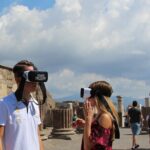
I like the mix of VR playback inside the site with real-time walking. You get a staff 5-minute VR training at the start, then a tour assistant guides you around while the headsets present up to 15 recreated 3D videos with audio commentary.
One consideration: the assistant is not a licensed guide, so you’ll get orientation and pacing, but not in-depth archaeology answers on the spot. If you’re the type who wants deep explanations for every corner, you’ll need to plan for that elsewhere.
In This Review
- Key Things to Know Before You Go
- 3D VR at Pompeii: what you’re really buying
- The 2.5-hour flow: training, headset stops, and walking time
- What the tour assistant can (and can’t) do
- Why the VR recreation adds meaning (not just wow factor)
- Languages: headset audio vs. assistant conversation
- Timing and departures: morning or afternoon
- Price and value: is $124.02 per person a fair deal?
- Comfort, safety, and who should think twice about VR
- How the walking part works with uneven Pompeii terrain
- Who this tour is best for
- Meeting points: where to start and where you’ll end
- Should you book this Pompeii VR tour?
- FAQ
- How long is the Pompeii private VR tour?
- What is included in the price?
- Are headset videos included?
- What languages are available?
- What are the age limits for the VR headset?
- Is this tour led by a licensed archaeological guide?
- Do I need to choose a morning or afternoon departure?
- Where do I meet the tour?
- Where does the tour end?
- What is the cancellation policy?
Key Things to Know Before You Go
- Private tour, your group only: you won’t get folded into a big crowd.
- VR first, then walking: you’ll switch between headset moments and seeing the ruins for real.
- Skip-the-line Pompeii entrance included: you trade waiting time for actual time in the park.
- Assistant speaks only English and Italian: headset audio covers more languages.
- Headsets are Gear VR style: minimum age is 9, and manufacturer guidance leans cautious under 13.
- Assistant can’t answer archaeological questions: commentary is mainly delivered through the headset.
3D VR at Pompeii: what you’re really buying
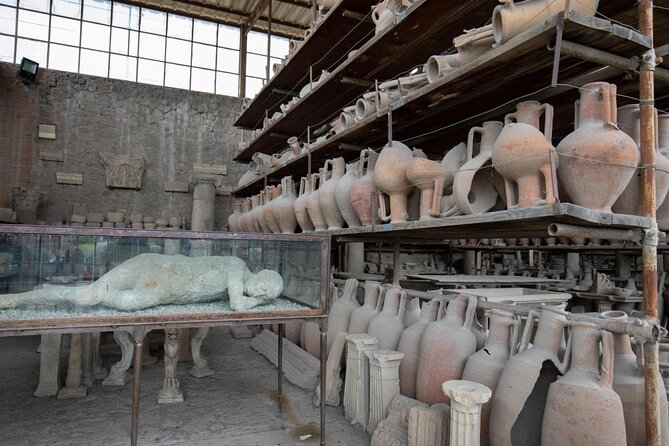
This isn’t a “watch a video in a room” kind of tour. You’re in the Pompeii Archaeological Park, and you’ll be physically moving through uneven terrain while the headset overlays 2,000-year-old Pompeii scenes onto what you see around you.
That matters because Pompeii can feel like a jumble at first: walls without roofs, floors without ceilings, and streets that only make full sense when you can mentally rebuild the setting. The VR layer helps you get your bearings fast. It’s not just spectacle. It’s a way to connect the standing stones to the lived-in spaces—temples, homes, shops, theaters, and streets—before the eruption.
Also, the tone of the tour is practical. You get a short setup, clear timing, and audio commentary through the headset in the language you choose. The human touch is there too, with a tour assistant who helps you stay on track and ready for the next VR segment.
You can also read our reviews of more private tours in Pompeii



The 2.5-hour flow: training, headset stops, and walking time
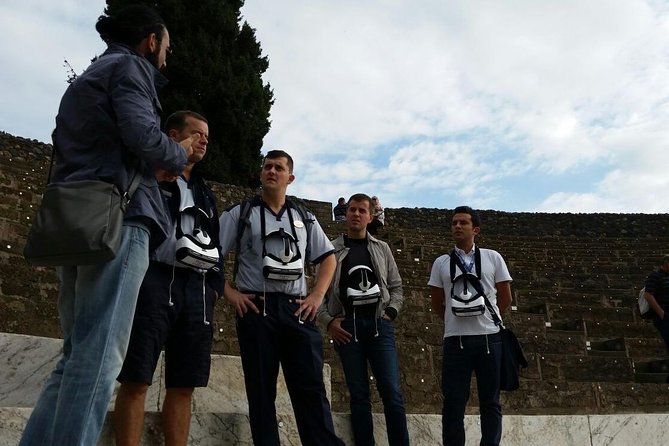
Plan for about 2 hours 30 minutes on the ground. The rhythm goes like this:
1) Quick VR training (about 5 minutes)
At the start, a staff member explains how to use the VR headset. This is one of the smartest parts of the experience, because it reduces the “learning curve” while you’re already surrounded by ancient ruins. You’ll know what to do before you start moving through the site.
2) Assisted walk through the park
Once you’re geared up, you walk through the ruins with the tour assistant. The assistant isn’t delivering a full licensed-guide talk, but they do lead you from area to area and manage the timing so the headset moments don’t become chaos.
3) Up to 15 3D virtual reality videos
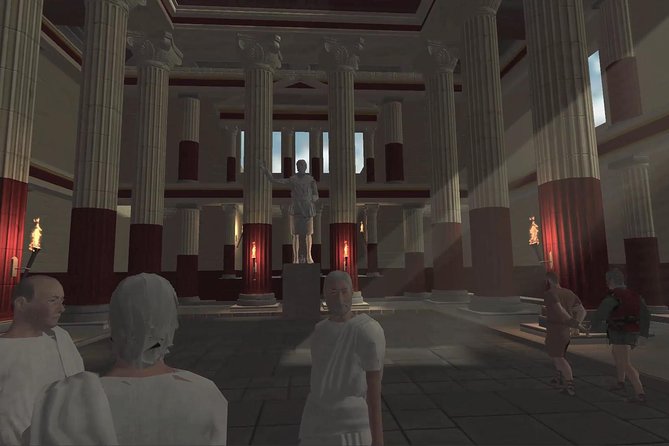
Inside the ruins, the headset takes over for short segments. The goal is to recreate Pompeii as it was roughly 2,000 years ago before Mount Vesuvius. You’ll see major categories of spaces come to life—streets, markets, homes, and public buildings—rather than random “effects.”
4) Audio commentary through the headset
Instead of relying on a spoken guide for every detail, you’ll listen through the headset. That’s a big advantage if your group includes different language comfort levels—though the assistant’s in-person language is still limited.
5) Real-world viewing between VR moments
The tour works best when you keep glancing back at the ruins during the walking stretches. The best “aha” moments happen when your eyes catch something in the real stonework that matches what you just saw in VR.
What the tour assistant can (and can’t) do
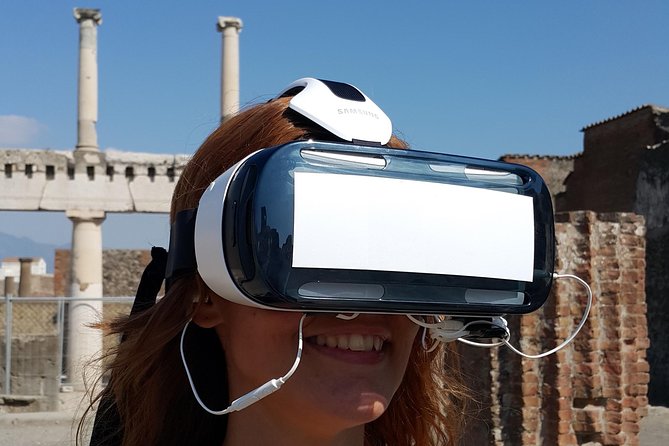
This is worth spelling out clearly.
Your tour includes a tour escort/host, but the assistant is specifically described as not a licensed guide. That means they’re not allowed to answer questions about the archaeological site in the way a certified guide would.
In practice, that still leaves you with useful support:
- You’ll get guided movement and timing through the park.
- The assistant can help you enjoy the experience without getting stuck.
- You’ll get help with the headset flow and pacing.
One of the best bits from the experience description is that your assistant is hands-on with the practical side. In one account, the assistant helped the family balance VR time and photo time so nothing felt rushed or lost.
If you want the deeper “why this wall is shaped that way” level of info, treat this as a visual interpretation tour first. Add your technical questions to another visit with a licensed guide, or use Pompeii independently with printed context after.
Why the VR recreation adds meaning (not just wow factor)
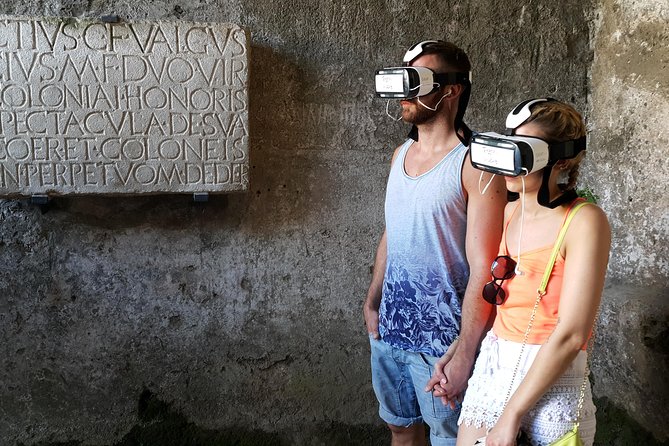
VR can be gimmicky in travel. Here, the value comes from how VR is used: to explain spatial relationships—how streets connect, how public spaces might have functioned, and how everyday areas could have looked.
Pompeii is all about layers: what’s standing now, what collapsed, what burned, and what time turned to rubble. VR can’t rebuild lost materials perfectly, but it does a good job of giving your brain a “translation.” You look at a street path, then the headset shows what a street scene might have looked like—so the physical layout becomes easier to understand.
I also like that the tour can show a lot of different building types—temples, homes, shops, theaters. That helps you avoid the common problem where you walk around one highlight and leave with a narrow impression.
One caution comes directly from real-world expectations: in one family experience, the VR visuals were considered good but not mind-blowing in graphics quality. The historical recreation was still considered a smart use of VR, especially for adding context you’d otherwise miss on your own. So go in thinking “interpretation tool,” not “cinematic graphics demo.”
Languages: headset audio vs. assistant conversation
This is one of the smoother features for mixed-language groups.
- The tour assistant speaks English and Italian only.
- The headset audio commentary is available in six languages: English, Italian, German, French, Spanish, and Russian.
That setup is practical because you control the learning track. Even if the assistant can’t answer your specific question in your language, you still get structured narration through the headset in the language you pick.
You’ll also notice a pacing benefit: audio commentary keeps the experience consistent. You won’t have long silences waiting for translation or digressions. You can focus on what matters—watching the VR segments and seeing how they match the ruins.






Timing and departures: morning or afternoon
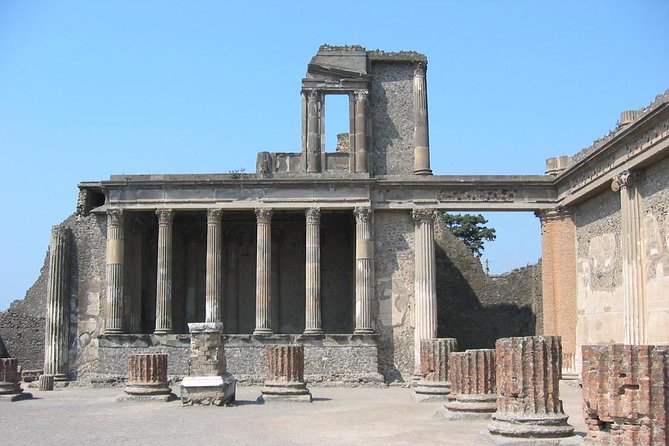
You can choose either a morning or afternoon departure. That’s more than convenience. Pompeii lighting changes how you perceive ruins, and heat can be a factor in outdoor ruins.
If you’re trying to keep the rest of your day flexible, morning tours can help you avoid stacking long outdoor periods later. Afternoon tours can work if you want a slower morning and plan other stops earlier.
The tour itself runs about 2 hours 30 minutes, so you can build a realistic schedule around it. It also helps that the entrance ticket and skip-the-line fee are included, so your time stays focused on the park.
Price and value: is $124.02 per person a fair deal?
At $124.02 per person, this isn’t the cheapest way into Pompeii. But you’re paying for three things that add value:
1) Skip-the-line entry
Pompeii doesn’t need extra delays. This includes the admission ticket and skip-the-line fee, which can help you spend more minutes in the ruins.
2) VR hardware and headset system
You’re getting one VR headset per adult and youth (with the age limits noted below). That equipment is the core of the product.
3) Private group experience with an assistant escort
Because it’s private—only your group—there’s less time wasted herding people around and more control over pacing.
Is it “worth it”? If you’re someone who needs help building a mental picture of Pompeii, VR can save your brain time. You’ll likely feel more satisfied than with a basic entry ticket plus a quick self-guided stroll.
If you’re already comfortable with Roman city layouts and you prefer a licensed guide’s archaeology explanations, you might decide this is extra tech you don’t need. In that case, you can get comparable value by doing a traditional guide tour and skipping the VR headset.
Comfort, safety, and who should think twice about VR
This tour includes VR headsets, and the safety notes are serious enough to read closely before you book.
The experience uses 3D headsets (Samsung/Oculus Gear VR). Use is not recommended for children under 13 by the manufacturer. The minimum age to use the headset is 9.
It’s also not recommended for people who have medical reasons to avoid VR. The guidance says to consult a doctor before the tour if you are pregnant, elderly, have pre-existing binocular vision abnormalities, psychiatric disorders, or a heart condition. There’s also a warning about dizziness and motion effects; about 1 in 4,000 people can experience severe dizziness with VR-like experiences.
If any of these apply, don’t treat the warnings as fine print. Take them seriously.
Also:
- You’ll walk on uneven terrain, so bring comfortable shoes.
- The tour requires an unimpaired sense of motion and balance.
- If you feel symptoms like dizziness, nausea, blurred vision, or disorientation, you should discontinue immediately (the tour notes list a long set of possible symptoms).
One more practical point: travel light. Bags can be annoying when you’re moving through crowds and adjusting your headset. A lightweight shoulder bag is fine.
How the walking part works with uneven Pompeii terrain
The tour is partly a walking tour, and Pompeii’s ground is not smooth. That’s why the comfort guidance matters.
Wear shoes with good traction. You’ll be moving over uneven surfaces, and you’ll likely want stable footing when you’re transitioning between headset and no-headset moments.
Also, keep your group’s “pace style” in mind. This is a private tour, but it still runs on a set flow. If someone in your party is slow on stairs or uneven ground, the VR schedule can feel rushed.
If your group likes to stop for photos often, you may want to communicate that at the start. The assistant can help you budget time, and that planning is something that came up positively in one account—helpful pacing made the experience better for both the VR segments and the real-photo moments.
Who this tour is best for
This format is especially strong for people who fit one of these profiles:
- You want a guided introduction to Pompeii without having to translate everything yourself.
- Your group includes tech-friendly folks who enjoy video-game style visuals but still want historical context.
- You’re traveling with kids old enough for the headset guidance, and you’re comfortable managing VR safely.
In one family example, a couple did it with sons aged 11 and 14. The family found the tour informative and enjoyed the VR aspect as a new dimension to their Pompeii time. They also had a realistic expectation: the graphics weren’t perfect, but the historical recreations helped them understand what they were seeing.
Where it may not be ideal:
- If you want a full, licensed-guide deep dive into archaeology questions, you may leave wanting more.
- If you or a family member has medical reasons to avoid VR, this may be the wrong fit.
Meeting points: where to start and where you’ll end
You’ll meet at:
- Hotel Vittoria, Piazza Esedra, 80045 Pompei NA, Italy
And you’ll finish at:
- Piazza Immacolata, 80045 Pompei NA, Italy
It’s helpful that the tour is near public transportation. It makes it easier to build your day without needing complicated logistics. Just remember: no hotel pickup/drop-off and no transportation to/from attractions is included.
Also, you’ll receive a confirmation after booking, and you can choose your starting time in the reservation notes (use the special requirements field to set it).
Should you book this Pompeii VR tour?
Book it if you want Pompeii to feel more legible fast. The combination of skip-the-line entry, short VR training, and headset audio in multiple languages makes it a strong value for people who learn best with visuals.
Skip it (or consider another option) if you mainly want archaeology explanations from a licensed guide, or if VR is a medical no-go for someone in your group. The warnings are extensive for a reason.
My practical call:
- If your goal is understanding and enjoyment in a limited time window, this tour is a smart buy.
- If your goal is maximum expert detail, pair Pompeii with a licensed guide for the “why” and use this (if safe for you) for the “how it looked.”
In other words: this is Pompeii with the volume turned up—without losing the walk.
FAQ
How long is the Pompeii private VR tour?
It runs about 2 hours 30 minutes.
What is included in the price?
The tour includes the VR headset, an escort/host, and a skip-the-line entrance fee to the Pompeii ruins. Admission ticket time is included in the duration.
Are headset videos included?
Yes. You can watch up to 15 3D virtual reality videos during the experience.
What languages are available?
The tour assistant speaks English and Italian. The VR headset commentary is available in English, Italian, German, French, Spanish, and Russian.
What are the age limits for the VR headset?
The minimum age to use the VR headset is 9. The manufacturer recommends that headsets should not be used by children under 13.
Is this tour led by a licensed archaeological guide?
No. The tour assistant is not a licensed guide and is not allowed to answer archaeological questions about the site.
Do I need to choose a morning or afternoon departure?
Yes. You can choose a morning or afternoon departure, and you should set your starting time in the reservation special requirements.
Where do I meet the tour?
You start at Hotel Vittoria, Piazza Esedra, 80045 Pompei NA, Italy.
Where does the tour end?
The tour ends at Piazza Immacolata, 80045 Pompei NA, Italy.
What is the cancellation policy?
You can cancel for a full refund if you cancel at least 24 hours before the experience’s start time. If you cancel less than 24 hours before, the amount paid is not refunded.
If you want, tell me your travel dates and group ages, and I’ll help you sanity-check whether the VR headset guidance fits your party.