REVIEW · POMPEII
Pompeii: Guided Tour with Priority Entrance
Book on Viator →Operated by IAMME IA! - Gray Line Amalfi Coast · Bookable on Viator
Pompeii without the bottleneck feels like a gift. This guided tour is built for real-world crowds: priority entrance into the UNESCO site, plus a guide who turns ruins into a story you can follow in real time.
What I like most is the licensed guidance and the fact that you get headsets on a busy day, so you can actually hear the commentary without craning your neck or losing your place.
The only real drawback is the site is spread out and outdoors, so you should expect hot sun and some uphill, uneven walking even on a “short” 2.5-hour route.
In This Review
- Key things you’ll notice on this Pompeii tour
- Why priority entrance matters at Pompeii
- Meeting point at Camping Zeus (and how to plan your arrival)
- The Forum area: Civic power at street level
- Civil Forum: where business, justice, and worship happened
- Temple of Jupiter: politics with a view of Vesuvius
- Basilica: justice and commerce inside a big hall
- Macellum and Via dell’Abbondanza: daily life, not just landmarks
- Macellum: the market with an imperial flavor
- Via dell’Abbondanza: Pompeii’s main street
- Stabian Baths (Terme Stabiane): how Romans cooled off and heated up
- Lupanar and the House of the Faun: the stories Pompeii tells
- Large Theater and Basilica again: entertainment with a crowd mindset
- What the headsets actually do for you
- Price and value: what $59.13 buys you
- Small group size (up to 25) and the pace you should expect
- Practical tips so Pompeii feels manageable
- Who this tour suits best
- Should you book this Pompeii guided tour?
Key things you’ll notice on this Pompeii tour
- Priority admission that’s designed to cut the longest waiting
- Headsets for clearer guide audio in a noisy, crowded setting
- Focused highlights across the Forum, baths, brothel area, and major houses
- A smart route that mixes civic life with daily life and entertainment
- Small group limits (up to 25), which usually makes it easier to keep up
- Practical guide support, including helping you get pointed for what to do after the tour
Why priority entrance matters at Pompeii
Pompeii is one of those places where the ruins are the easy part. The hard part is the flow of people. On a classic self-guided visit, you can lose time to lineups and confusion at entrances and key viewpoints.
This tour addresses that directly with skip-the-line admission built into the experience. For you, that means more time looking at walls, mosaics, and streets instead of standing in the heat with everyone else. You’ll still see crowds inside the site at the big stops, but you start off with a faster entry and a guide keeping the group moving.
The other big reason I’d pick a guided format here: Pompeii rewards context. A street corner is interesting, but it’s more powerful when someone explains what you’re looking at, why it was built that way, and how people used the space day to day.
You can also read our reviews of more guided tours in Pompeii

Meeting point at Camping Zeus (and how to plan your arrival)
You meet your guide at Camping Zeus, Via Villa dei Misteri, 3, 80045 Pompei NA, Italy, at the Zeus car park meeting area. The tour also ends back at the same meeting point, so you’re not left figuring out transit or walking back on tired legs.
This matters because Pompeii can feel like a puzzle your first time. You’ll be walking on uneven, ancient ground, and after a few stops you’ll be glad you don’t have to navigate the whole exit by yourself. Also, the tour is about 2 hours 30 minutes overall, so smooth logistics help you actually finish with energy left.
If you’re picking a time slot, consider that an earlier start tends to feel better in summer heat. Even with shaded pockets, you’ll still be in the open air for much of the walk.
The Forum area: Civic power at street level
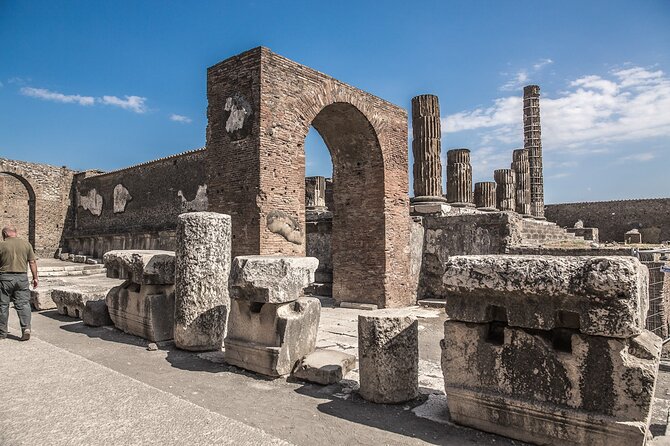
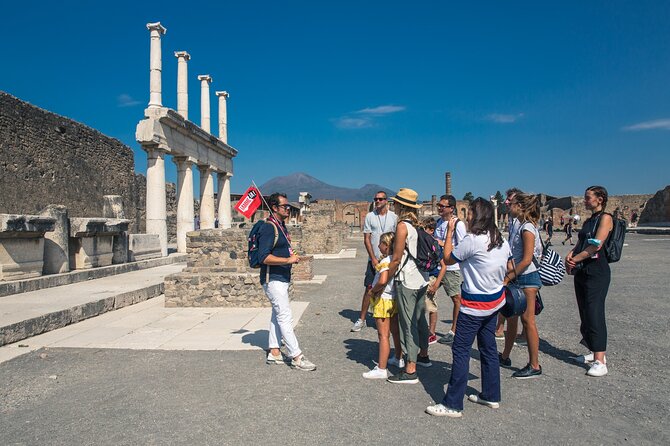
The heart of your Pompeii visit is the Forum zone, where daily life, religion, and government all collided. You’ll start with the core of the city’s public spaces, including the Civil Forum and major landmark buildings around it.
Civil Forum: where business, justice, and worship happened
Think of the Civil Forum as the city’s main stage. It’s described as the focal point for public administration and justice, plus the place tied to business management, trade, and markets. It’s also connected to citizen worship.
The payoff for you is that you get to understand Pompeii as a functioning town, not just a pile of stones. You’re looking at how public decisions got made, where people gathered, and how sacred and practical life blended.
A small reality check: the Forum area is busy. Even with priority entrance, the best viewpoints are also the easiest places for lines and waiting. Your guide’s job is to time the group through key spots, so you’re not stuck in the same bottleneck forever.
Temple of Jupiter: politics with a view of Vesuvius
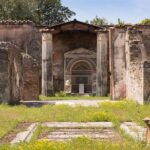
Next you’ll see the Temple of Jupiter, positioned on the north side of the Forum, with Mount Vesuvius rising behind it in the background. The temple you’ll encounter is tied to major historical change: after the colony was founded in 80 BC, the temple was renovated and effectively became a Capitolium style complex, associated with Jupiter alongside Juno and Minerva.
What makes this stop click is the idea that the Romans didn’t just build temples. They built statements of power. The statues were placed so they’d be visible across the Forum square, meaning religion was also public messaging.


Basilica: justice and commerce inside a big hall
You’ll also visit the Basilica, which was one of the most sumptuous buildings in the Forum area, with about 1,500 square metres of space. It was used for business and for administration of justice.
Inside, it’s accessed from the Forum through multiple entrances and organized into a divided interior space with three naves and brick columns topped with Ionic capitals. Even if you’re not into architecture, this building helps you picture the way people moved and worked in a packed civic environment.
A potential drawback here is simple: you may only get a short look, because the tour time is limited and the Forum is a hub of stops. If you fall in love with one particular building, make a note and plan to return after the tour if you have time.
Macellum and Via dell’Abbondanza: daily life, not just landmarks
Pompeii’s big temptation is to treat it like a set of famous attractions. This tour does a better job of pulling you into ordinary life.
Macellum: the market with an imperial flavor
The Macellum was a market complex, but not a plain one. It’s described as a tuff quadriporticus with a hall for worship positioned on the elevated eastern side. The layout connects commerce and religion in a way that feels very Roman.
You’ll also hear about how the niches held copies of marble statues (including a female and an armed male) and how another fragment probably points to the imperial cult, referencing an emperor such as Titus or Vespasian. In other words, your market wasn’t just about food. It was part of the political religious world too.
One thing you’ll appreciate: the tour doesn’t jump straight from the Forum to the baths. It shows you the “in-between” spaces where people bought, ate, prayed, and talked.
Via dell’Abbondanza: Pompeii’s main street
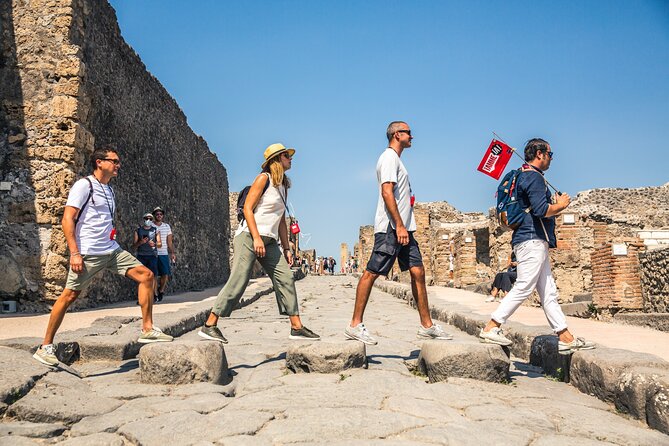
Then you move to Via dell’Abbondanza, identified as Pompeii’s main street, a decumanus maximus running east/west between the Forum area and Porta Sarno.
This is where the ruins start to feel less like isolated rooms and more like a city street. In ancient times, it was crowded and noisy with shops, workshops (officinae), cafes, snack bars, and places to eat and drink.
The guide’s commentary is key here because the street layout can look obvious at first glance, but the details of what types of businesses sat along it are what make it come alive.
Stabian Baths (Terme Stabiane): how Romans cooled off and heated up
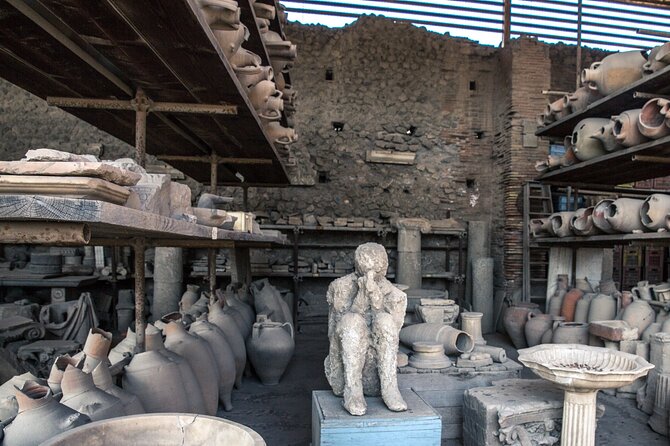
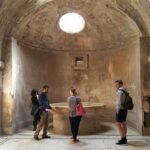
Next up is the Stabian Baths, located behind the Temple of Jupiter. You’ll learn these date to shortly after the colony of veterans was founded around 80 BC. The baths had separate entrances and areas for women and men, which is one of those practical Roman details that makes the place feel real.
You’ll also pass through the logic of bath temperatures:
- an apodyterium (dressing room) used for the tepidarium and other transitional spaces
- a frigidarium for cold baths
- a calidarium for hot baths
Then, because Pompeii is what it is, the story also includes damage: the baths were heavily damaged during the earthquake of 62 AD.
This stop is also a good reset emotionally. After the Forum’s big public buildings, the baths feel more intimate, like daily life rather than government theater. Do expect it to still be a quick look, since the tour format keeps moving.
Lupanar and the House of the Faun: the stories Pompeii tells
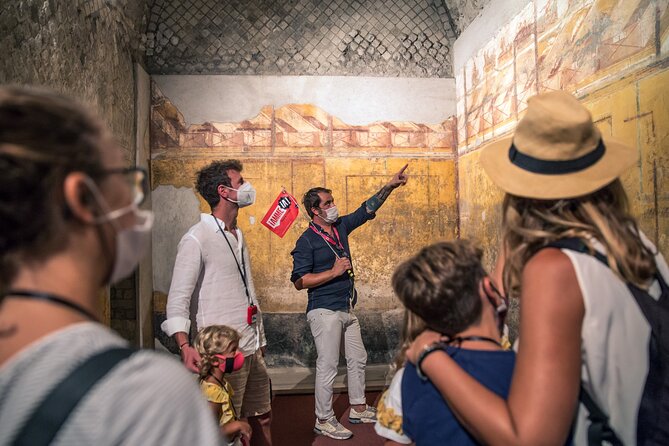
Pompeii doesn’t shy away from adult themes. You’ll see the Lupanar, described as the most famous brothel in the ruined Roman city, also known as the Lupanare Grande. The standout detail here is the erotic paintings on the walls, which were part of the room’s messaging.
The tour’s coverage stays factual and historical, including that many prostitutes were described as Greek and Oriental slaves and that payment was discussed in ancient terms (with comparisons like the cost of a glass of wine). Even if you’re not interested in that subject, it’s an important slice of how people lived and what the city contained.
Then the tour shifts into art and elegance with the House of the Faun, a grand Roman villa known for mosaics, including the striking Alexander Mosaic. This is one of the big emotional turns of Pompeii: you go from rough street life and hard civic spaces to a home designed to impress.
If you like art and design, this is the portion you’ll probably remember later. The mosaics help you picture wealth and taste in a city that also had markets and public institutions.
Large Theater and Basilica again: entertainment with a crowd mindset
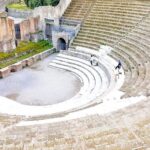
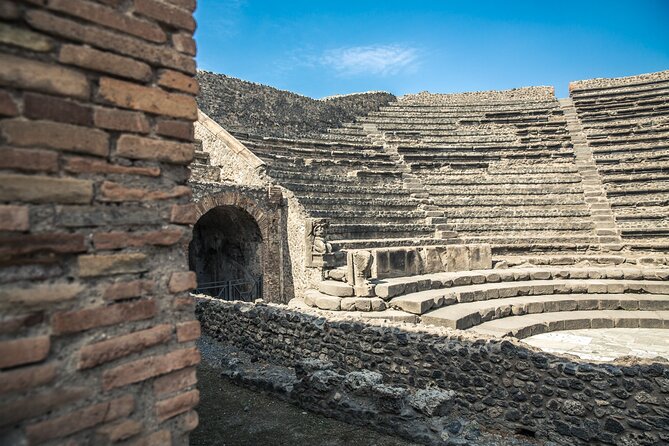
You’ll also visit the Large Theater, an open-air venue where crowds gathered for comedies, dramas, and musical performances. In modern terms, this is the spot where Pompeii wasn’t just working and trading. People were also watching, laughing, reacting, and spending time together.
Because it’s open-air, you’ll feel the same reality as the ancient audience: it’s built for shared sightlines and group energy. Even if the seats are gone or incomplete, the site gives you a sense of how performances fit into everyday life.
The tour also highlights the Basilica once more as part of the Forum area framing, so you’ll see how Pompeii’s public spaces covered everything from entertainment to administration of justice.
What the headsets actually do for you
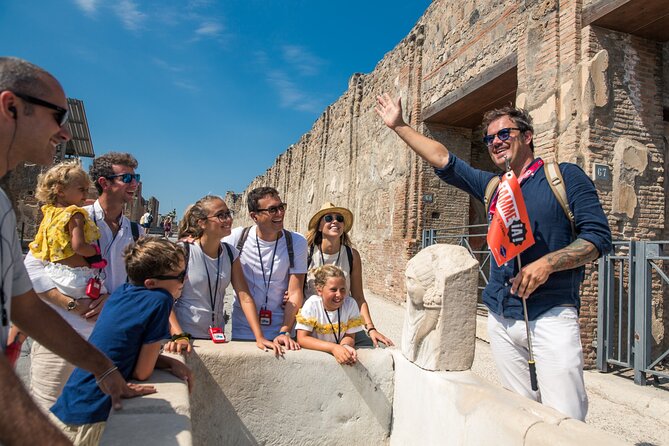
Pompeii is outdoors, and sound travels in ways you don’t expect. In a crowd, it’s easy to miss half the story if you’re standing slightly off from the guide.
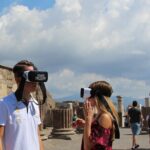
That’s why I’m glad this includes headphones in Pompeii, especially when groups are larger than 10 passengers. You can keep your eyes on what’s in front of you and still get the commentary, rather than trying to lip-read through other people’s shoulders.
Quick practical tip: when you receive the headset, test it immediately before you drift too far from the start of the walk. If anything feels off, raise it right away so it doesn’t ruin your momentum later.
Price and value: what $59.13 buys you
At $59.13 per person, you’re paying for more than a guide’s narration. You’re also paying for:
- priority entrance to the Pompeii ruins (including admission ticket value as part of the experience)
- an official, licensed guide
- a structured route through key highlights
- headsets to keep the experience readable in a crowded outdoor setting
Value-wise, this is a solid deal if you want to maximize your limited time. Pompeii is huge, and 2.5 hours can fly by when you’re getting context while you walk rather than researching each stop one by one.
If you’re the type who loves wandering freely, you may feel the structure slightly limits you. But for most people, this format hits a sweet spot: you get the biggest “why does this matter” moments without losing your whole day.
Small group size (up to 25) and the pace you should expect
The tour caps at 25 travelers. That’s a meaningful detail because Pompeii can swallow larger groups. A smaller crowd usually means:
- you can hear better (especially with headsets)
- you can move in chunks
- the guide can regroup more effectively
From the guide experiences described by past visitors, the best outcomes often came from guides who kept a steady pace and answered questions clearly. Some guides mentioned by name included Alessio, Vincenzo, Max, Claudio, Giulia, Vicente, and Vivianna. If you’re assigned someone with that same mix of clarity and energy, you’ll likely feel like the ruins make more sense fast.
Practical tips so Pompeii feels manageable
Pompeii is forgiving if you show up prepared. Bring the basics and you’ll enjoy it more.
- Wear comfortable shoes for uneven ground.
- Expect sunscreen needs. The tour is outdoors and heat is real.
- Bring a light water plan. There are water fountains you can use to refill on site, so you can keep going without carrying something heavy the whole day.
- Avoid heavy bags. You’ll be glad for the lighter load during repeated stops and movement.
- If you care about a specific area, keep an eye on the guide’s pacing and note what you want to revisit after the tour ends.
Who this tour suits best
This is a strong choice if you:
- want priority entrance to cut time wasted at the start
- like guided context, especially for the Forum and civic buildings
- appreciate headsets in busy outdoor crowds
- want a clear highlight route without committing an entire day
It’s less ideal if you want total freedom to stop for long stretches whenever you feel like it. The tour is paced, and the group needs to stay together. Also, if you’re traveling with kids who need flexibility, you may find that some spaces can be harder to manage in a tight group setting.
Should you book this Pompeii guided tour?
Book it if you want a well-structured Pompeii visit that starts fast, includes skip-the-line admission, and gives you the kind of context that makes the ruins feel legible. At $59.13 for a 2.5-hour guided walk with headsets, it’s a practical way to get value from limited time.
Skip it if you prefer total independence and plan to spend most of your day drifting between sites at your own tempo. Pompeii is amazing on its own, but you’ll work harder to translate what you’re seeing.
If you’re on the fence, my advice is simple: if crowds and not knowing where to look would stress you out, this tour is built to reduce that pressure and help you enjoy the city’s most important scenes with less friction.