REVIEW · POMPEII
Pompeii: Skip-the-Line Entry Ticket with Digital Audio Guide
Book on Viator →Operated by Vox City International Ltd · Bookable on Viator
Pompeii is huge, and time disappears fast. This skip-the-line ticket pairs reserved entry with a smartphone audio guide that hits 130+ points, from major landmarks to mosaics. I like the quick ticket pickup by Piazza Esedra and the multilingual narration in English, French, Spanish, German, and Italian. My only real caution: the whole experience runs through your device and headphones, so tech hiccups can turn frustrating fast.
What makes Pompeii so gripping is that it is not a vague ruin. You walk real stone streets and square corners of everyday life—then you look at what Vesuvius left behind. Plan on the Pompeii Forum, major temples dedicated to Venus, Apollo, and Jupiter, and standout houses such as the House of the Faun, all while using the audio to decide where to look next.
One more thing before you buy: suburban villas are not included. Access to places like the Villa dei Misteri is an extra €8, so if those are your must-sees, you’ll want to plan for the add-on. Also, you’ll need your own mobile phone and headphones since those are not provided.
In This Review
- Key things that matter before you go
- Entering Pompeii through Piazza Esedra (and why it saves time)
- Downloading the digital audio guide before you arrive
- Walking Pompeii by smartphone: 130+ points and what that looks like
- Pompeii Forum: where trading, politics, and everyday noise meet
- House of the Faun and the housing story you can actually follow
- Temples to Venus, Apollo, and Jupiter: religious Rome in stone
- Amphitheatre and streets: how to pace a 2-to-3-hour visit
- The suburban villas you miss (and when it matters)
- Price and value: is $33 a good deal for Pompeii?
- Practical tips to make the audio work for you
- Should you book this Pompeii skip-the-line audio ticket?
- FAQ
- What is included with the Pompeii skip-the-line entry ticket?
- Where do I redeem the voucher for entry?
- Do I need headphones or a mobile phone?
- How do I get the audio guide?
- Are the suburban villas included, like Villa dei Misteri?
- How long should I plan to spend inside Pompeii?
Key things that matter before you go

- Reserved entry at Piazza Esedra: you collect your ticket at Piazza Esedra 1, in front of Hotel Vittoria, right by the entry area.
- Smartphone audio with 130+ stops: the guide is designed to take you from landmark to landmark across the park.
- Multilingual by default: English, French, Spanish, German, and Italian audio tracks are included.
- You download first: scan the QR code on your voucher and download the audio guide before you arrive.
- Headsphones and device not included: bring them, and test your volume before you hit the busiest lanes.
- Suburban villas cost extra: Villa dei Misteri and other suburban sites are not part of this ticket.
Entering Pompeii through Piazza Esedra (and why it saves time)
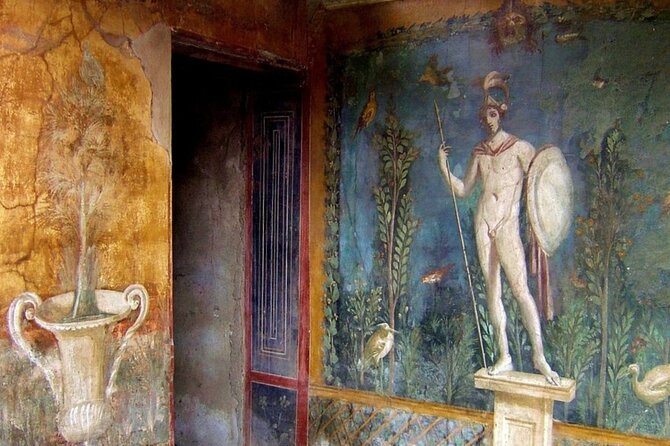
For Pompeii, the first win is where your ticket starts. You redeem your voucher at Piazza Esedra 1 (80045 Pompei NA), right in front of Hotel Vittoria. The pickup is described as easy and close to the entry gate area, which matters because Pompeii can be chaotic when you arrive unprepared.
This ticket is sold as skip-the-line, but the practical meaning is more specific: you get reserved entry access tied to the voucher. In a place this large, that can mean fewer minutes spent hovering near checkpoints and more minutes walking.
If you hate the start-stop feeling of waiting around, this is the kind of ticket that helps. It does not replace Pompeii’s basic reality—there are crowds, sun, and a lot of stone to decode—but it can smooth the first stretch of your day.
You can also read our reviews of more tours and experiences in Pompeii



Downloading the digital audio guide before you arrive
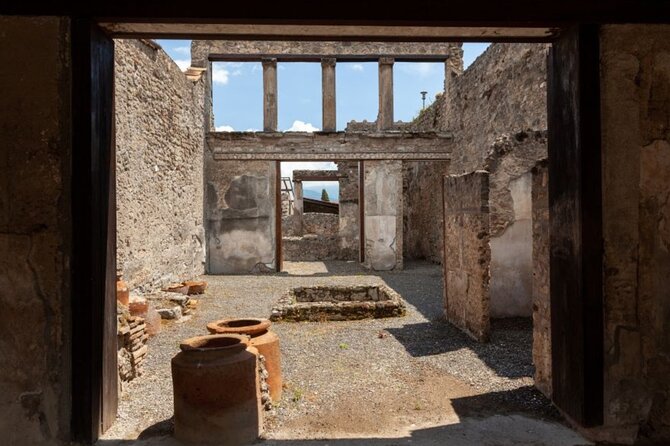
The audio guide is a smartphone experience, and your success depends on prep. Scan the QR code on your voucher to download the audio guide prior to arrival. The good news: the setup is meant so you do not need internet once you are inside.
That is the plan. But I’ll be blunt about the other side of it: if your phone runs out of space, if your headphones are picky, or if your download fails, the tour can fall apart. One review mentioned the audio guide becoming unusable after hours of downloading due to a disconnection message, even though the app is designed to work offline.
So I recommend you do two things at home (or on your travel break before you go):
- Download the audio guide with time to spare, not at the last minute.
- Do a quick headphone test before you leave—low volume or wonky audio is annoying when you are standing in front of a small mosaic you want to understand.
Also, the audio guide does not include headphones, and it does not include a mobile device. You’re bringing both.
Walking Pompeii by smartphone: 130+ points and what that looks like

Pompeii covers 44 square hectares, and you are typically looking at 2 to 4 hours inside depending on your pace. This experience is listed at 2 to 3 hours, which is a workable chunk if you focus on key zones rather than trying to see everything.
The audio guide is designed to send you to more than 130 points of interest. That number sounds huge because it is. In practice, it means you will constantly be switching attention—street, corner, building entrance, mosaic detail, then back out into open space.
Here’s what I like about the concept: Pompeii is made of details, not just big monuments. The guide’s coverage includes mosaics and historic residences, and it points you toward major areas like the Forum and temples. If you enjoy learning while you walk, the audio can turn the park from scenery into a story you can follow at your speed.
Here’s the possible downside: because the stops can feel like many individual points rather than a tight route, you may not feel like you are moving in a single clean order. One caution was that there is not a prescribed order and that the GPS map did not behave reliably for at least one person. Their point was simple: if you rely on the tour map, you can waste time.
My practical fix: grab a physical map when you enter. You’ll still use the audio, but the map helps you keep your bearings and avoid wandering in circles.
Pompeii Forum: where trading, politics, and everyday noise meet
If you only pick one “heart” of Pompeii, pick the Forum. It is the trading hub and political center, and it is where the whole city starts to feel like a living place rather than a frozen set.
The audio guide encourages you to stop there, and that makes sense. From the Forum you can understand why people gathered: commerce, civic decisions, public life. You’re not just reading stone labels—you’re placing buildings into a social context.
When you’re standing in the Forum area, give yourself a few minutes to slow down. You’ll get more from it if you look for sightlines—what you can see across open spaces, where entrances cluster, and how the streets feed into the civic core. Then when the audio prompts another point nearby, it lands better because you already understand the area’s role.
House of the Faun and the housing story you can actually follow

A big reason Pompeii feels different from other ruins is the scale of private life. The audio guide includes notable residences, including the House of the Faun.
Why that matters for you: houses like this turn Pompeii from “one giant archaeological site” into a place where real families cooked, entertained, worked, and displayed art. Even if you are not an expert on Roman architecture, the contrasts are obvious: courtyards, room sequences, decorative floors and wall spaces.
Also, Pompeii’s layout helps. You often move from street to doorway to courtyard without needing a museum-sized leap. If you like walking through spaces with your own feet, the housing stops are where you get that satisfaction.
If you notice the audio feels scattered, use this approach: choose one residence stop as your anchor. Let the rest of the guide serve as bonus stops rather than demanding you follow everything in order.
You can also read our reviews of more guided tours in Pompeii






Temples to Venus, Apollo, and Jupiter: religious Rome in stone
The audio guide highlights temples dedicated to Venus, Apollo, and Jupiter. These stops matter because they show how religion shaped public space.
Even without a lecture, you can read the difference between a residential area and a religious one. Temple sites pull you into a more formal setting—places people visited not for privacy, but for shared rituals and community identity.
I also like how the audio connects these themes to what you can see around you. When the guide points you to a temple dedicated to one of these gods, you start noticing patterns in how space is arranged—where you enter, how the area opens, what kind of view you get from nearby streets.
Amphitheatre and streets: how to pace a 2-to-3-hour visit
Your time budget is the real decision here. Pompeii is open daily, and the grounds cover a lot of space. Most people spend 2 to 4 hours, and this experience is roughly 2 to 3 hours.
So you need a pacing plan, especially if your phone audio is your main navigation tool. The amphitheatre is one of the featured highlights, and it is a good anchor because it is visually dramatic and it gives you a strong “I’m in Pompeii” moment early in the walk.
A good strategy:
- Start strong with a big, clear landmark (the amphitheatre or Forum).
- Then switch to smaller, explanation-friendly stops (mosaics, residence details, temple points).
- Leave room for the effects of Vesuvius—those ash-covered scenes hit harder when you are not rushing.
The suburban villas you miss (and when it matters)
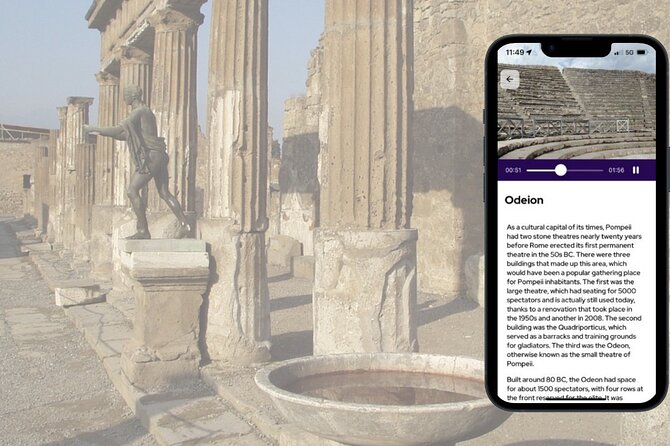
This ticket does not include access to the suburban villas, including the Villa of the Mysteries and Villa dei Misteri (and other suburban sites like Villa of Diomedes and Villa Regina). The extra cost listed is €8.
Should you care? If you specifically want those famous out-of-town sites, then yes—you’ll need to plan an add-on. If your goal is a solid taste of Pompeii’s main urban core—Forum, temples, major houses, big public spaces—then you may be satisfied within the included zones.
The key is that you avoid disappointment by setting expectations now. You are paying for reserved entry plus a smartphone audio guide across the main experience, not a full suburban-villa day trip.
Price and value: is $33 a good deal for Pompeii?
At $33, the value depends on what you bring to the table.
You are getting:
- A reserved entry ticket to Pompeii
- A smartphone audio guide with 130+ points
- Multilingual audio commentary in English, French, Spanish, German, and Italian
You are not getting:
- Headphones or a mobile device
- Suburban villas access (extra €8)
So for a self-paced visit, $33 can be a fair value—especially because Pompeii entry is non-negotiable and the audio guide is included rather than sold separately. The risk is when your tech workflow breaks down: if your audio download fails or your headphones don’t cooperate, that “value” turns into an expensive ticket to walk around without the guidance you expected.
If you travel with a reliable phone, good headphones, and you are comfortable using a QR code download, this ticket fits your style. If you have a low-storage phone or you tend to rely on paper maps only, it may be smarter to plan your own wayfinding and treat the audio as optional.
Practical tips to make the audio work for you
These are the small things that keep the experience smooth:
- Download early and test: scan the QR code on your voucher and download before you arrive. Then test audio with your headphones.
- Bring your own map habits: if the phone map or the guided order feels odd, use a physical map when you enter to avoid aimless walking.
- Expect variability in your route: the guide can feel like many points rather than a strict parade, so pick what you care most about (Forum, a residence like House of the Faun, one temple cluster, amphitheatre).
- Use the audio for context, not trivia: treat it like a helper that explains what you’re looking at in front of you. When you find a stop you care about, let it run before moving on.
And if you notice the audio is not performing as expected in the moment, don’t keep forcing it. Switching to a simple “walk with your map, read the plaques, use audio when it works” plan can still turn your day into a win.
Should you book this Pompeii skip-the-line audio ticket?
I think this is a good fit if you want a self-paced Pompeii visit with structured help. You’ll likely enjoy it most if you:
- Want reserved entry to reduce the stress at arrival
- Like learning through a smartphone audio track
- Bring your own headphones and a phone you can trust for downloading and playback
- Are focused on Pompeii’s main urban core rather than suburban villas
I would hesitate if:
- Your phone storage is tight or downloads usually fail for you
- You dislike tech-dependent experiences
- You were hoping suburban villas like Villa dei Misteri are included (they are not)
If you do book, go in with a clear plan: anchor on the Forum, make time for at least one standout residence such as House of the Faun, and use the audio to add meaning to what you’re seeing, not to replace your sense of direction.
FAQ
What is included with the Pompeii skip-the-line entry ticket?
You get a reserved entry ticket to Pompeii and a smartphone audio-guided tour with 130+ points of interest. The audio includes multilingual commentary in English, French, Spanish, German, and Italian.
Where do I redeem the voucher for entry?
You exchange your voucher at the info point located at Piazza Esedra 1, 80045 Pompei NA (in front of Hotel Vittoria). Entry to Pompeii requires these entry tickets.
Do I need headphones or a mobile phone?
Yes. Headphones and your mobile device are not included, but you can use your smartphone for the digital audio guide.
How do I get the audio guide?
Scan the QR code on your voucher to download the audio guide prior to arrival. The QR download is described as the way to get the audio app ready before you enter.
Are the suburban villas included, like Villa dei Misteri?
No. This ticket does not include access to the suburban villas, including Villa of the Mysteries / Villa dei Misteri. Access to suburban villas is listed as an extra €8.
How long should I plan to spend inside Pompeii?
The experience runs about 2 to 3 hours, and Pompeii visitors typically spend 2 to 4 hours inside. Pompeii is open daily and covers 44 square hectares.