REVIEW · POMPEII
Pompeii Skip-the-Line Tour – Private and limited group options
Book on Viator →Operated by Towns of Italy · Bookable on Viator
Pompeii hits different. This skip-the-line Pompeii tour (private or limited group) is designed for a quick, guided look at a Roman city frozen by the AD 79 disaster. With an expert archaeologist leading the walk, you get the why behind what you’re seeing, not just the where.
I really like the limited-group feel, especially the more personal pacing you get with the private or small-max options. I also love that you’re not left guessing: the guide brings attention to key zones like the Foro and the theatres area while giving practical context you can carry with you after.
One thing to plan for: even with skip-the-line entry, there’s still a compulsory security check, which can add a little waiting time. Add in dress code rules and bag limits too, and you’ll want to show up ready to pass through smoothly.
In This Review
- Key highlights to know before you go
- Skip-the-line at Pompeii: faster start, not instant entry
- Piazza Esedra meeting point: getting oriented fast
- The archaeologist guide: what expert narration changes
- Pompeii’s big picture: why the AD 79 story matters
- Ercolano Door, Temple of Isis, and the theatres zone
- The walk through the city: houses, workshops, Foro, and public life
- Amphitheatre and what you’ll notice when the guide slows you down
- Necropolises and Villa dei Misteri: the edge-of-city story
- What fits into 2 hours (and what doesn’t)
- Price and value: is $40.43 a good deal?
- Dress code, bags, ID, and comfort rules that matter
- Who this Pompeii tour suits best (and who should skip it)
- After the ruins: where Pompeii artifacts live
- Should you book this Pompeii skip-the-line tour?
- FAQ
- How long is the Pompeii tour?
- Is the tour offered in English?
- Does this include skip-the-line entry?
- Is the admission ticket included?
- Where do I meet for the tour?
- What should I bring and wear?
- Are there bag restrictions?
- Do I need an ID?
- Is the tour suitable for people with impaired mobility or heart conditions?
- Are drones or pets allowed?
Key highlights to know before you go
- Skip-the-line access to Pompeii ruins helps you start faster than standard entry lines
- Expert archaeologist guidance keeps the ruins understandable and connected
- English-only experience (or Spanish) helps quality stay consistent
- Small-group options range from intimate to max 16, plus audio support for very small groups
- A focused 2-hour route covers major landmarks without pretending you can see everything
Skip-the-line at Pompeii: faster start, not instant entry

Pompeii is famous, which means it’s also popular. That’s why the skip-the-line piece matters: it’s meant to shave off the most frustrating part of the visit so you spend your energy walking the site instead of staring at a line. The tour also runs for about 2 hours, so every minute counts.
That said, skip-the-line does not mean no checkpoints. You’ll still face a compulsory security check before you enter the archaeological park, and that can slow you down a bit even when you’re prioritized. If you’re visiting in peak season or right at a busy entry window, build a little buffer into your expectations.
The good news is that the rest of the experience is structured around keeping the group moving. You’re not just let loose in a maze. You follow a guide who knows the route, what to look at, and what clues in the stone actually mean for everyday Roman life.
You can also read our reviews of more private tours in Pompeii


Piazza Esedra meeting point: getting oriented fast
You meet back at Piazza Esedra, 80045 Pompei NA, and the tour ends there too. That round-trip format is helpful. You avoid the stress of trying to figure out a new meeting location later in the day when you’re already tired from walking.
Piazza Esedra is also described as near public transportation, which is great if you’re coming in by bus or train. Pompeii can be a “legs and stairs” kind of day, so having a convenient access point helps you keep control over your schedule.
A practical tip for your own plan: wear shoes that can handle uneven ground and long stretches. The tour strongly recommends good walking shoes (no flip-flops), plus hat and sunscreen. Pompeii is outdoors, and the sun doesn’t care how many centuries you’re looking at.
The archaeologist guide: what expert narration changes
The biggest upgrade you get here is the quality of the explanation. This tour includes expert guidance from a professional archaeologist, and that’s not a marketing line. Pompeii is full of fragments, and without context they can feel disconnected. With an archaeologist guiding you, the ruins become readable—like you’re learning a language made of streets, wear patterns, and building layout.
In one standout experience, the guide named Marina was described as very professional, with clear, agile explanations. That matches what you want in a 2-hour format: a guide who can move you quickly through the right stops while still making each stop click.
You’ll also benefit from the way the tour handles communication. It’s monolingual (English, or optionally Spanish), and for very small groups (maximum of 5 participants), audio devices are provided. That setup is useful in real life—Pompeii can be noisy and spread out, and you don’t want to lose the explanation because you’re standing too far away.
Pompeii’s big picture: why the AD 79 story matters
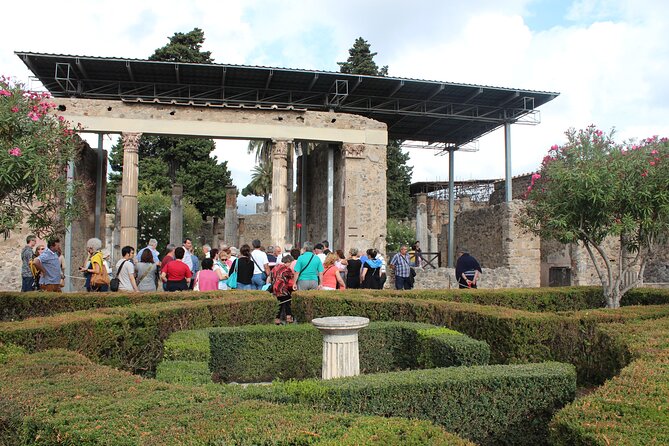
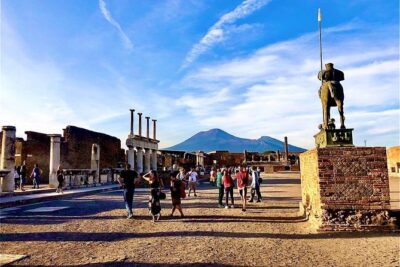
At the center of the site is a dramatic event. The ruins were buried under ash and lapilli—material blasted by a volcanic event in 79 AD after an earthquake—estimated at about 6 meters high. That burial is why buildings stayed in such remarkable condition. You’re not looking at “just ruins.” You’re looking at a city caught mid-life.
During the tour, you’ll hear how Pompeii’s excavated sections give a sense of the whole urban pattern. You start by looking at key excavation areas, and then you walk the ancient streets where houses, shops, public spaces, and sacred buildings sit in a real-world network.
That context is the difference between seeing Pompeii as a list of famous spots versus understanding it as a functioning city: people lived, worked, ate, prayed, and spent time in public buildings. And the way the guide points things out makes it easier to notice details you’d likely miss on your own.
Ercolano Door, Temple of Isis, and the theatres zone
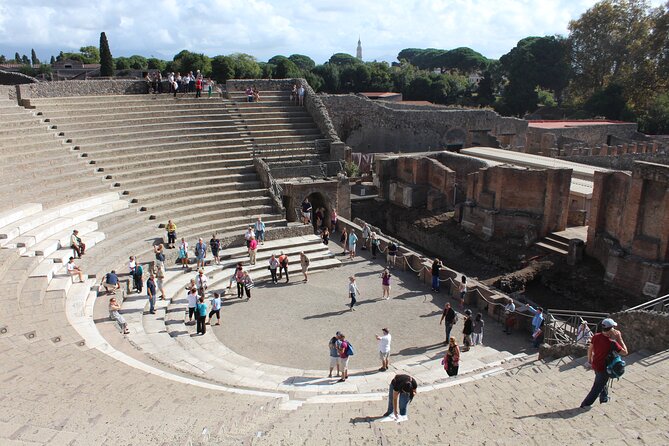
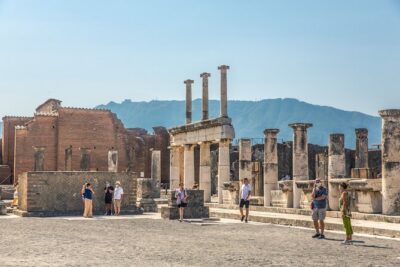
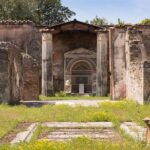
One of the first areas highlighted is around Ercolano Door and the Temple of Isis, plus a section of the theatres area. These stops help you understand two sides of Pompeii at once: the city’s movement (gate and main circulation) and the cultural/religious life (temple and theatre spaces).
The Temple of Isis matters because it reflects religious complexity, not just a single Roman-state style of worship. Seeing that temple context next to the rest of the urban layout helps you understand how different beliefs existed side by side in daily life.
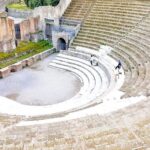
Then you get into the theatres area. Even if you’re not a “theatre person,” this is where you start noticing how Romans organized entertainment and public gathering. Theatres also show you how form follows function—audiences, circulation, and the street pattern around them.
The only caution here is your time. A 2-hour tour can’t cover everything at Pompeii at a slow museum pace. You’re getting the key zones and the strongest interpretive stops, so you’ll still want a longer free day if you want deep wandering after the tour.
You can also read our reviews of more tours and experiences in Pompeii



The walk through the city: houses, workshops, Foro, and public life
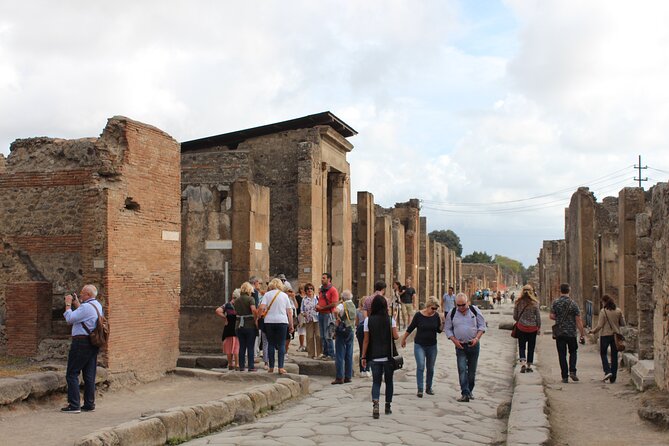
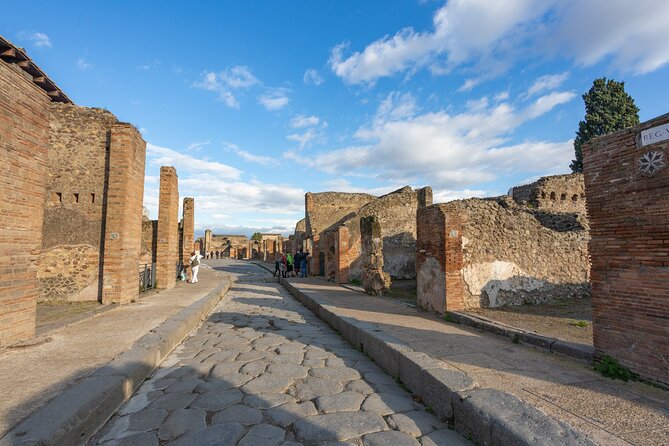
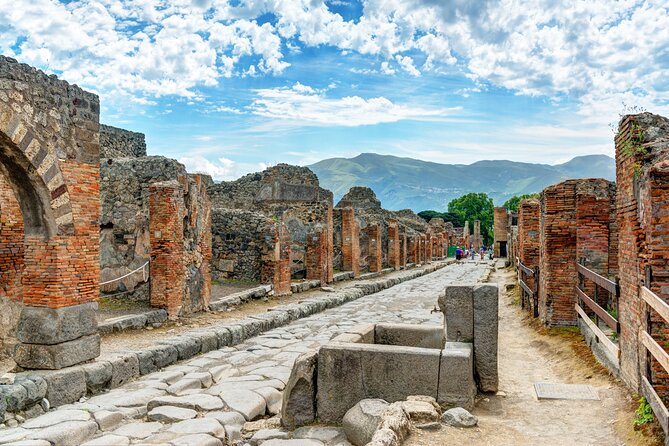
Once you’re in the right zone, the guide’s job becomes helping you connect the dots across the city. The tour route is described as walking ancient streets where you can admire houses, workshops, the Foro, public buildings, and sacred sites, along with baths and the theatres area.
This is where guided Pompeii pays off. On your own, it’s easy to stare at a wall and forget what you’re seeing. With the archaeologist’s explanations, you learn to read the building layout and purpose: where everyday work likely happened, where social life played out, and how public space differed from private space.
The Foro is the kind of stop that anchors everything else. It’s where you can feel the “public heart” of the city—commerce, civic life, and the kind of space Romans built to keep people meeting in the same places.
And then there are the baths. Romans took bathing seriously, and when you see bath spaces connected to street life, you start understanding Pompeii as a city designed for routine. That’s the theme you’ll keep hearing: this wasn’t frozen chaos. It was a normal day for people who never got to finish it.
Amphitheatre and what you’ll notice when the guide slows you down
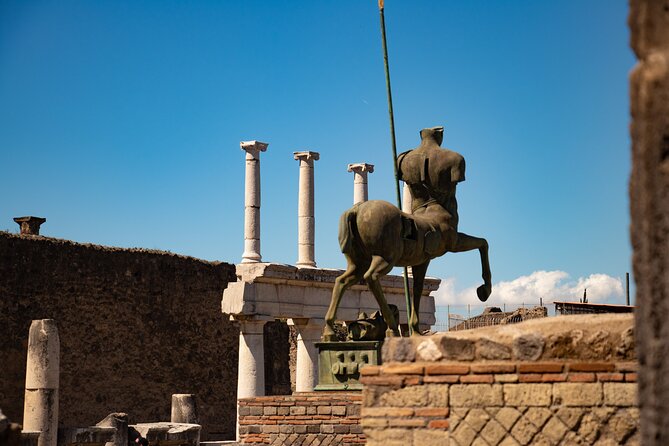
Near the end of the main city walk, the route includes the amphitheatre area. Amphitheatres are big, loud, and built for mass attention. Even in ruined form, they give you a sense of scale and crowd behavior.
What I like about this kind of stop in a short guided format is that it gives you a final “contrast point.” After seeing domestic and civic spaces, the amphitheatre reminds you Pompeii also included spectacle. It’s not just shops and homes. It’s also performance and public attention.
If you’re the sort of traveler who likes photos, pause when the guide asks you to. You’ll often get a specific angle or detail worth capturing—like how the space would have worked. In a 2-hour tour, those guided micro-moments add up more than random snapshots.
Necropolises and Villa dei Misteri: the edge-of-city story
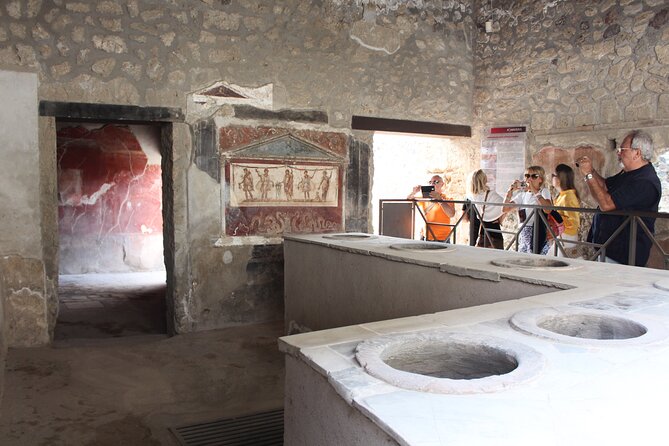
Outside the main excavations, the tour describes stopping at four necropolises with monumental tombs. This is a key piece of the Pompeii puzzle because it shows you how Romans thought about death, memory, and status. In many cities, the burial space becomes a long-term “public record,” and Pompeii’s preserved layout makes that idea easier to grasp.
The tour also references suburban residences, including Villa dei Misteri. This matters because it expands the visit beyond the core urban grid. A villa gives you a different view of wealth and lifestyle—less crowded, more spread out. You start seeing Pompeii not only as streets and buildings packed together, but also as a wider landscape of different living types.
In practical terms: these are still part of a tight itinerary. You’ll likely get a structured look rather than an all-day wander. If your goal is deep exploration of necropolises or villas, you may want to save extra time for afterward, when you can slow down and read each area at your pace.
What fits into 2 hours (and what doesn’t)
A 2-hour Pompeii tour is ideal if you want the big story and the key stops. It’s not ideal if you want to see every street and every room at a leisurely pace. Pompeii is large, and even with skip-the-line entry, you’re limited by walking time and the route plan.
That’s why I consider this a smart way to start—or a smart way to do Pompeii in one focused shot. You’ll get guided context across major zones: gate and temple area, the civic core, baths and entertainment spaces, then the necropolis/villa edge-of-city perspective.
After the tour, you’ll be better equipped to choose where to go next. The archaeologist explanations help you recognize what’s worth your time if you want to return later on your own. So even though the schedule is short, it can still feel like you learned how to navigate Pompeii, not just where to stand for pictures.
Price and value: is $40.43 a good deal?
At $40.43 per person for about 2 hours, the value comes down to three things: time saved, expert interpretation, and group size.
First, you’re paying for the expedited entry with skip-the-line access. If Pompeii entry lines are eating your day, reducing that wait has real value, especially since the tour itself is short.
Second, you’re paying for an archaeologist guide, not just a general walk leader. Pompeii works better when someone helps you understand why these ruins look the way they do—especially with the AD 79 context driving the preservation.
Third, there are options for more personal pacing: private expert archaeologist if you buy the private option, or a more intimate group size (select private or max 16 participants). The small-group approach can mean more time to ask questions and better control of the walk.
Also worth noting: audio devices are provided for groups up to 5 participants. That’s a small detail, but it reflects an effort to keep the experience intelligible.
If you’re trying to fit Pompeii into a tight schedule, this price can feel fair. If you’re the type who loves long, self-guided wandering with no structure, you might decide you’d rather spend your time differently. But if you want a focused, high-signal visit, this checks a lot of boxes.
Dress code, bags, ID, and comfort rules that matter
Pompeii has rules, and they affect how smoothly your visit starts.
You’ll need to follow a dress code to enter the Pompeii Archaeological Park. No disrespectful clothing and no shirtless access. If you show up without appropriate coverage, your entry can be refused.
There are also restrictions on bags. No backpack or big bags are allowed, with a max size noted as 30x30x15. Intrusive objects aren’t allowed, and you must deposit items in the cloakroom.
Plan for ID too. You’ll need an ID card or a valid passport.
Finally, comfort matters because this is outdoors walking. Bring a hat and sunscreen, and wear good shoes. You’ll also want water, since you’re moving through open-air ruins for the full 2-hour window.
Who this Pompeii tour suits best (and who should skip it)
This works best if you want structure, interpretation, and a guided route that hits major highlights without turning your trip into an endurance test.
You’ll likely enjoy it if:
- You want expert guidance in English (or Spanish)
- You prefer a limited group experience, including max 16 options
- You value time savings with skip-the-line access
It’s not suitable if you have impaired mobility needs or heart conditions, per the tour’s information. Also, pets aren’t allowed.
If you’re traveling with kids, the tour says most travelers can participate, but you’ll still be walking and dealing with rules and security checks. For families, it can be fine if everyone can handle the pace and the outdoor conditions.
After the ruins: where Pompeii artifacts live
Pompeii doesn’t stop at the site. The information connected to the ruins notes that evidences preserved from Pompeii—like furnishings, mosaics, paintings, and statues—are kept in places such as the Antiquarium of Boscoreale and the Archaeological Museum of Naples.
That’s useful to know because it changes how you think about what you’re seeing. The ruins are the set. The artifacts are often elsewhere, so if you’re the kind of traveler who loves the physical objects, pairing a guided ruins visit with a museum visit can make the whole story feel complete.
If you don’t have time for museums, that’s okay. The guide’s explanations still help you connect the streets and buildings to the bigger cultural picture of Roman life.
Should you book this Pompeii skip-the-line tour?
Book it if your goal is a smart, guided Pompeii visit in about 2 hours—with skip-the-line entry, an archaeologist guide, and a pacing that works well for limited time. It’s also a good choice if you don’t want to spend your precious hours learning what to look at.
Skip it if you want to roam freely for half a day or more, or if you’re sensitive to rules like the strict dress code and bag limits. Also skip if you fall into the groups the tour states as not suitable due to mobility or heart condition concerns.
My take: for most people, Pompeii gets better with context, and this tour gives you that context without wasting your day on lines. If you plan to return later for extra wandering, this is a strong way to start with the right mental map.
FAQ
How long is the Pompeii tour?
The tour lasts about 2 hours.
Is the tour offered in English?
Yes. The experience is available exclusively in English (or Spanish).
Does this include skip-the-line entry?
Yes. It includes expedited entry with skip-the-line access to the Pompeii ruins.
Is the admission ticket included?
The itinerary is listed as Admission Ticket Free.
Where do I meet for the tour?
The meeting point is Piazza Esedra, 80045 Pompei NA, Italy. The tour also ends back at the meeting point.
What should I bring and wear?
You should wear good walking shoes (no flip-flops), and it’s strongly suggested to bring a hat and sunscreen. You may also want water.
Are there bag restrictions?
Yes. Big bags and backpacks are not allowed, with a maximum bag size of 30x30x15. You’ll need to deposit allowed items in the cloakroom.
Do I need an ID?
Yes. You must have an ID card or a valid passport.
Is the tour suitable for people with impaired mobility or heart conditions?
No. The tour is not suitable for guests with impaired mobility and/or heart patients.
Are drones or pets allowed?
Drones (RPA) are not allowed, and pets are not allowed.