REVIEW · POMPEII
Pompeii tour with LOCAL GUIDE and SKIP THE LINE entrance
Book on Viator →Operated by Gennaro Balzano · Bookable on Viator
Pompeii hits hardest when you don’t waste time at the gate. This skip-the-line tour pairs an authorized local guide with entry tickets so you can focus on how Romans actually lived, worked, and relaxed. Just know the main tradeoff: the format is fast, so a 2 hours 30 minutes highlights plan may feel a little short if you want to linger.
You meet at Via Villa dei Misteri, 3, Pompei, with a small group capped at 14, and you get a mobile ticket plus priority entry. You’ll move through the core sites that explain Pompeii’s daily rhythm and then can stay inside on your own after the guided portion ends.
In This Review
- Key Things to Know Before You Go
- Pompeii’s Ash Time Capsule: What You’re Really Paying For
- Meeting at Via Villa dei Misteri: Getting Started Without Stress
- The Priority Entry Advantage: Why Skip-the-Line Matters Here
- Archaeological Park of Pompeii: Streets, Stories, and How the City Reads
- Casa del Menandro: An Elite Home With Real Finds Under the Floors
- The Lupanar Stops: Sexual Economy as Daily Infrastructure
- Foro de Pompeya: Where Politics, Trade, and Religion Intersect
- Stabian Baths (Terme Stabiane): Oldest Thermal Complex, Buried and Found
- Guides Make the Difference: The Human Tone Behind the Ruins
- Price and Logistics: Is $66.38 Good Value?
- Who This Tour Fits Best
- Should You Book This Pompeii Tour?
- FAQ
- How long is the Pompeii tour with a local guide and skip-the-line entry?
- What’s the price per person?
- Is the tour offered in English?
- Does this tour include the skip-the-line entrance?
- What stops will we visit during the tour?
- Are entrance tickets included?
- Do I need to print anything, or is there a mobile ticket?
- What’s the group size limit?
- Can I stay inside Pompeii after the guided portion ends?
- Are service animals allowed?
Key Things to Know Before You Go
- Skip-the-line priority helps you get into the ruins without a long wait
- Small group size (max 14) keeps the guide’s pace realistic and the questions manageable
- English-speaking local guide with direct, site-specific storytelling
- A focused loop that touches Pompeii’s elite homes, public life, and leisure spaces
- Time to wander afterward if you want to revisit what grabs you
Pompeii’s Ash Time Capsule: What You’re Really Paying For
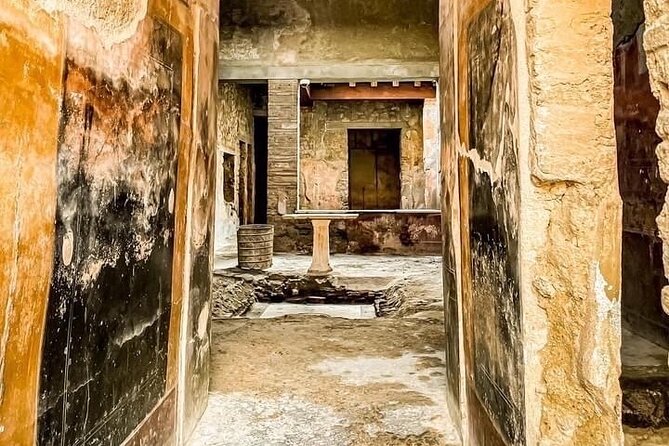
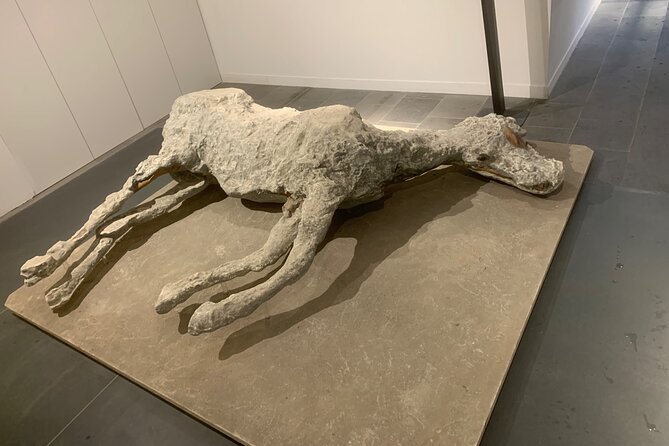
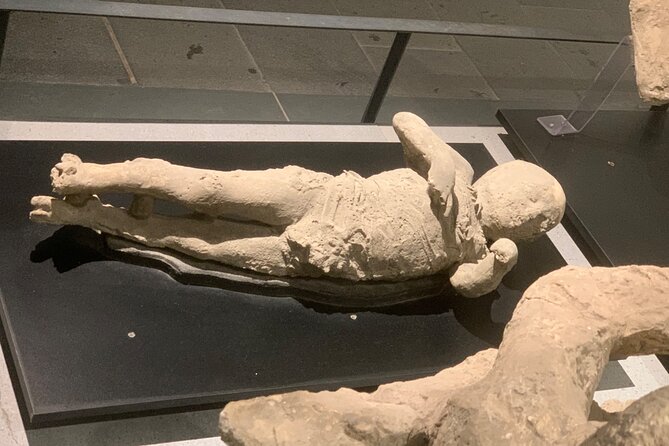
Pompeii isn’t just a big pile of stones. It’s a rare archaeological record where volcanic ash preserved street-level life so well that you can still picture daily routines from roughly 2,000 years ago. That preservation effect is the reason the park matters so much: the excavation progress has brought about 75% of the site to light over more than two centuries, so you’re not seeing only isolated ruins—you’re seeing a functioning city layout.
This tour earns its value by compressing the most informative parts of the site into a short, guided route. At $66.38 per person, the price is easier to justify because it bundles the key things that usually cost extra: entrance, priority service, and a local guide. If you arrive on a first-time schedule, this matters. Pompeii can feel like a maze when you’re on your own, and a timed itinerary prevents you from wandering into the wrong corners at the wrong speed.
You can also read our reviews of more guided tours in Pompeii


Meeting at Via Villa dei Misteri: Getting Started Without Stress
The meeting point is Via Villa dei Misteri, 3, 80045 Pompei NA, Italy, and the tour ends back at the same spot. The start happens near the park entrance, a few meters from the station and car parks, which is a practical detail if you’re juggling train schedules or parking.
Also, you’ll be working with a short overall timeline. That’s why the “on time” part matters more here than on a long tour. If you’re coming in from elsewhere, build in margin. Even small delays can shrink the time you have inside the ruins, especially because this route doesn’t promise every famous stop—it’s curated to fit.
The Priority Entry Advantage: Why Skip-the-Line Matters Here
Skip-the-line isn’t a luxury in Pompeii. It’s how you protect your time. The ruins stretch out, and once you’re moving, every minute counts. Priority service helps you start the experience sooner, then spend that time learning from a guide instead of standing around.
You’ll use a mobile ticket, which is convenient for most people because you don’t need to track paper documents. And because the group is capped at 14, the entry flow typically stays manageable. This is one of the clearest reasons to pick a guided, priority version over a self-guided visit when you have limited time.
Archaeological Park of Pompeii: Streets, Stories, and How the City Reads
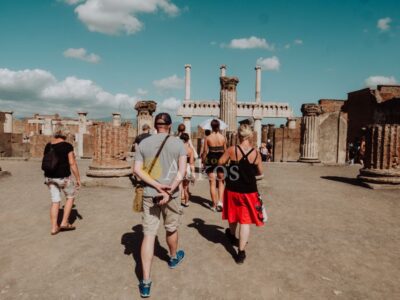
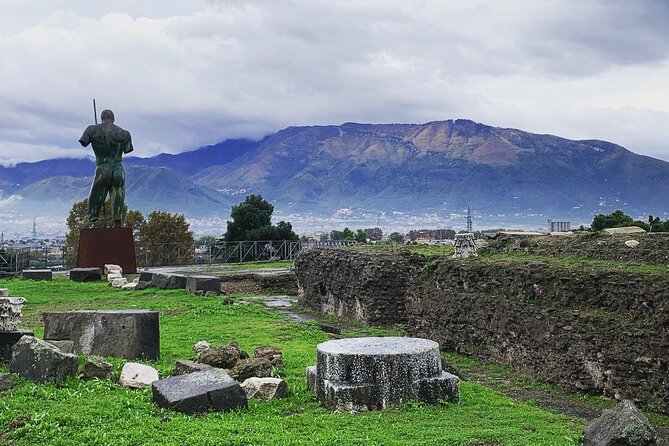
Your guided portion begins at the Archaeological Park of Pompeii and walks through the urban core—streets and recognizable building fronts where it can feel like time didn’t move. That effect is what your guide will keep pointing out: the way ash preserved surfaces helps you understand the city’s structure and movement.
This stop is also where the guide’s job is most important. Pompeii is big enough that without context, you’ll get stuck looking at highlights but missing connections. A good local guide helps you read the place like a system: this corridor is where people moved, this building type is where status shows up, and this public area is where decisions and business happened.
Time-wise, you’ll start the tour and then branch into specific buildings and public spaces. The big drawback is the pace. If you want to slow down for photos, sketchy details, or just soaking in the atmosphere, you may wish you had a longer guided option. Still, even in a tight schedule, the park visit sets the right mental map for what you’ll see next.
At the end of the guided tour, you have the chance to remain inside the excavations. That’s your safety net: if something stops you in your tracks, you can circle back after the structured portion finishes.
Casa del Menandro: An Elite Home With Real Finds Under the Floors
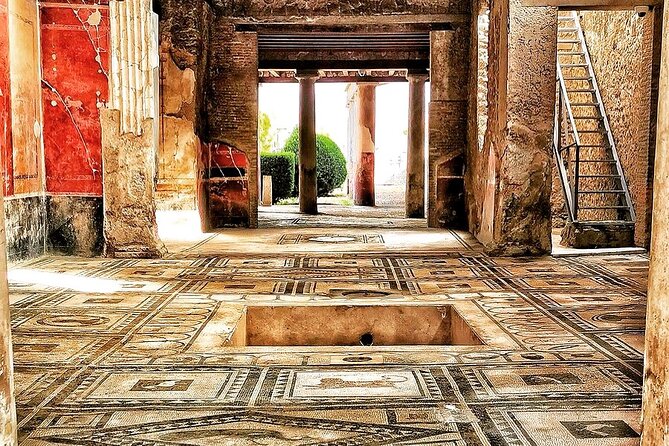
One of the most compelling stops is Casa del Menandro, a large home tied to a high-ranking family. The layout matters because it shows how status worked inside Roman domestic life: you get the atrium, the decorated living spaces, and then the peristyle area that signals a more private, elevated lifestyle.
Here are the details that make this stop worth your attention:
- A frescoed atrium with scenes drawn from the Iliad and the Odyssey
- A rhodium-type peristyle, with the northern side being higher
- The home’s name from a portrait of Menander, an Athenian playwright, placed in the porch
But the real wow factor is what the house points to beyond wall art. Beneath the thermal district is an underground room—possibly a cellar—where a chest holding 118 pieces of silverware was found. That set was hidden before restoration began and has been displayed in the National Archaeological Museum of Naples. Even if you never go to Naples on this trip, knowing the treasure came from this home helps you understand Pompeii as a place that still reaches into modern museum collections.
One practical consideration: a detailed house stop can be easier to enjoy if you’re not rushing. If you tend to move fast and skip side areas, you might miss some of the most interesting architectural cues. The time here is short, but it gives you enough to feel the “why” behind Roman home design.
You can also read our reviews of more tours and experiences in Pompeii





The Lupanar Stops: Sexual Economy as Daily Infrastructure
You’ll visit the Lupanar, the brothel complex, and the itinerary includes more than one moment connected to it. That’s useful because the lupanar isn’t just a shocking footnote—it’s part of the city’s economy and social structure.
What you’ll see and learn centers on how the building functioned:
- Women (often described as Greek and Oriental slaves) practiced their profession for payment measured in asses
- A cup of wine cost one ass
- The building has two floors: living areas upstairs and five rooms on the lower level
- Each lower room has a built-in bed, and the rooms were closed by a curtain
- At the corridor end, under the stairwell, there’s a latrine
The walls also carried small erotic images along the corridor, basically serving as advertising and information for visitors. The name itself connects to the Latin word lupa, used to refer to a prostitute.
This stop can be uncomfortable for some people, depending on your comfort level with explicit subject matter. If you’d rather keep your Pompeii experience strictly “family-friendly,” plan for a different pace or consider a different tour style. If you want the full picture of Roman life—including the parts that weren’t polite—this is one of the most revealing stops on the route.
Foro de Pompeya: Where Politics, Trade, and Religion Intersect

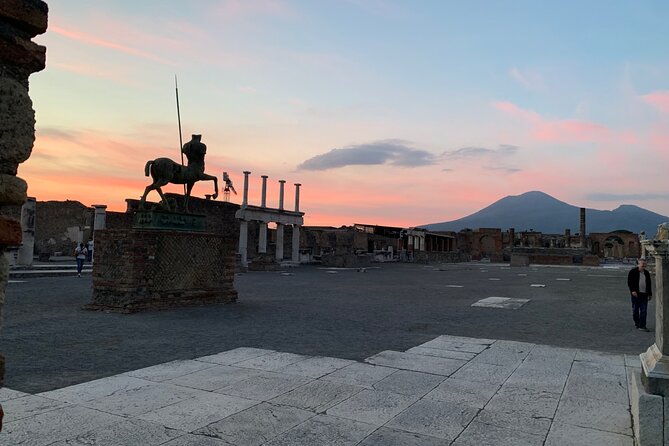
The Forum (Foro de Pompeya) is the daily-life center of the city. If you only see buildings, Pompeii can feel like a museum. The Forum is what makes it feel like a living system again—administration, justice, commercial activity, and public space all overlap here.
Your guide will likely bring you through the way the Forum evolved over time:
- It began as a more open, irregular area with rammed earth.
- On one side you had the Sanctuary of Apollo, and on the other a row of shops.
- Between the 3rd and 2nd centuries B.C., the square was regularized and surrounded by arcades, with the bottom paved using tuff slabs.
- The axis of the square aligned the facade of the Temple of Jupiter with Vesuvius.
- In the imperial age, the Forum was paved with travertine slabs, and you can spot recesses used for bronze letters tied to large inscriptions.
This is the kind of stop where having a guide helps you stop treating it like a big open area and start reading it as a map of power. Even in a short time window, it gives you context for everything else you see: where decisions were made, where commerce moved, and how religion framed public space.
Stabian Baths (Terme Stabiane): Oldest Thermal Complex, Buried and Found
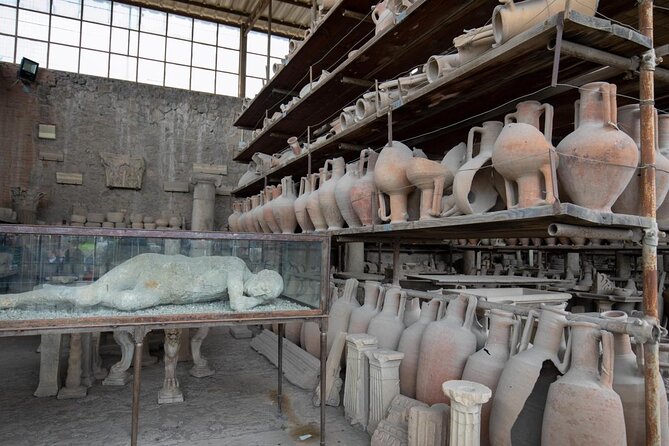
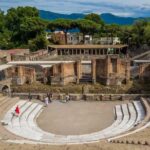
You’ll finish with Terme Stabiane, Pompeii’s thermal complex and the oldest building of its kind in the city. Baths are a great stop for first-timers because they show leisure and social behavior—Romans didn’t just work. They gathered, talked, exercised, and relaxed in shared spaces.
The story here is tightly linked to Vesuvius. The baths were buried in 79 and later rediscovered during excavations of Pompeii. Even if you don’t have a lot of architectural vocabulary, your guide can help you see how a thermal complex functioned as both infrastructure and social stage.
This stop also balances the tour emotionally. After lupanar subject matter and public administration space, baths feel like a return to everyday rhythms. It’s a practical reminder that Pompeii was a full life city, not just a set of dramatic deaths.
Guides Make the Difference: The Human Tone Behind the Ruins
This is a guided experience, and the guide’s style can dramatically change how the ruins land. The provider listed for this experience is Gennaro Balzano, and the local-guide approach shows up in how you’ll be taught to notice details instead of rushing past them.
In particular, I’d pay attention to how your guide handles three things:
- Families and pacing (a guide who can explain complex Roman life without turning it into a lecture makes a big difference)
- Q&A time (you get the most value when the guide answers your real questions about what you’re seeing)
- Tone (Pompeii includes heavy topics, so a guide who stays respectful and clear helps you process what you’re looking at)
If you end up with a guide known for patience and keeping kids engaged—like Antonio, Anna, or Sasa-style explanations—you’re likely to enjoy the tour more, not less. And if you get a guide who’s friendly and funny while staying grounded in facts—people have specifically praised Gennaro for that kind of vibe—this can feel like a conversation, not a march.
Price and Logistics: Is $66.38 Good Value?
For $66.38, you’re getting:
- Entrance tickets
- Priority service to skip the line
- Authorized local guide
- A mobile ticket
- A route that includes Casa del Menandro, the lupanar, the Forum, and the Stabian Baths
When you compare that to piecing together tickets, guided entry help, and time lost to lines, the bundle starts to make sense. The main thing you’re paying for is efficiency plus interpretation.
Where value can slip is in expectations. If your dream Pompeii visit is spending hours inside one house or reading every inscription, then this short format may not satisfy. One recurring concern with shorter tours is that you get the overview and some standout rooms, but not the slower, deeper wander you might want. If that’s your style, you’ll be happier with a longer guided option or with adding self-guided time after the tour ends.
Also keep in mind weather. The experience requires good weather, and if it gets canceled due to poor weather, you’ll be offered a different date or a full refund. It’s non-refundable and can’t be changed for any other reason, so check forecasts.
Who This Tour Fits Best
This Pompeii loop is ideal if:
- You’re on a tight schedule and want a structured, high-impact visit
- You value skip-the-line entry more than you value total free roaming
- You’re visiting in English and want a guide to explain what you’re looking at
- You like seeing a range of life—elite homes, public space, and daily leisure—within one pass
It’s not as ideal if:
- You want a slow, photo-heavy deep study of just one or two buildings
- You get frustrated when time feels tight between stops
Should You Book This Pompeii Tour?
If you want Pompeii to feel understandable fast, this is a smart pick. The priority entry plus local guide combo is exactly how you protect your time at a huge site. Casa del Menandro gives you art and archaeology in one stop, the Forum helps you read the city, and the Stabian Baths finish with a sense of daily Roman life.
I’d still make one adjustment to your mindset: treat this as an excellent overview route. If Pompeii is a once-in-a-lifetime trip and you know you love details, consider pairing it with extra self-guided time after the tour ends—or choose a longer guided format if it’s available.
If you’re ready to see the big story of Pompeii efficiently, book it. You’ll leave with a clearer picture than you’d get from walking in cold.
FAQ
How long is the Pompeii tour with a local guide and skip-the-line entry?
It’s about 2 hours 30 minutes.
What’s the price per person?
The price is $66.38 per person.
Is the tour offered in English?
Yes, it’s offered in English.
Does this tour include the skip-the-line entrance?
Yes. It includes priority service for entry to help you skip the line.
What stops will we visit during the tour?
You’ll visit the Archaeological Park of Pompeii, Casa del Menandro, the lupanar, the Foro de Pompeya, and the Stabian Baths (Terme Stabiane).
Are entrance tickets included?
Yes. Admission tickets are included for the stops.
Do I need to print anything, or is there a mobile ticket?
You’ll use a mobile ticket.
What’s the group size limit?
The tour has a maximum of 14 travelers.
Can I stay inside Pompeii after the guided portion ends?
Yes, after the guided tour there is the possibility of remaining inside the excavations.
Are service animals allowed?
Yes, service animals are allowed.