REVIEW · POMPEII
Sharing Tour of Pompeii
Book on Viator →Operated by Tours Pompei · Bookable on Viator
Pompeii is a city you can read. This 2.5-hour sharing-style tour focuses on three standout Pompeii sites: a Roman temple under ash, the art-packed Casa dei Vettii, and the stark, still-visible lupanari. I like how it stays efficient without rushing the best details, and I like that you get a real guide handling the who-what-why so you don’t wander like a lost Roman tourist. One thing to consider: the Pompeii entrance ticket is not included, so the final cost depends on your group size and the €20 per person ticket.
The vibe here is practical. You meet at Pompei Scavi Villa Dei Misteri, and the guide waits for you with a Sharing Tour of Pompei sign. You’ll use a mobile ticket, and you can request pickup, which matters if you don’t want to play bus-and-walk roulette in advance.
With a 4.9 rating and 98% recommending, the odds are good you’ll like the pacing and the on-the-ground explanations. Still, be smart: one negative note in the feedback points to last-minute uncertainty, so keep an eye on confirmation and updates as your date gets close.
In This Review
- Key points I’d bet you’ll care about
- Pompeii in 2.5 Hours: A Pace You Can Actually Enjoy
- Meeting at Pompei Scavi Villa Dei Misteri (And Why That Helps)
- What You’re Getting: Private Guide, Sharing-Style Name, Real Control
- Price and Value: $193.49 Per Group, Plus Pompeii Tickets
- Stop 1: The Roman Temple Buried by Vesuvius
- Stop 2: Casa dei Vettii and the Power of Roman Wall Art
- Stop 3: The Lupanari and What It Really Was
- Group Size, Ticketing, and How to Prep So You Don’t Lose Time
- How to Get the Most From Your Guide at Each Stop
- What If Plans Change? The Only Real Risk I See
- Who This Tour Fits Best
- Should You Book This Pompeii Tour?
- FAQ
- How long is the Pompeii sharing tour?
- How much does it cost?
- Is the Pompeii entrance ticket included?
- Does the tour include pickup?
- Where do we meet?
- What language is the tour offered in?
- Is this a private tour?
- Can service animals join?
- What is the cancellation policy?
Key points I’d bet you’ll care about
- 2 hours 30 minutes is long enough to see real highlights, short enough to avoid a full-day slog.
- Casa dei Vettii is treated as a major stop, with focus on Roman domestic life and standout first-century wall art.
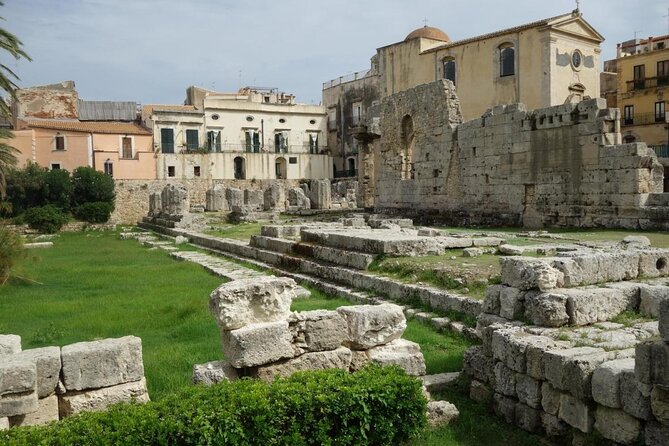
- A Roman temple stop gives you a quick but useful view of religion and public space, not just houses.
- The lupanari stop tackles daily life in Pompeii with direct, no-nonsense context for what you’re seeing.
- Pompeii entrance tickets are extra (listed as €20 per person), so plan your budget up front.
Pompeii in 2.5 Hours: A Pace You Can Actually Enjoy
Pompeii is huge. Even if you stay in the city center, you’re still walking among blocks of stone, collapsed roofs, and street layouts that look simple until you try to make sense of them. This tour aims for the sweet spot: enough time to understand what you’re looking at, without turning your day into a race.
The duration is about 2 hours 30 minutes, and that time window is the whole point. You’ll move through three clearly chosen sites: a Roman temple, Casa dei Vettii, and the lupanari. That makes it easier for you to remember what’s what afterward. No scattershot. No “we saw everything” exaggeration. Just the kind of focused route that works well for first-time visits.
Also, I like that it’s an English tour with a private guide. “Private” here matters because Pompeii explanations can get thin when groups bunch up. A guide who can talk you through what matters keeps the experience from feeling like a photo walk.
You can also read our reviews of more tours and experiences in Pompeii.



Meeting at Pompei Scavi Villa Dei Misteri (And Why That Helps)
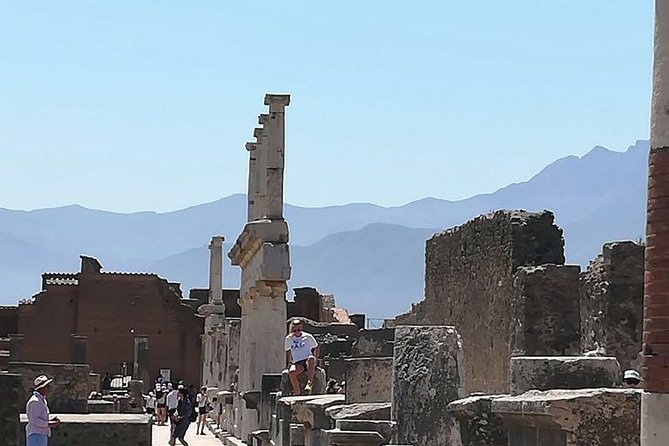
You meet at Pompei Scavi Villa Dei Misteri, in Pompei. That’s a good anchor because it places you right near the archaeology zone you want. The guide will be waiting for you with a sign that says Sharing Tour of Pompei, so you’re not guessing which person with a lanyard is the correct one.
If you’re considering pickup, this tour says pickup is offered. That can be a real time saver, especially if you’re not staying close to the site entrance or you want to avoid figuring out transit on a tight schedule. Even if you choose not to use pickup, being near public transportation keeps this plan from feeling fragile.
Practical win: you get a mobile ticket. In places like Pompeii, that cuts down on the friction of paper tickets and last-minute line chaos. Just have your phone charged and ready.
What You’re Getting: Private Guide, Sharing-Style Name, Real Control

One detail I’d underline is how the experience is described: it’s called a sharing tour, yet it’s also listed as private for your group only. In normal human terms, that usually means you won’t be fighting for guide attention with a random crowd the way some large group tours can feel.
Included in the price is the private tour guide. That’s the core value. The ruins are impressive, but they can also be confusing. A guide’s job is to translate: what you’re looking at, how it worked, and why it’s important. This tour is built around that translation, not just sight lines.
You’ll also want to know what is not included. The Pompeii entrance ticket is not part of the listed price, and it’s stated as €20 per person. That means your final cost is: tour price for the group plus the site ticket per person.
Price and Value: $193.49 Per Group, Plus Pompeii Tickets
The price is $193.49 per group, for up to 8 people. That’s a group-based pricing model, so the value depends on how many people you’re sharing with. If you’re a couple, you’ll pay more per person than a group of eight. If you’re a family or small group, the per-person math improves quickly.
Then there’s the entrance ticket: €20 per person, not included. This is common for Pompeii tours, but it changes the budget more than people expect. If you’re booking for more than a couple of people, add the ticket cost early so there are no surprises at checkout.
What I’d call the real value here is the combination of:
- guided context at major sites, and
- a tight route that fits in one morning or afternoon chunk.
If you’ve got limited time and you care more about understanding than just collecting photos, a guided plan like this can be worth the extra cost compared with wandering on your own.
Stop 1: The Roman Temple Buried by Vesuvius

Your first major stop is described as a Roman temple that was buried by the eruption of Vesuvius in 79 and later recovered through Pompeii excavations.
Why this stop works on a short tour: temples give you structure. Before you see homes and street life, you get a sense of public space and religious or civic priorities. Even if you don’t know Roman architecture terms, a guide can help you read the basic purpose: where worship happened, how people moved in relation to the building, and what the temple signaled in the city.
What to pay attention to when you’re there:
- how the layout suggests public access, not private rooms
- how the ash-and-time preservation makes parts of the architecture easier to interpret than in scattered ruins
- anything that looks worn, rebuilt, or exposed during excavation
The drawback is simple: because the tour is only 2.5 hours, this temple stop won’t feel like an hours-long deep study. If you’re the kind of visitor who wants to trace every column and label, you may want more time in Pompeii than this tour allows. But for most people, it’s a smart setup.



Stop 2: Casa dei Vettii and the Power of Roman Wall Art
Then you hit Casa dei Vettii—a Roman domus (a private house) also buried by the eruption and uncovered during Pompeii excavations.
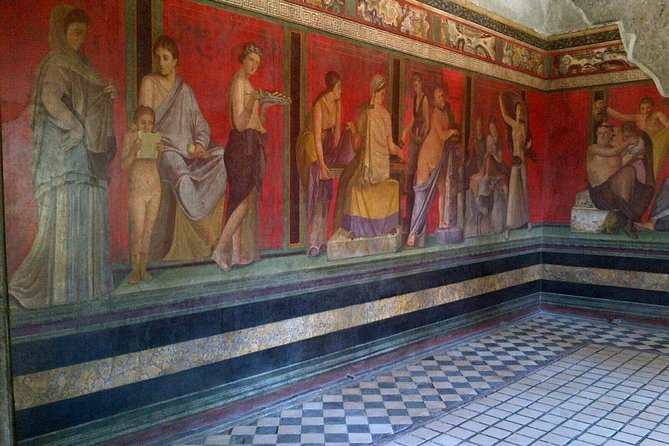
This is the kind of stop that turns an old city from “cool ruins” into something human. The description emphasizes that Casa dei Vettii is one of the greatest examples of Roman art from the first century and is named after the owners, the Vettii. That tells you what the guide should focus on: not just the rooms, but the visual storytelling inside them.
Here’s what you’ll likely find most satisfying:
- A clear picture of how wealthy Romans lived and decorated
- Enough time to understand the house as a system, not a list of rooms
- A better sense of everyday power and culture than you’d get from outside structures alone
Potential drawback: domus layouts can feel confusing if you don’t understand how rooms connect around the central spaces. That’s exactly why a guide helps. If you go without one, it’s easy to miss why certain areas mattered. With the guide, you can connect the art and the architecture instead of treating them like random backdrops.
Stop 3: The Lupanari and What It Really Was
Finally, the tour visits the lupanari. The term is tied to the Latin word lupa, and the description is blunt: these were places dedicated to mercenary sexual pleasure—essentially appointment houses or brothels. The best part is that some of them are still visible in Pompeii.
This stop isn’t just shock value. It’s an important part of reading a city’s daily life. When you see the rooms and how the space functioned, you stop imagining the ancient world as only temples and mansions. Pompeii includes commerce, services, and human behavior in all its messy reality.
What I’d tell you to watch for:
- how the layout suggests short-term use, not long stays
- how the building’s design likely shaped interactions
- the contrast between official public life (temples) and private, profit-driven life (the lupanari)
One consideration: if you’re sensitive to sexual content, this stop will still be part of the itinerary. The tour provides context, but it won’t sanitize what it is. If that’s not your thing, it’s the only clear “content warning” moment on the route.
Group Size, Ticketing, and How to Prep So You Don’t Lose Time
You’re capped at up to 8 people per group. That’s a sweet spot for a guided Pompeii walk: big enough to share costs, small enough for a guide to keep you moving and answering questions.
You’ll also use a mobile ticket, which is generally faster than paper. Still, I recommend you do this before you leave your hotel:
- have the mobile ticket ready offline or with reliable service
- check that your phone battery is charged
- decide ahead of time whether you want pickup or you’ll meet at the site
The tour says most travelers can participate, and service animals are allowed. It also notes it’s near public transportation, which helps if your lodging isn’t walkable.
How to Get the Most From Your Guide at Each Stop
A good Pompeii guide doesn’t just recite dates. They help you form a mental map. Here’s how you can steer the experience toward maximum payoff.
At the Roman temple:
- ask how this space fit into daily civic life
- look for how people would have approached it
- don’t skip the guide’s explanation because ruins can look similar until someone tells you what to notice
At Casa dei Vettii:
- focus on what the art is communicating, not just that it exists
- ask how the house reflects wealth and status
- take a slow minute in the areas the guide highlights most—those are the points that will make everything else click
At the lupanari:
- ask what the setup tells you about social behavior
- use the guide’s framing so it stays informational, not just graphic
- take note of the contrast to houses and temples
What If Plans Change? The Only Real Risk I See
Most people book this tour well ahead. On average, it’s booked about 50 days in advance, which suggests it’s a popular option and typically runs smoothly.
That said, there is at least one negative note in the feedback about the tour being canceled at short notice with an unhappy customer. I’m not going to overreact based on a single complaint, but I will give you one practical habit: confirm your status as your date gets close, and keep your schedule flexible enough to handle a change.
Who This Tour Fits Best
This is a strong choice if:
- you have limited time in Pompeii and want the main ideas in one go
- you care about explanation, not just walking around
- you want a route that covers public life (temple), private life (Casa dei Vettii), and everyday commerce (lupanari)
It’s also a good match if you’re traveling with up to 8 people and can share the group price.
You might want another format if:
- you need a completely content-free visit (because the lupanari stop includes explicit context)
- you want to spend longer at one single site
- you expect the entrance fee to be included in the tour price
Should You Book This Pompeii Tour?
If you want Pompeii with direction, and you like the idea of three well-chosen stops in about 2.5 hours, this booking makes sense. The high rating and recommendation rate point to a smooth experience for most people, and the private guide setup is the right kind of upgrade when you’re navigating a site as large and confusing as Pompeii.
Just budget correctly. Plan on adding €20 per person for the Pompeii entrance ticket, and make sure you’re comfortable with the lupanari stop and its context. If those two points fit your needs, I’d say this tour is an efficient, high-value way to see Pompeii without wandering in circles.
FAQ
How long is the Pompeii sharing tour?
It runs for about 2 hours 30 minutes.
How much does it cost?
The price is $193.49 per group for up to 8 people.
Is the Pompeii entrance ticket included?
No. The Pompeii entrance ticket is not included in the price and is listed as €20 per person.
Does the tour include pickup?
Pickup is offered. The guide will be waiting for you with a Sharing Tour of Pompei sign at the meeting point if you do not use pickup.
Where do we meet?
You meet at Pompei Scavi Villa Dei Misteri, 80045 Pompei, Metropolitan City of Naples, Italy.
What language is the tour offered in?
The tour is offered in English.
Is this a private tour?
It is described as a private tour/activity, and only your group will participate.
Can service animals join?
Yes, service animals are allowed.
What is the cancellation policy?
You can cancel for free up to 24 hours in advance for a full refund. If the minimum traveler count isn’t met, you’ll be offered a different date/experience or a full refund.