REVIEW · POMPEII
Pompeii 2h Small-Group Tour with Expert Archaeologist
Book on Viator →Operated by Mondo Guide Srl · Bookable on Viator
Pompeii in just two hours. This small-group route hits the most recognizable corners of the ancient city, so you do not waste your limited time wandering. I love that the guide points out what you are seeing, including frescoes and key public buildings, so the ruins click into place quickly.
The big win is that the tour price bundles in entry tickets for the major stops, which cuts down on gate hassle. One thing to keep in mind: even when it’s marketed as small-group, the flow can depend on who shows up, and audio or crowd pacing can vary by group setup.
In This Review
- Key things to know before you go
- Why this two-hour Pompeii route works
- Meeting point and start-time sanity (Piazza Esedra)
- Archaeological Park of Pompeii: the setting and the frescoes
- Odeon and Teatro Piccolo, then Teatro Grande
- House of Menander: wealth, decoration, and space
- Stabian Baths (Terme Stabiane): the city’s oldest thermal complex
- Lupanar: the most famous brothel in Pompeii
- Via dell’Abbondanza: using the street to orient yourself
- House of the Faun and the Forum/Basilica power zone
- Guides and pacing: what stands out in real service
- Heat, walking, and bringing kids without stress
- Price and ticket value: is $32.67 worth it?
- Should you book this Pompeii small-group tour?
- FAQ
- How long is the Pompeii tour?
- Is the tour offered in English?
- Where do I meet for the tour?
- What is the price per person?
- Are Pompeii entrance tickets included?
- What group size should I expect?
- Is this tour family-friendly?
- What kind of physical fitness level do I need?
- Are there any days when Pompeii entrance is free?
- What if the tour is canceled due to minimum numbers?
Key things to know before you go
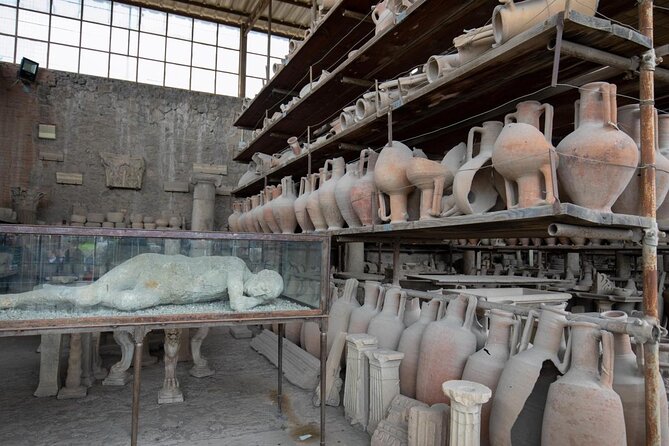
- Timed highlights in ~2 hours: a tight route that still covers major sights
- Admission included for the stops on the walk
- English-led tour with an expert archaeologist format
- Max group size of 30 on this experience
- Family-friendly style, with guidance that can help kids stay interested
- Easy logistics with a clear meeting spot near public transport
Why this two-hour Pompeii route works
Pompeii is huge, and your biggest enemy is not your shoes. It is time. This tour is built around a smart, walkable circuit that hits the areas most people want first, without turning your visit into a full day mission.
In practice, you get a sequence of spaces that show how the city functioned: entertainment, daily streets, wealthy homes, public baths, and the civic center. You also get help reading what you are looking at. That matters, because Pompeii can feel like random walls until someone gives you the frame—where you are, what it was used for, and why it was designed that way.
This format also tends to feel manageable in the heat. Several guides in the same program are praised for pausing in shade when needed, and for keeping the pace steady for mixed-age groups.
You can also read our reviews of more tours and experiences in Pompeii


Meeting point and start-time sanity (Piazza Esedra)
You’ll meet at Ristorante Suisse in Piazza Esedra, Pompei (Piazza Esedra, 10/13). The tour ends back at the same meeting spot, which is a nice setup if you want to keep the rest of your day flexible.
You’ll receive confirmation at booking, and you’ll use a mobile ticket on the day. Plan to arrive a bit early so you can check in, find your guide, and settle your plan before the walking starts. Pompeii can get crowded, and getting your timing right makes the tour feel smoother.
If you’re visiting on a day with free entry—Pompeii entrance is always free on the first Sunday of each month—you might want to double-check what you still need for the tour itself, since the tour includes admissions as part of the package.
Archaeological Park of Pompeii: the setting and the frescoes
The tour begins inside the Archaeological Park of Pompeii. This is where you get the foundation: Pompeii was an ancient Roman city preserved by the eruption of Mount Vesuvius in 79 AD. A guide’s job here is to help you connect the physical remains to everyday Roman life.
One of the specific early targets is the frescoes. In a few minutes, you start to see how wall art helped shape rooms—advertising status, setting a mood, and decorating spaces that would have been lived in, not just admired.
A practical note: fresco areas can feel visually dense. If you tend to rush through museums, slow down for the fresco stop. Look for composition, color choices, and how the artwork fits the wall space. A good guide will point out what to focus on so you do not miss the details that make it meaningful.
Odeon and Teatro Piccolo, then Teatro Grande
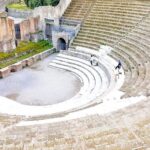
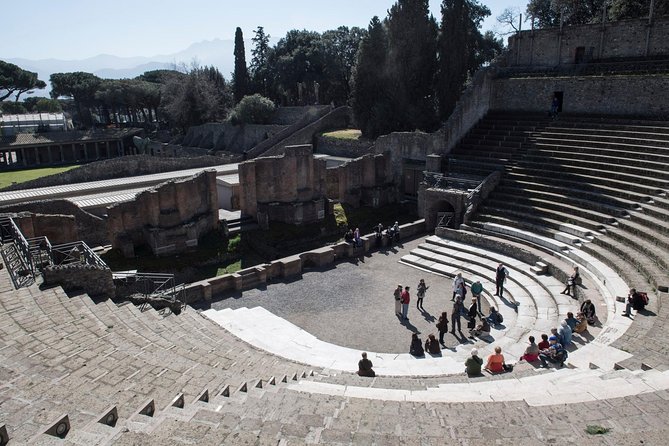
From the park, you move into the entertainment district zone. The route includes the Odeon (Teatro Piccolo) for a first taste of Pompeii’s performance spaces, then the Teatro Grande as the big centerpiece.
What makes the theater stops valuable is contrast. You see how public entertainment worked and how theaters were designed to draw people in. Even if you are not a theater buff, these buildings are a shortcut to understanding what mattered in Roman public life: crowds, spectacle, and community events.
A helpful way to experience these stops is to watch the space in sections. Note where you’d sit or stand, how the layout frames the performance area, and how sound and movement would have worked. A guide can make this easier by translating stone and steps into a picture of how the building functioned.
In a packed site, theaters can also be where crowds gather. The time-boxed nature of the tour helps here: you get a focused look without spending an entire hour stuck behind slow-moving groups.
House of Menander: wealth, decoration, and space
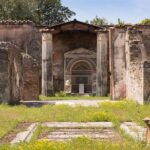
Next comes one of the richer private residences: the House of Menander. This stop focuses on architecture and decoration, plus what the contents tell you about the household.
This is not just a fancy building stop. A well-run guide uses the layout to explain how rooms connected, how decoration signaled status, and how private life differed from the public areas you saw earlier. Pompeii’s homes are especially effective for learning because you can visually follow transitions—front areas versus deeper rooms, and how a visitor would have moved through the space.
The time here is short, so you will not see everything. Instead, you get a guided snapshot of what makes this house notable, so you leave with a mental model for other homes you might explore later on your own.

Stabian Baths (Terme Stabiane): the city’s oldest thermal complex
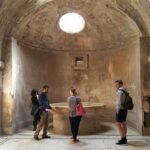
The Stabian Baths cover a large area and are described as the oldest thermal complex in the city. Baths in Roman life were more than washing. They were social hubs with routines, conversation, and public gathering built into the architecture.
This stop is a great one for people who like practical history. You get a sense of how spaces were organized for different parts of the bathing process, and why the complex mattered to daily schedules.
One consideration: baths areas can involve uneven ground and more walking within a larger footprint. If you have moderate mobility limits, wear supportive shoes and pace yourself. A guide can help keep the flow steady, and shade breaks are often part of how the tour stays comfortable.
Lupanar: the most famous brothel in Pompeii
Then comes the Lupanar, the well-known brothel site in the ruined Roman city. This is a historically significant stop, and it is also the one that can feel most awkward depending on your group.
For adults, it is often a lens into commerce, gender dynamics, and how the city dealt with private services alongside public life. For kids, this kind of topic can be harder to keep engaging, even on a family-friendly tour.
So here’s my practical advice: if you’re bringing young kids, decide in advance whether this stop will be okay for your family. The tour is marketed as family-friendly, and many guides are good at keeping kids engaged, but not every historical subject lands the same way for every age group.
Via dell’Abbondanza: using the street to orient yourself
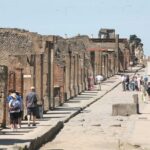
The tour also includes Via dell’Abbondanza. Think of this as the orientation tool. Streets like this helped organize how people moved and where activity happened.
Walking a main street in a guided format helps you understand Pompeii’s layout beyond the standalone big sights. You start to picture neighborhoods as living grids, not isolated attractions.
If you later explore on your own, this street stop can be the difference between feeling lost and feeling oriented. It’s one of those subtle parts that makes the whole visit make more sense.
House of the Faun and the Forum/Basilica power zone
Two more big elements follow. First is the House of the Faun, described as one of the largest and most impressive private residences, known for its architecture, decoration, and overall scale. Then you step into the public heart: the Forum of Pompeii and the Basilica.
The House of the Faun works well as a paired contrast to earlier homes. You see how wealth showed up in scale and design, and you get another guided reminder that private life in Pompeii could be elaborate and carefully planned.
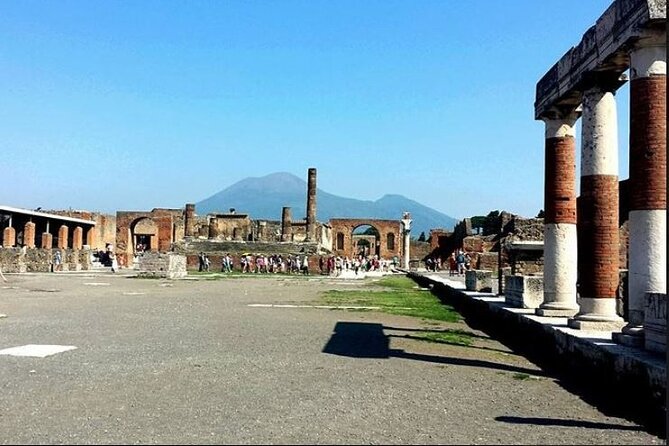
Then the Forum and Basilica bring you back to civic life. The Forum is the main square—where people would gather for politics, business, and community activity. The Basilica is an open portico that sheltered merchants and other daily activities. Together, these stops show you how the city balanced public decision-making and commerce in the same central zone.
If you want Pompeii to feel more than ruins, this is where it happens. You connect the entertainment and homes to the places people ran real life.
Guides and pacing: what stands out in real service
The tour experience depends heavily on the guide’s tone and pacing, and the program includes guides who are praised for story delivery and keeping the group moving at a moderate pace.
You’ll see names like Luca, Gianluca, Roberta, Manuela, Enzo, Patrizia, Mafilda, and Clare in past guide feedback. The common thread is how they help people understand what they are looking at, plus how they manage breaks and crowd flow. In hot conditions, several guides are noted for stopping in shaded spots, which is not a small detail at Pompeii.
Still, there is one fairness note: if you are expecting an extremely intimate group size, remember the tour has a maximum group size and can be influenced by who joins that day. Audio can also be a factor if a larger group setup uses headsets, so do a quick check of how you hear and communicate.
Heat, walking, and bringing kids without stress
Pompeii is often hot and exposed. This tour is designed around a steady walk of multiple major sites in a short window, so you should treat it like a short hike through an archaeological park.
Bring sunscreen, a hat, and water. If you get tired, the tour’s guided stops help you reset your attention. Guides are also praised for planning shade breaks, which can make a huge difference when the sun is relentless.
For families, the tour is explicitly family-friendly, and multiple kids age groups have done well with guides who explain in a way children can follow. At the same time, there is no magic age-proof guarantee. Some kids care about stories; others care about movement and short bursts. If your child is on the sensitive side, consider whether the more adult topic like the Lupanar will be okay.
Price and ticket value: is $32.67 worth it?
At $32.67 per person for about two hours, the value comes from two places: the focused route and the bundled admissions included for the major stops.
Many self-guided visits look cheap at first, then you add the cost of entry tickets and you spend time figuring out what is worth your attention. With a guide-led circuit, you get fewer decision points. The time saved is often the real value, especially if you have one shot at Pompeii.
Also, Pompeii has free entrance rules on certain days (first Sunday monthly) and for people under 18 (with valid ID). If you qualify for free entry, you still might find the guided tour worth it for the structure and interpretation, since that is what helps the site click.
If you want more control over the pace—extra stops, more time per room, more questions—there is also an upgrade option for a private tour. That can be the best choice for families with very specific energy levels or for anyone who dislikes rushing.
Should you book this Pompeii small-group tour?
Book it if you want a smart first visit that covers Pompeii’s headline zones in about two hours, with admission included and a guide who can connect frescoes, theaters, baths, and civic buildings into one story. It is also a good match if you are traveling with kids and want structured pacing rather than wandering.
Skip or adjust your expectations if you need a fully private feel inside a strict tiny group, or if your child struggles with topics that can be sensitive (like the Lupanar). In that case, consider the private upgrade or plan a shorter, more kid-friendly self-guided add-on after the tour.
If your schedule is tight, I’d treat this as your ticket to not missing the important stuff. Then, if you feel like it, you can add a bit of free time to explore at your own pace with better orientation.
FAQ
How long is the Pompeii tour?
The tour lasts about 2 hours.
Is the tour offered in English?
Yes, it is offered in English.
Where do I meet for the tour?
You meet at Ristorante Suisse, Piazza Esedra, 10/13, 80045 Pompei NA, Italy. The tour ends back at the meeting point.
What is the price per person?
The price is listed as $32.67 per person.
Are Pompeii entrance tickets included?
Yes. Admission tickets are included for the stops on the itinerary.
What group size should I expect?
The tour has a maximum of 30 people, and it requires a minimum number of travelers to run.
Is this tour family-friendly?
It is described as family-friendly, and kids can stay engaged during the visit with the right pacing.
What kind of physical fitness level do I need?
A moderate physical fitness level is recommended.
Are there any days when Pompeii entrance is free?
Yes. Pompeii entrance ticket is always free on the first Sunday of each month. Entrance is also free for people under 18, but they must show valid document ID or passport.
What if the tour is canceled due to minimum numbers?
If the tour is canceled because minimum numbers are not met, you will be offered an alternative or a full refund.