REVIEW · POMPEII
Pompeii Skip-the-Line Entry & Guided Tour with a certified guide
Book on Viator →Operated by Pompei Tour Organizer_Tempio Travel · Bookable on Viator
Pompeii makes sense when someone points. You get skip-the-line entry plus a guide who turns scattered stone into daily Roman life, not just photo stops; I love how the stops hit the places you’d otherwise miss because they look unmarked. The one drawback is the tour runs on a tight clock, so you may feel a bit rushed at busy times.
I also like the practical value: admission and a guided walk are bundled into one price, so you spend less time solving ticket problems and more time looking. Express tickets are included, and when the group is larger you’ll get headsets, which really helps in a loud, crowded site.
Logistics are fairly straightforward if you start in the right place. You meet at Via Villa dei Misteri 1 in the first-floor office inside the Circumvesuviana Pompei Scavi Villa dei Misteri station, with a max group size of 35.
In This Review
- Key things worth knowing before you go
- Price and what you actually get for $58.87
- Where to meet: the station office that prevents the scramble
- How the 2-hour pace works on the ground
- Stop by stop: what each part teaches you
- Foro di Pompei: the city’s stage for politics, religion, and trade
- Macellum: the “market square” that food lovers will notice first
- Terme del Foro: baths with clear zoning and real tech behind the scenes
- Casa del Fauno: a big Roman home and the Alexander mosaic copy
- Casa dei Vettii: erotic art, names tied to ownership, and why it matters
- Via dell’Abbondanza to Thermopolium: where street life comes back
- Guide style and headsets: why you’ll hear the story
- Practical tips that make the tour smoother
- Should you book this skip-the-line Pompeii tour?
- FAQ
- How long is the Pompeii skip-the-line guided tour?
- Is admission to the archaeological site included?
- Does this tour include the Villa of Mysteries?
- Is the tour offered in English?
- Where do I meet the tour group?
- Is there a headset included?
- What’s the maximum group size?
- Is hotel pickup or drop-off included?
- Are service animals allowed?
- Can I cancel and get a refund?
Key things worth knowing before you go
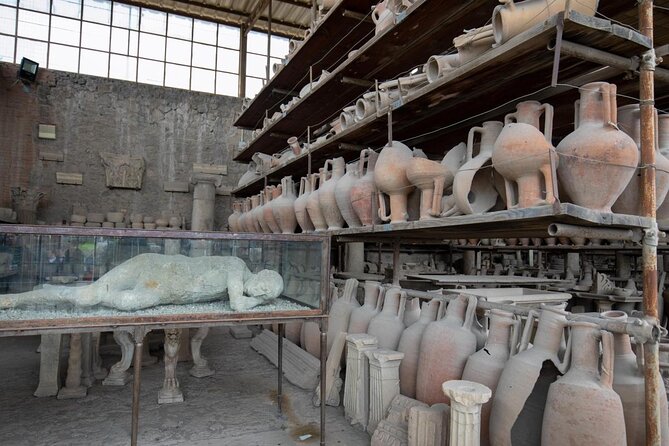
- Skip-the-line express admission is included, so you’re not stuck waiting at the gate.
- Your guide adds context in areas that feel confusing without explanation.
- Headsets help when groups grow, so you don’t strain to hear.
- The tour is tightly timed around a set route through the forum, baths, homes, and a food shop.
- Villa of Mysteries isn’t covered unless you add a different ticket, since this includes only the main site.
- Plan for a steep approach once you’re at the ruins—good shoes matter.
Price and what you actually get for $58.87
At $58.87 per person, this is the kind of Pompeii tour that can feel worth it or not—depending on your tolerance for waiting and for “I don’t know what I’m looking at.” The big value here is simple: you’re paying for both entry and a guided route that focuses on the most readable parts of the city.
Most people don’t come to Pompeii for one building. They come to understand how everything fit together: government, religion, baths, housing, markets, and everyday food. With this tour, you get that framework in roughly 2 hours. If you try to do it solo in the same time window, you’ll likely spend extra effort figuring out what matters and where to go next.
One thing to keep clear in your head: this tour includes express tickets for the archaeological site, but it does not include a “plus” ticket for the Villa of Mysteries. If that villa is on your must-see list, you may need to plan it separately.
You can also read our reviews of more guided tours in Pompeii


Where to meet: the station office that prevents the scramble
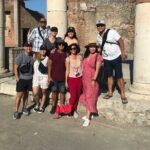
Pompeii tours live or die on meeting-point clarity, and this one is best when you follow the exact start instructions. You should arrive 15 minutes early at the agency in the station building.
Here’s the key detail I’d write on a sticky note: the meeting point is on the first floor of the Circumvesuviana station Pompei Scavi Villa dei Misteri, at Via Villa dei Misteri 1. The office name you’re looking for is Tempio Travel / Pompeii Tickets. The station is in a red building, so it’s usually hard to miss once you’re there.
And yes, there’s a practical reason this matters: the meeting spot is about 100 meters from the entrance of Porta Marina Superiore. So if you show up late and start searching, you can lose your place fast—especially when the crowd is already forming.
How the 2-hour pace works on the ground
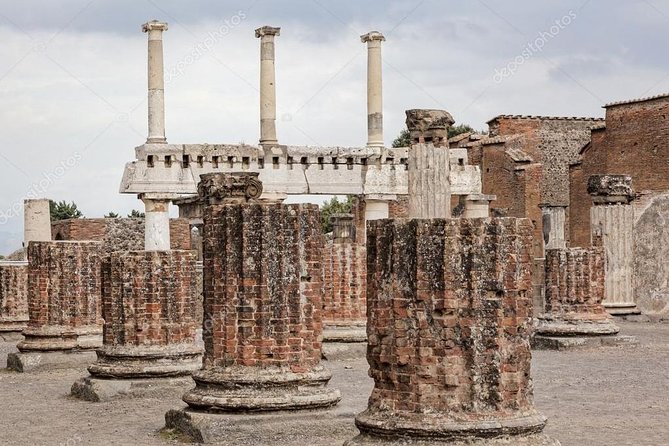
The route is built as a compact “greatest hits” walk. You’ll move through the main civic center, then into baths and two notable homes, then out along the main street toward a small food stop.
Time is the trade-off. Some stops are short—often 10 minutes—so you don’t get to linger like you would on a long independent visit. That’s not bad, though, if you treat the tour as a guided orientation. You’ll leave knowing what you’re seeing and what’s worth returning to later for a deeper look.
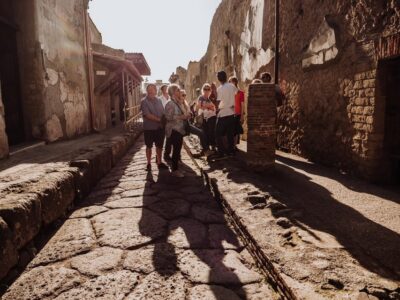
Also note the terrain. Pompeii can be steep and uneven, and the approach to the ruins takes effort even before you start walking inside the archaeological area. Wear shoes you’d trust on cobblestones and pack water if you’re visiting in heat.
Stop by stop: what each part teaches you
Foro di Pompei: the city’s stage for politics, religion, and trade
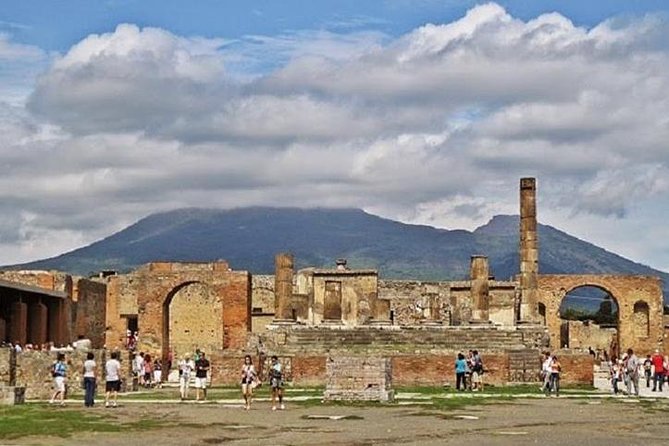
Your first real focus is the Foro di Pompei, the city’s main square. This is where the civic identity shows up: the political center, the economic hub, and the religious heart all overlapping in one place.
The reason this stop is a smart opener is that it gives you orientation. Once you understand the forum’s role, the rest of the ruins stop looking like random walls and start reading like a working city.
Expect about 30 minutes here, including your entry ticket time. If you’re only going to be in Pompeii for a short visit, this is the part that most improves your next hour.
You can also read our reviews of more tours and experiences in Pompeii





Macellum: the “market square” that food lovers will notice first
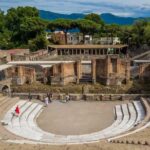
From the forum you head to the Macellum, which was the market area for meat and fish. The standout detail is that you can spot affish style decoration and wall art that points to what Roman diners ate in the 1st century AD.
This stop tends to land with people because it’s tangible. You’re not just looking at “ancient stuff.” You’re seeing how a place served everyday needs—buying food, planning meals, and moving through the market flow.
It’s a shorter visit (around 10 minutes), so go in ready to look quickly. If the market art is what hooks you, you’ll be thankful you have a guide to translate what you’re seeing.
Terme del Foro: baths with clear zoning and real tech behind the scenes
Next up are the Terme del Foro, the forum baths behind the Temple of Jupiter. This area is fascinating because it isn’t just about hot water. You learn how bathing was organized and how the city handled water supply.
Here are the specific things you’ll want to pay attention to:
- The baths had separate male and female areas, with independent entrances.
- Water came from the aqueduct of Serino, though they also had a well if supply was short.
- The ceiling surfaces in many rooms are original, and you can still see stucco work from the era.
- In the caldarium, the tub is marble, and there’s a mosaic floor.
This stop is about 15 minutes, which is a decent window for a place with multiple rooms and details. If you enjoy architecture and systems—how people lived, not just what they built—this is one of the strongest stops on the walk.
Casa del Fauno: a big Roman home and the Alexander mosaic copy
Then you visit Casa del Fauno, one of Pompeii’s large aristocratic homes. The star detail often comes down to the floor artwork: the Mosaic of Alexander.
One important nuance: what you’ll see here is a copy. The original is conserved at the MANN. That kind of context matters because it changes how you look. Instead of thinking you’re seeing “the real thing,” you understand it as part of how the household displayed power and taste.
This stop is around 10 minutes. It’s short, but a guided explanation helps you notice which spaces were public vs. private in a domus.
Casa dei Vettii: erotic art, names tied to ownership, and why it matters
Now we get into a home that feels more personal and more complicated: Casa dei Vettii. The house was buried during the eruption of Vesuvius in 79 AD and uncovered later during archaeological work.
The name comes from the owners: Aulo Vettio Restituto and Aulo Vettio Conviva. That’s the kind of detail you want a guide for, because otherwise you’re staring at rooms without knowing why this house has a special label.
A key part of the visit is a room with erotic wall paintings. The tour explanation connects this art to the likely function of the space in the household, describing the link between erotic imagery and a setting used by a prostitute who lived there with the owner.
This stop also runs about 10 minutes. It’s brief, but the guided framing turns it from “surprising content” into “a window into social realities.”
Via dell’Abbondanza to Thermopolium: where street life comes back
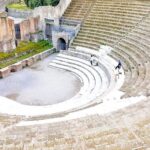
After the houses, you continue along Via dell’Abbondanza, Pompeii’s main street connecting key zones between the forum and Porta Sarno. Along the way, the tour points out major areas you might otherwise miss—places like the Terme Stabiane, the Teatri, the Tempio di Iside, and the Anfiteatro.
This stretch matters because it recreates the city’s rhythm: you’re not just moving between attractions. You’re walking the route someone would have used to get from civic life to entertainment and daily movement.
Then you end at Thermopolium Regio VI, Insula VIII, 8. Thermopoliums were basically the ancient version of a quick-service food place—literally a spot where you bought hot food to go. It’s one of the best ways to end the tour because it brings the story back to everyday needs.
Expect about 10 minutes at this final stop, including your entry ticket time.
Guide style and headsets: why you’ll hear the story
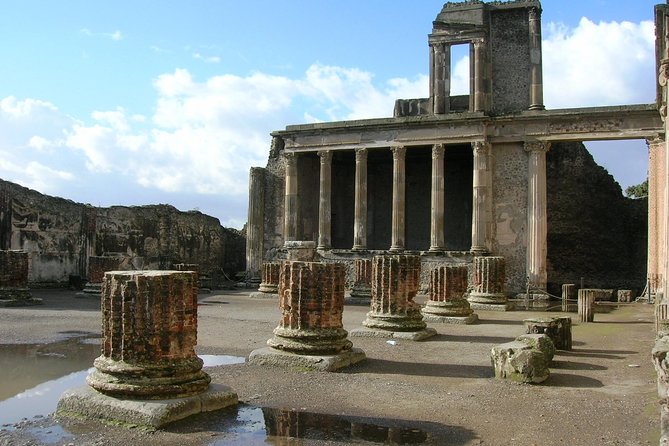
Pompeii is big, and a lot of the ruins don’t come with clear labels on every corner. That’s why having a guide is not a luxury—it’s the difference between wandering and learning.
You’ll also be given headsets when the group is more than 15 people. That matters here because Pompeii’s sound situation is unpredictable: stone echoes, street-level noise, and groups clustering. Headsets keep the guide’s explanation audible, so you don’t miss key details while you’re looking up at carvings or floor mosaics.
As for the human side of the tour, the operator has offered English-guided experiences with guides such as Alfonso, Eraldo, and Annaliza. If your guide’s humor and clarity click with you, this tour becomes much more than a checklist.
Practical tips that make the tour smoother
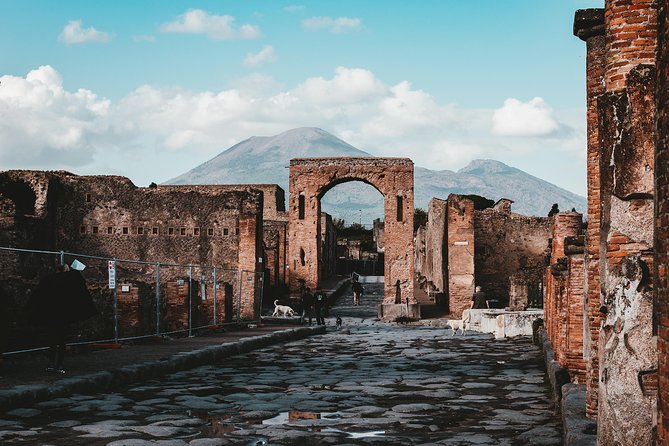
Pompeii is an outdoor site with real sun and real walking. A few prep moves can turn a stressful tour day into an easy one.
- Wear grippy shoes. The approach and the routes include uneven ground and stair-like changes in elevation.
- Bring sun protection. The site can cook under harsh weather, so sunscreen and shade strategy matter.
- Consider an umbrella in summer. Even a basic cover can help when the sun feels relentless.
- Keep your eyes up on the street. Things like fresco fragments, floor levels, and doorway changes can disappear if you only look straight ahead.
- Don’t plan a long sit-down afterward. This tour ends back at the meeting point, and the area can be busy.
Should you book this skip-the-line Pompeii tour?

Book it if you want to make your short time count. This tour is a good fit when you’re not trying to win a personal contest against the biggest site on earth. You want express entry, a guided route that explains the unmarked parts, and a pace that gets you from forum life to baths and homes without getting lost.
Skip it (or pair it differently) if you’re the type who needs long, quiet time in a single location. The schedule is tight, and some stops are designed to be quick passes. If Villa of Mysteries is a top priority, you’ll also want to plan that separately since this tour doesn’t include that “plus” ticket.
If you’re deciding between solo wandering and guided structure, I’d pick the guided version here. Pompeii rewards attention, and this route tells you where to aim it.
FAQ
How long is the Pompeii skip-the-line guided tour?
It runs for about 2 hours.
Is admission to the archaeological site included?
Yes. The tour includes express entrance tickets for the archaeological site.
Does this tour include the Villa of Mysteries?
Not with a plus ticket. The Villa of Mysteries entrance is not included.
Is the tour offered in English?
Yes, it’s offered in English.
Where do I meet the tour group?
Meet at Via Villa dei Misteri, 1, 80045 Pompei NA, Italy. The meeting point is at the first floor of the Circumvesuviana Pompei Scavi Villa dei Misteri station in the office called Tempio Travel / Pompeii Tickets.
Is there a headset included?
Headsets are provided when the group size is more than 15 people.
What’s the maximum group size?
The tour has a maximum of 35 travelers.
Is hotel pickup or drop-off included?
No. Hotel pickup and drop-off are not included.
Are service animals allowed?
Yes, service animals are allowed.
Can I cancel and get a refund?
You can cancel for a full refund if you cancel at least 24 hours before the experience’s start time. Free cancellation is allowed up to 24 hours in advance.