REVIEW · POMPEII
Private Awesome Pompeii Family Tour + Guide, Transport & Tickets
Book on Viator →Operated by Leisure Italy · Bookable on Viator
Pompeii can feel like a lot. This private family tour keeps it human-sized with a guide who sets the pace and lets you ask questions while you walk the ruins. You’ll also get included admission where it matters most, plus a route that hits Pompeii’s big public spaces and classic houses without turning your day into a sprint.
I particularly like two things: the chance to have the experience shaped for kids (a guide like Fabrizio, praised for clear explanations, really works well with young visitors), and the smart timing that can help you avoid the worst crush—one tour was planned to steer away from early morning crowds. I also like that the stops are spread out around the most story-rich sites, so you’re not just collecting photos.
One thing to consider: Pompeii is still a lot of walking over uneven ground. If your family moves slowly or gets tired quickly, the 4 to 5 hour window can feel busy, so plan for breaks and bring proper footwear.
In This Review
- Key highlights to plan your day around
- Private guide + family pace: why this tour works
- How long it really takes (4 to 5 hours)
- Meeting in Naples or Sorrento: the easiest way to get there
- The big ticket moment: Archaeological Park of Pompeii (about 2 hours)
- Porta Marina and Pompeii’s walls: getting oriented fast
- Vesuvius from the bottom: views without the climb
- Public life center: Basilica, Forum, and Temple of Apollo
- The Basilica: contracts, courts, civic order
- Temple of Apollo: religion tied to politics
- Forum of Pompeii: the square where everything converged
- Macellum market and Forum Baths: food, trade, and social time
- Macellum: Pompeii’s main indoor market
- Terme del Foro (Forum Baths): public bathing as a social scene
- Casa del Fauno and Insula dei Casti Amanti: elite life vs. dense neighborhoods
- Casa del Fauno: a grand mansion and the Alexander Mosaic
- Via dell’Abbondanza and Insula of the Chaste Lovers: everyday streets and a rooftop-style view
- Teatro Grande: sit where ancient performances happened
- Antiquarium di Pompei: connecting ruins to real objects and casts
- Price and value: is $457 per person worth it?
- Who should book this family Pompeii tour
- Should you book it?
- FAQ
- How long is the Pompeii private family tour?
- Is Pompeii admission included?
- Will we see Mount Vesuvius?
- Where can pickup happen?
- Is this a private tour?
- What language is the tour in?
- What should I wear or bring?
- Are service animals allowed?
- Can I cancel for a full refund?
- FAQ
- Do I need to provide names for tickets?
- Is there a mobile ticket?
Key highlights to plan your day around
- A true private guide: only your group, with room to ask questions and slow down when kids get curious
- Two hours inside the main ticketed Pompeii park for the core walking route
- Vesuvius views from the ground, with great photo angles but no drive to the top
- Forum-area “public life” stops that connect law, religion, markets, and baths
- Family-friendly pacing that’s been praised for keeping younger visitors engaged
- Antiquarium di Pompei to connect the ruins you see with artifacts and casts
Private guide + family pace: why this tour works
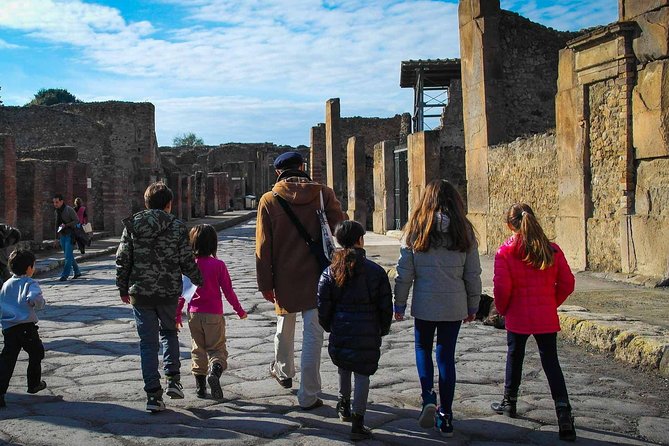
Pompeii isn’t hard to visit. It’s hard to understand, especially when you’re trying to manage strollers, snacks, and attention spans. A private guide turns the ruins into a readable story. You can linger at a mosaic, re-check a detail, or ask why a space looks the way it does—without feeling rushed by a larger group.
This tour is designed for families, not just archaeology fans. Your guide keeps a comfortable pace across a packed site and chooses what to emphasize so adults get meaning too. One reason this stands out is how guides such as Fabrizio (sometimes heard as Fabio) have been praised for explaining everything in a way kids can actually follow, not just translate in their heads.
Also, you’ll get flexible pickup service in the Naples and Sorrento area. That matters because reaching Pompeii takes time and logistics. When transport is handled for you, you can spend your energy on the ruins instead of maps, schedules, and parking.
You can also read our reviews of more tours and experiences in Pompeii


How long it really takes (4 to 5 hours)
The experience runs about 4 to 5 hours. The main chunk is around 2 hours at the Archaeological Park of Pompeii with admission included. The rest of the route is made up of short stops at major landmarks and viewpoints.
That format is smart for families. You get enough time to feel like you did Pompeii (not just a drive-by), but you’re not stuck for hours inside one single “must-see” building. Still, it’s not a slow Sunday walk. You’ll want sturdy shoes and the patience to pause often.
Meeting in Naples or Sorrento: the easiest way to get there
Pickup is flexible within the Naples and Sorrento area. You just need to specify your pickup place, and the rest of the day is structured around that meeting point.
This is especially helpful if you’re staying in Sorrento and want a direct day plan to Pompeii. Instead of cobbling together trains or buses, you’re handed a clean plan: meet, travel, tour, and return.
Tip: use practical footwear and plan for some sun. The tour notes suggest bringing sun gear from May to September, which is exactly when Pompeii can feel like an oven.
The big ticket moment: Archaeological Park of Pompeii (about 2 hours)

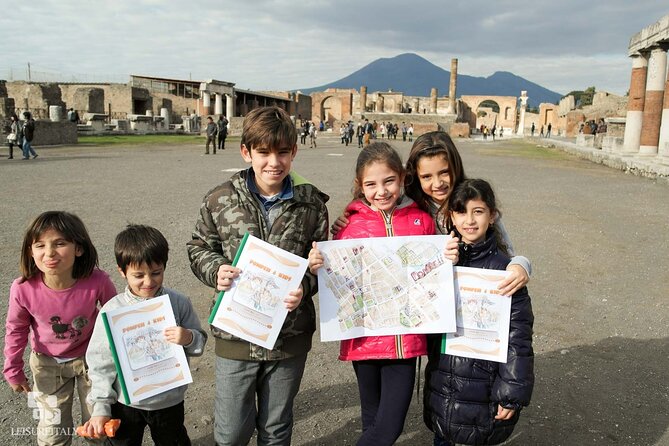
This is where the tour earns its name. You’ll spend roughly 2 hours inside the Archaeological Park with admission included. With a private family-friendly guide, you walk the ancient streets and key spaces at a pace that doesn’t force you to “move on” every minute.
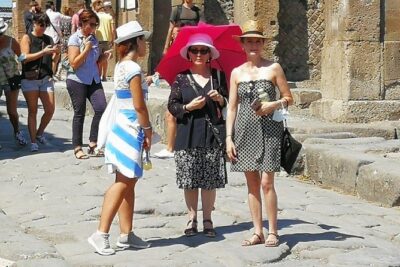
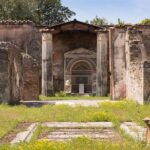
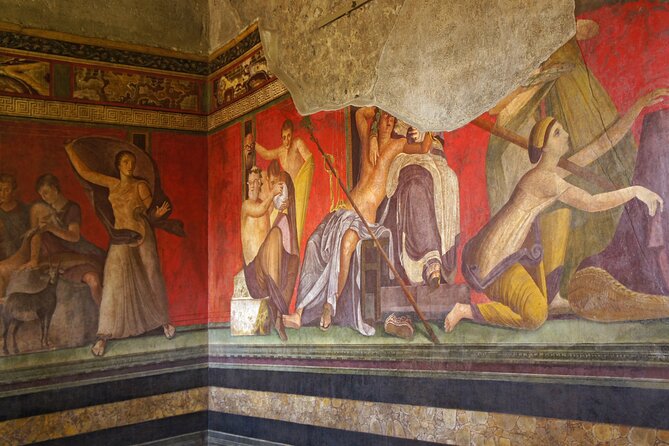
Expect to see Roman daily life in fragments that start to connect. You’ll move through areas that include homes, shops, bath houses, and public squares. The best part of a guided route here is interpretation: you don’t just look at stones—you learn how Romans worked, ate, worshipped, and relaxed before the AD 79 eruption.
What to like: the park time isn’t random. It’s guided so you understand what you’re looking at as you go.
Possible drawback: if your family loves a single deep topic (like mosaics, baths, or mythology), 2 hours can feel tight. It’s enough for a strong overview, but not enough for full specialization.
Porta Marina and Pompeii’s walls: getting oriented fast
After the main park start, you’ll visit Porta Marina and the surrounding city walls. This area helps you get bearings fast because it’s tied to how people entered Pompeii in ancient times.
Your guide explains the city layout and defensive walls, plus how Pompeii connected to ports and trade routes. For families, this is a great “big picture” stop. Kids often understand a gate and a wall instantly, and it helps you visualize why Pompeii’s streets and neighborhoods formed the way they did.
This segment is brief, but it sets context for everything you see next.
You can also read our reviews of more guided tours in Pompeii


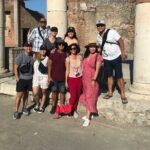



Vesuvius from the bottom: views without the climb
You’ll also see the volcano from the bottom. This is a practical, family-friendly decision: you get strong photo opportunities from Pompeii, and you’re not driving up to the top.
If you’ve been to viewpoints that involve extra travel time or lots of walking, you’ll appreciate this. The tour keeps the focus on Pompeii itself while still giving you that “we’re right here” moment with Mount Vesuvius in view.
Public life center: Basilica, Forum, and Temple of Apollo

Pompeii’s power and culture show up in the civic spaces. This part of the tour is where the city feels like a living place—law, religion, commerce, and public gatherings all mixed together.
The Basilica: contracts, courts, civic order
Inside the Basilica, your guide explains how it functioned as Pompeii’s hub for law and business. Merchants negotiated contracts. Officials handled legal disputes. Civic life took shape under a grand interior with tall columns.
It’s a powerful stop because it’s not only about architecture. It’s about how people organized their everyday rules and transactions. Even if your kids don’t care about ancient legal systems, the space helps explain why cities needed central meeting places.
Temple of Apollo: religion tied to politics
At the Temple of Apollo, you’ll learn about one of Pompeii’s important sanctuaries dedicated to a god linked with music, prophecy, and the arts. Your guide points out how religion, politics, and public ritual blended into daily Roman life.
If you like atmosphere, this is a good place to pause. It gives you a sense of ceremony and public worship, not just “tourist ruins.”
Forum of Pompeii: the square where everything converged
The Forum is the heart of public life, and your guide brings it to life by connecting temples, administrative buildings, markets, and porticoes. This is where citizens gathered to trade goods, seek justice, attend ceremonies, and exchange news.
For families, the Forum is a useful anchor. It helps you picture Pompeii’s “center of gravity,” so later streets and neighborhoods feel connected instead of disconnected.
Macellum market and Forum Baths: food, trade, and social time
Pompeii wasn’t only about temples and big buildings. It was also about eating, buying, washing, and chatting.
Macellum: Pompeii’s main indoor market
At the Macellum, you’ll see how food and ingredients moved through the city. The indoor market setup highlights stalls for fish, meat, produce, grains, and spices. You also get to understand how trading worked, including what was happening behind the scenes in storage rooms and counters.
This stop is great for kids because it’s relatable: markets are still a thing. And for adults, it’s a reminder that Roman daily life had real logistics, not just murals and myths.
Terme del Foro (Forum Baths): public bathing as a social scene
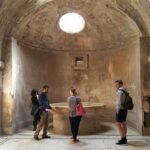
Then you’ll step into Terme del Foro, one of the best-preserved bath complexes. Roman baths weren’t only hygiene. They were social spaces where people might bathe and discuss business.
Your guide walks you through heated rooms, with attention on preserved frescoes and stucco decorations, plus original changing areas and marble basins. It’s a very “liveable” kind of stop. You can almost imagine what it felt like to spend time there on a normal day.
Casa del Fauno and Insula dei Casti Amanti: elite life vs. dense neighborhoods
Pompeii gives you both ends of the social spectrum, and this route includes both.
Casa del Fauno: a grand mansion and the Alexander Mosaic
At the House of the Faun, you’ll explore a lavish residence that shows immense wealth and refined taste. Expect courtyards and intricate mosaics, including the famous Alexander Mosaic.
Your guide helps connect architecture to lifestyle: elite families hosted banquets and expressed status through art and design. For families, this is where you often see the “wow” moment. For adults, it adds meaning to the rest of the visit because you can compare how different Pompeiians lived.
Via dell’Abbondanza and Insula of the Chaste Lovers: everyday streets and a rooftop-style view
Walking along Via dell’Abbondanza gives you a slice of Pompeii’s busiest commercial life. You’ll pass spaces tied to workshops, bakeries, taverns, and homes, and you’ll learn how daily errands and trade shaped the feel of the city.
Your guide also explains infrastructure details like water fountains and raised stepping stones—small features that mattered a lot in daily movement. This is a good reminder that Roman cities worked in very practical ways.
Then comes an elevated viewpoint at the Insula dei Casti Amanti (Insula of the Chaste Lovers). From above, you can read the layout of homes, private courtyards, bakeries, and working spaces. It’s one of the best ways to understand density: how people could live close together yet carve out distinct spaces for daily routines.
Teatro Grande: sit where ancient performances happened
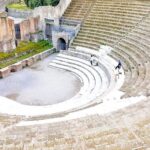
At the Grand Theatre (Teatro Grande), your guide leads you into one of Pompeii’s most atmospheric places. This is an open-air stage where comedies, tragedies, and political performances once entertained large audiences.
You’ll sit on original stone tiers. Your guide can help you imagine how voices projected across the bowl-shaped space, and you’ll get views of the stage and surrounding ruins from higher seats too.
This stop is a morale booster for many families. It breaks up the walking with a moment that feels almost like theatre today, just without the modern crowd noise.
Antiquarium di Pompei: connecting ruins to real objects and casts
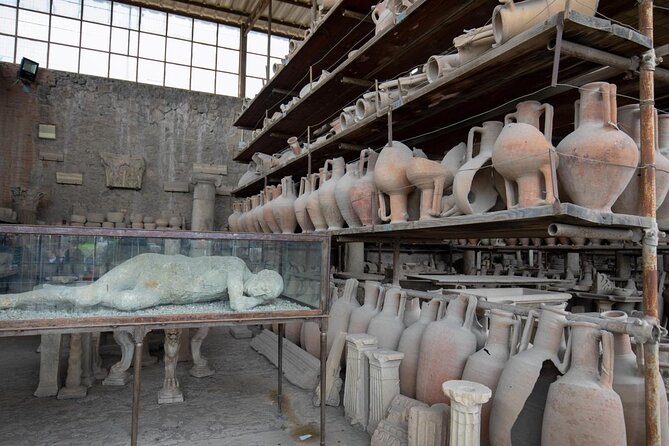
Near the end, you’ll visit the Antiquarium di Pompei. This modern exhibit helps you connect what you saw outdoors with artifacts that would have filled homes, shops, and temples.
You’ll see statues, frescoes, daily objects, and powerful casts of victims. For many visitors, this is the emotional bridge that turns the ruins from “cool stuff” into a human story with weight.
Practical advice: if your family gets tired, this is still manageable. It’s not as physically demanding as the open-air routes, and it gives your brain time to process what you walked past.
Price and value: is $457 per person worth it?
At $457.02 per person, this isn’t a budget tour. But the price is also not just “a guide standing next to you.” You’re paying for a private experience with admission included for Pompeii’s main park time, plus pickup and transport from the Naples/Sorrento area.
So what’s the value calculation?
- Private format for families: With kids, the “saved time” isn’t just logistics. It’s also the mental cost of keeping everyone engaged while navigating crowds and queues.
- Meaningful route design: You hit major civic spaces (Basilica, Forum, Temple of Apollo), food and baths (Macellum and Terme del Foro), elite and street life (Casa del Fauno, Via dell’Abbondanza), and a theatre and museum tie-in (Teatro Grande and the Antiquarium).
- Short, focused structure: You get a full Pompeii overview in about 4 to 5 hours without a long day commitment.
If your family prefers to wander independently with no structure, you could do Pompeii on your own for less money. But if you want a guided story that works for kids and reduces friction, this price starts to make sense.
Who should book this family Pompeii tour
This tour fits best if you:
- are traveling with kids and want a guide who can explain things clearly
- want a private setup that avoids the stress of large groups
- prefer a structured route that still feels flexible
- care about understanding Roman daily life, not just collecting landmark photos
It may not be the best fit if:
- your group hates walking and needs minimal stepping over uneven ground
- you plan to spend most of your trip in one single deep-interest zone (like only villas or only mosaics)
Should you book it?
I’d book this if your priority is a Pompeii visit that feels manageable and understandable for a family. The private guide format is the main advantage, and the route hits the places that help you piece together how Romans lived—civic life, markets, baths, elite homes, theatre, and the museum tie-in.
If you’re the kind of traveler who wants every detail slowed down, you might still enjoy it, but consider that the timing is built for a strong overview, not hours of one narrow topic. For most families, though, a clean 4 to 5 hour plan with smart stops is exactly what turns Pompeii from overwhelming into memorable.
FAQ
How long is the Pompeii private family tour?
It’s about 4 to 5 hours. The tour includes around 2 hours in the main Archaeological Park of Pompeii.
Is Pompeii admission included?
Yes, admission for the Archaeological Park of Pompeii is included. The other listed stops are noted as free.
Will we see Mount Vesuvius?
You’ll see the volcano from the bottom. The tour is not going up to the top of the volcano.
Where can pickup happen?
Pickup is flexible within the Naples and Sorrento area. You’ll need to specify your pickup place.
Is this a private tour?
Yes. It’s a private tour/activity, and only your group participates.
What language is the tour in?
The tour is offered in English.
What should I wear or bring?
Wear appropriate walking shoes and plan for walking over uneven ground. The tour suggests bringing sun gear from May to September.
Are service animals allowed?
Yes, service animals are allowed.
Can I cancel for a full refund?
You can cancel up to 24 hours in advance for a full refund. If you cancel less than 24 hours before the start time, the amount paid is not refunded.
FAQ
Do I need to provide names for tickets?
Yes. You should indicate all participants full names, since they are required for tickets.
Is there a mobile ticket?
Yes, the tour includes a mobile ticket.