REVIEW · POMPEII
Skip-the-Line Half-Day Private Tour Ancient Pompeii Highlights with Native Guide
Book on Viator →Operated by Tours of Pompeii with Lello & Co. · Bookable on Viator
Pompeii is huge; this tour keeps you on track. I like the skip-the-line entry, so your time doesn’t get chewed up by bottlenecks. I also like the private format with an art-historian guide, which means you get explanations that actually match what you’re looking at. The one thing to watch is the clock: at about 2 hours, the route is efficient, so it’s not the best fit if you want a slow, wander-all-day pace.
What makes this feel different is the way the guide turns ruins into lived-in places. You’ll walk main streets, hit the Forum and thermal baths, and learn the city’s layout without feeling lost in a maze. One note: there’s no hotel pickup, so you’ll start at the listed meeting point and go from there.
In This Review
- Key highlights worth your time
- Why skip-the-line matters more than you think in Pompeii
- Private art-historian guidance: seeing more by getting oriented fast
- Teatro Grande and Teatro Piccolo: the drama, plus the sound
- Via dell’Abbondanza: walking the street like a Roman
- The Forum and Pompeii’s markets: power, commerce, and everyday life
- Stabian Baths (Terme Stabiane): heat, routine, and the underground view
- Lupanar and erotic frescoes: real history, with a heads-up
- Pompeii Archaeological Park: where the time actually goes
- Price and value: is $83.48 worth it?
- Who should book this Pompeii private highlights tour
- Booking this tour: how to make it go smoothly
- Should you book this Pompeii Highlights Private Tour?
- FAQ
- How long is the Pompeii highlights private tour?
- Is this tour private?
- Does the tour include skip-the-line entry?
- What language is the tour offered in?
- Do I need to pay separate admission tickets?
- Where do I meet the guide?
- Is hotel pickup included?
- How fit do I need to be?
- Are children allowed on the tour?
- What if the weather is bad?
Key highlights worth your time
- Guaranteed skip-the-line entry, so you start seeing Pompeii fast
- Art-historian storytelling that connects buildings to everyday Roman life
- Prime hits in 2 hours, including the Stabian Baths and the Forum
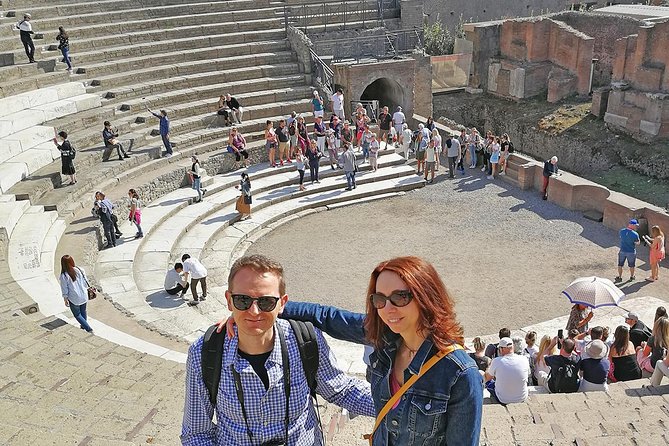
- Teatro Grande and Teatro Piccolo details, including sound and acoustics
- Lupanar stop for the infamous erotic frescoes (know what you’re signing up for)
- Private pacing, so you can ask questions and adjust the flow
Why skip-the-line matters more than you think in Pompeii
Pompeii isn’t just big. It’s big and uneven, with people funneling through entrances and popular zones. When you’re paying for a short visit window, anything that reduces waiting is automatically good value.
With this tour, skip-the-line entry is built in. That means you’re spending your energy on stone stairs and street corners, not standing in line with a thousand other plans. It also keeps the early part of the day from feeling stressful.
The practical bonus: your guide can spend more time on context. In a site like Pompeii, five extra minutes of explanation can make a whole wall, doorway, or bath complex click. This tour is designed around that idea.
You can also read our reviews of more guided tours in Pompeii

Private art-historian guidance: seeing more by getting oriented fast
You’ll have a guide who doesn’t just point. The tour is described as an art-historian approach, and the goal is simple: no getting lost. Instead of guessing what matters most, you follow a route tied to how Pompeii worked.
This is also why the private format feels worthwhile. In a group tour, the guide has to keep everyone moving. Here, your guide can slow down where you’re interested and speed up where you’re already catching on.
In reviews, names like Lello, Italo, and Fabio come up often, with praise for the way they make Pompeii feel like a real city. People also mention that the guide avoids crowds and customizes to interests, which is exactly what you want in a place where the “busy areas” can swallow an afternoon.
Teatro Grande and Teatro Piccolo: the drama, plus the sound
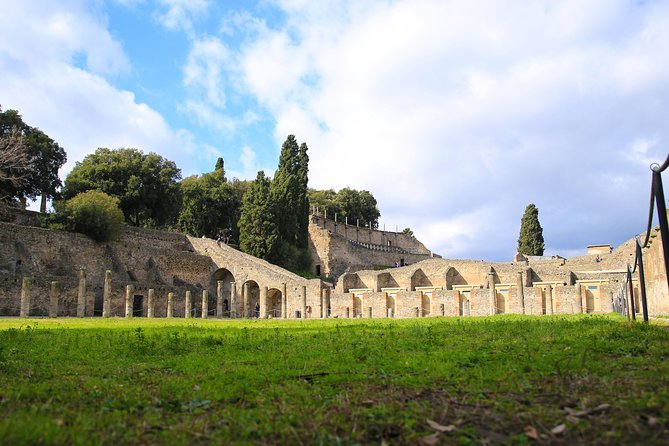
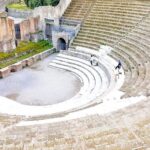
If Pompeii had a social media feed, the theaters would be all over it. You’ll visit the Teatro Grande, one of the most impressive public spaces left standing. The guide is set up to tell the stories behind what you’re seeing, not just list facts.
One specific treat is the mention of Teatro Piccolo and its auditory/acoustic perfection. If you’ve ever wondered why Romans cared so much about performance spaces, this kind of detail helps connect architecture to experience.
Time-wise, this section is quick—about the first part of your route. That can be a drawback if you want long stage-by-stage technical explanations. Still, even in a short tour, you’ll get enough orientation to understand why these rooms were built for noise, rhythm, and crowd energy.
Via dell’Abbondanza: walking the street like a Roman
A highlight of this tour is the walk along Via dell’Abbondanza, Pompeii’s main street. This is the kind of stop that works best with a guide, because ruins can look random until someone explains how the city’s daily life organized itself.
You’ll be shown how Romans moved through their day—where people walked, shopped, and passed by the kinds of buildings that shaped routine. The tour description emphasizes you’re walking the main streets “just as the ancient Romans did,” and that’s the point: it turns Pompeii into a map of human behavior.
The value here is speed with meaning. Without guidance, you can wander and still miss the logic. With guidance, you start to see cause-and-effect: where the city’s center pulled people, and how public life flowed.
The Forum and Pompeii’s markets: power, commerce, and everyday life
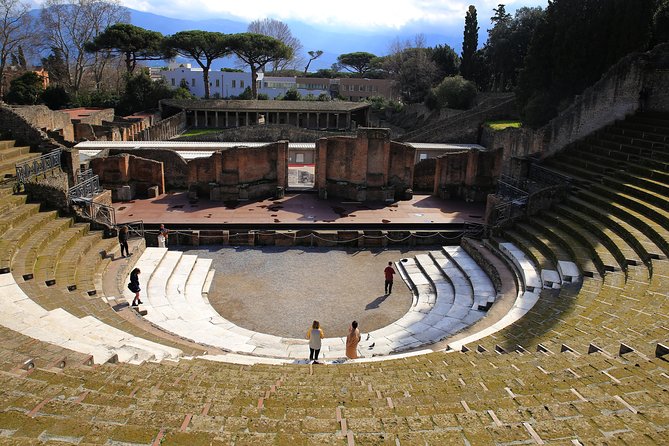
Next comes the Forum area (listed as Foro de Pompeya). This is where Pompeii feels most like a functioning civic center—politics, trade, gathering, and noise, all stacked together.
You’ll see the Forum and its excavated spaces, and the tour context is that markets operated there as part of everyday life. That framing matters, because the Forum is not just a pretty ruin to photograph. It’s a place where you can imagine decisions being made and goods changing hands.
Some reviews specifically call out the Forum excavations as not to be missed. That matches how the Forum tends to land for people: once you understand what it was, it becomes the mental anchor for the whole city.
You can also read our reviews of more private tours in Pompeii




Stabian Baths (Terme Stabiane): heat, routine, and the underground view
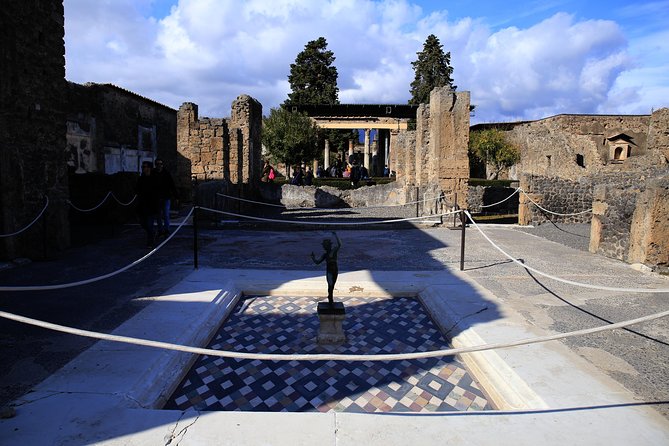
If Pompeii has one place that shows Roman life as a habit, it’s the baths. This tour includes the Stabian Baths (Terme Stabiane), and the focus is on thermal-bath life—what people did there and why it mattered socially.
A practical bonus appears in reviews: many people love the underground section. You’ll likely appreciate it because it adds depth to what’s above—spaces that feel hidden compared to the sunlit streets.
Even if you only have about 20 minutes here, the baths can be a high-return stop. They’re built for movement and temperature changes, so you get a sense of flow, not just static ruins. And because the setting includes multiple levels and spaces, your guide can explain how the system worked without you having to translate everything yourself.
Bring water in summer. Reviews call this out directly, and it’s easy to ignore until you’re standing in bright sun with stone steps and dry air.
Lupanar and erotic frescoes: real history, with a heads-up
This tour includes a stop at the Lupanar (Lupanare). It’s famous for its erotic frescoes, and the description is clear about the theme.
Here’s the practical way to handle this: decide ahead of time whether you want to see that material. There’s nothing wrong with skipping it on a self-guided day, but in this tour it’s part of the “Pompeii highlights” package. If that content makes you uncomfortable, tell your guide early so they can steer your attention accordingly.
The value is historical context. The Lupanar isn’t just shock content; it reflects how sex work, commerce, and social boundaries functioned in that world. With the right guide, you see the building as evidence, not as a gimmick.
Pompeii Archaeological Park: where the time actually goes
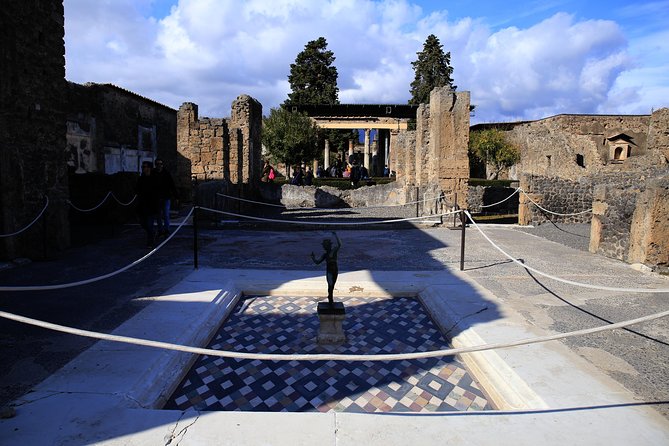
The tour is described as spending the bulk of your time in Pompeii’s archaeological park with a private, top-rated guide. In practice, this is where your route compresses multiple key zones into a tight visit.
That’s the tradeoff with highlights tours: you get a strong overview, but not every street and doorway. If you’re the type who wants to study mosaics for an hour, plan a longer trip or add time for a second visit.
The upside is that you walk away with a clear mental model. You leave knowing what the Forum meant, what the baths were for, and where the city’s public life concentrated. That’s the best souvenir Pompeii can give: understanding, not just photos.
Price and value: is $83.48 worth it?
The price is $83.48 per person for roughly 2 hours, in English, with skip-the-line entry and admission included. Whether that’s a smart purchase comes down to what you value most in Pompeii: time, interpretation, or both.
Here’s how I’d think about it:
- If you’re losing hours to queues on your own, skip-the-line can quietly justify the cost.
- If you want the site explained as Roman daily life—not just “here’s a wall”—the art-historian style helps.
- If you’re the type who enjoys slow self-exploration, a highlights private tour may feel rushed.
Reviews are heavy on praise for guides like Lello, with comments about engagement, humor, and making Pompeii feel real. But there’s at least one critical note: one person felt the tour wasn’t worth the money and that the guide focused on busy areas and moved quickly. That’s a reminder to go in expecting a structured, efficient route.
Also note the booking behavior: it’s commonly booked around 87 days in advance. That’s a hint that the best time slots can vanish, especially in busy seasons.
Who should book this Pompeii private highlights tour
This tour fits best if you want:
- a tight 2-hour plan that hits the major emotional beats of Pompeii
- a guide to translate ruins into daily life
- less time navigating and more time understanding
It may not be your best match if you:
- want to roam without structure
- need a very slow pace
- dislike content tied to the Lupanar
- rely on hotel pickup, because there’s none here
It’s described as requiring moderate physical fitness, so comfortable shoes matter. Pompeii has steps and uneven ground, and even a short tour adds up.
Booking this tour: how to make it go smoothly
This starts at Hotel Vittoria, Piazza Esedra, 80045 Pompei NA, Italy and ends back at the meeting point. So you’ll want to plan your arrival so you’re there a bit early, ready to walk.
It’s also listed as near public transportation, which helps if you’re staying around Pompeii town. The tour uses a mobile ticket, which is convenient if you don’t want paper confirmations.
If you’re sensitive to heat, treat this like a summer hike. Reviews directly mention bringing water bottles, and the baths plus street walking can add up fast under sun.
Should you book this Pompeii Highlights Private Tour?
If your goal is to see the key Pompeii sites with less waiting and more meaning, I think this is a strong choice. The skip-the-line entry plus the art-historian style guidance is a practical combo for a short stay.
I’d book it if you:
- want a private plan with a guide doing the heavy lifting
- like story-driven explanations and historical context
- prefer a structured route over wandering for hours
I’d think twice if you:
- want to fully explore the park at your own pace
- strongly prefer strictly academic, detail-by-detail historical debates
- need hotel pickup or very limited walking
Bottom line: in a place like Pompeii, time is the scarce resource. This tour spends your limited hours on the parts that most often make the site click.
FAQ
How long is the Pompeii highlights private tour?
It’s listed at about 2 hours.
Is this tour private?
Yes. It’s private, and only your group participates.
Does the tour include skip-the-line entry?
Yes. Guaranteed skip-the-line entry is included.
What language is the tour offered in?
The tour is offered in English.
Do I need to pay separate admission tickets?
Admission tickets are included for the stops listed in the tour.
Where do I meet the guide?
The tour starts at Hotel Vittoria, Piazza Esedra, 80045 Pompei NA, Italy.
Is hotel pickup included?
No. Hotel pickup and drop-off are not included.
How fit do I need to be?
It’s described as requiring moderate physical fitness.
Are children allowed on the tour?
Children must be accompanied by an adult.
What if the weather is bad?
The experience requires good weather. If it’s canceled due to poor weather, you’ll be offered a different date or a full refund.

![SHARING TOUR COSTIERA [english driver available] POSITANO,AMALFI,RAVELLO NOLUNCH - What the $120.02 price really buys you](https://d.thesorrentoguide.com/wp-content/uploads/sharing-tour-costiera-english-driver-available-positanoamalfiravello-nolunch-400x267.jpg)